

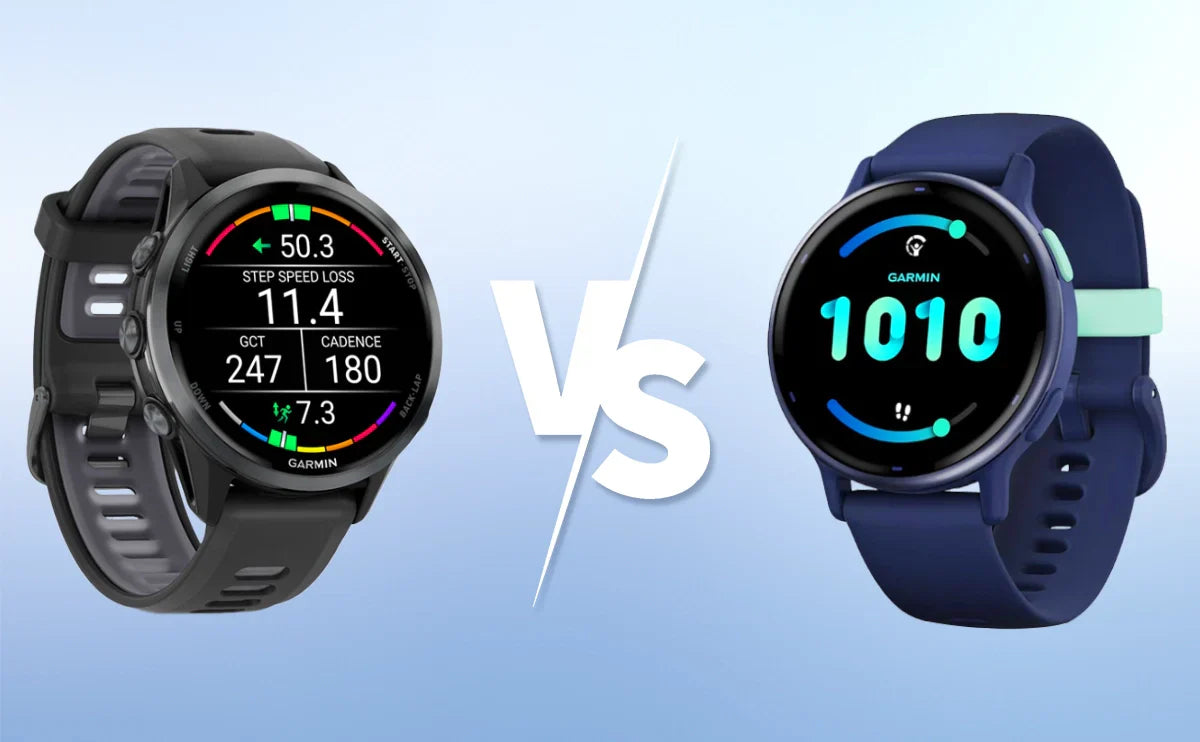
This guide compares Garmin Vivoactive 5 vs Garmin Forerunner 965 in real-world use, including design, AMOLED readability, health and training features, GPS accuracy and maps, battery life, and overall value. By the end, you’ll know which watch fits your routine best - and whether the Forerunner 965’s higher price is actually worth it for your training goals.
Main content:
- Quick Decision Guide (30-Second Answer)
- Garmin Vivoactive 5 vs Garmin Forerunner 965 - Design & Appearance
- Garmin Vivoactive 5 vs Garmin Forerunner 965 - Display & Readability
- Garmin Vivoactive 5 vs Garmin Forerunner 965 - Health & Sports Features
- Garmin Vivoactive 5 vs Garmin Forerunner 965 – GPS Accuracy & Navigation
- Garmin Vivoactive 5 vs Garmin Forerunner 965 - Battery Life
- Daily User Experience - Living with Vivoactive 5 vs Forerunner 965
- Garmin Vivoactive 5 vs Garmin Forerunner 965 – Price & Value: Is the Upgrade Worth It?
- Final Recommendation - Which Garmin Should You Buy?
- FAQs about Garmin Vivoactive 5 vs Garmin Forerunner 965
Choosing between Garmin Vivoactive 5 vs Garmin Forerunner 965 is not just about specs- it’s about deciding whether the significant price difference actually makes sense for how you train and live.
Many buyers face the same dilemma:
- Do I really need the advanced training tools of the Forerunner 965, or would that be overkill?
- Is the Vivoactive 5 still powerful enough if I run regularly and work out multiple times a week?
- What do I actually gain from paying nearly double the price?
This comparison focuses on real-world use, not just spec sheets. We’ll break down Garmin Vivoactive 5 vs Garmin Forerunner 965 across design and comfort, display quality, health and sports tracking, GPS and navigation, battery life, and- most importantly- price vs performance, so you can make a confident decision.
Quick Decision Guide (30-Second Answer)
Choose Garmin Vivoactive 5 if you:
- Want a lightweight smartwatch for all-day wear and sleep tracking
- Focus on health, fitness, and casual running rather than structured training
- Prefer a smaller, more lifestyle-friendly design
Want the full daily-wear experience? Read the full Garmin Vivoactive 5 review (real-world pros & cons).
Choose Garmin Forerunner 965 if you:
- Follow structured training plans or train for races
- Need advanced performance metrics like training readiness and stamina
- Rely on precise GPS accuracy and full offline maps
If you’re leaning toward the upgrade, see the complete Garmin Forerunner 965 review (maps, GPS & training tools).
If you’re still unsure which model fits you best, the detailed Garmin Vivoactive 5 vs Garmin Forerunner 965 breakdown below will show exactly where the extra money goes- and whether it’s worth it for you.
Garmin Vivoactive 5 vs Garmin Forerunner 965 - Design & Appearance
When comparing Garmin Vivoactive 5 vs Garmin Forerunner 965, design isn’t just about looks- it directly affects comfort, wrist fit, and long-term wearability, especially if you plan to wear the watch all day and during sleep.
Size, Weight & Materials at a Glance
|
Feature |
Garmin Vivoactive 5 |
Garmin Forerunner 965 |
|
Case Size |
42.2 × 42.2 × 11.1 mm |
47.2 × 47.2 × 13.2 mm |
|
Weight |
Approx. 23 g (watch only) / ~35–36 g with strap |
Approx. 53 g |
|
Bezel Material |
Aluminum alloy |
Titanium bezel |
|
Glass |
Gorilla Glass 3 |
Gorilla Glass DX (anti-reflective) |
|
Display Size |
1.2-inch AMOLED |
1.4-inch AMOLED |
|
Design Style |
Lightweight, lifestyle-focused |
Performance-driven, sport-focused |
|
Best For |
Daily wear / fitness users |
Training / racing / advanced athletes |
Real-World Wearing Experience- Comfort vs Presence
The most immediate difference in the Garmin Vivoactive 5 vs Forerunner 965 comparison is how each watch feels on the wrist over long periods of time.
The Garmin Vivoactive 5 feels exceptionally light and unobtrusive. Its smaller 42 mm case and slim profile make it easy to forget you’re wearing it- whether at work, during sleep tracking, or throughout a full day of activity. This lightweight feel is especially appealing for users with smaller wrists or anyone who values comfort over a “sporty” look.
The Garmin Forerunner 965, by contrast, has a more substantial wrist presence. While its 47 mm case is clearly larger, the titanium bezel and curved lugs help distribute weight evenly, preventing the watch from feeling top-heavy. Even on moderately sized wrists, it sits securely during runs and intense workouts, where stability matters more than minimalism.
Small Wrists vs Large Wrists- Which Fits Better?
- Vivoactive 5 is better suited for smaller wrists, slimmer arms, and users who want a watch that blends naturally into everyday outfits.
- Forerunner 965 works best for medium to large wrists or users who prefer a bold, athletic look and don’t mind a larger footprint in exchange for functionality.
Materials & Build Quality
Material choice further separates these two models:
- Garmin Vivoactive 5 prioritizes comfort and everyday usability with an aluminum bezel and lightweight polymer body.
- Garmin Forerunner 965 steps up with a titanium bezel and Gorilla Glass DX, offering improved durability, better glare reduction, and a more premium feel- particularly beneficial for outdoor training and bright conditions.
This upgrade in materials contributes to the higher price of the Forerunner 965 and aligns with its role as a performance-focused training watch.
Style & Use-Case Positioning
Visually, the Vivoactive 5 leans toward a lifestyle smartwatch design. It pairs well with casual or office wear and doesn’t look out of place outside of workouts.
The Forerunner 965, on the other hand, looks unmistakably like a high-end sports watch. Its larger AMOLED screen isn’t just for aesthetics- it improves readability for training data and maps, reinforcing its purpose as a serious training and race-day companion.
Design Verdict- Which One Should You Choose?
From a design and comfort perspective:
Choose Garmin Vivoactive 5 if you want:
- a smaller, lighter watch for all-day and overnight wear
- a discreet design that fits smaller wrists
- a balance between fitness tracking and everyday style
Choose Garmin Forerunner 965 if you need:
- Alarger, more stable watch for intensive training
- Premium materials and improved durability
- Abigger AMOLED screen for workouts and navigation
Ultimately, the Garmin Vivoactive 5 vs Garmin Forerunner 965 design decision comes down to comfort vs capability - not which watch looks better, but which one fits your wrist and your daily routine.
If you’re choosing mainly for style and health features, you may also want to compare Venu 4 vs Vivoactive 5 for everyday wear and wellness-focused use.

Garmin Vivoactive 5 vs Garmin Forerunner 965 - Display & Readability
In the Garmin Vivoactive 5 vs Garmin Forerunner 965 comparison, the display is one of the few areas where both watches share the same core technology- AMOLED- yet deliver very different real-world experiences depending on how much data you view during workouts.
|
Feature |
Garmin Vivoactive 5 |
Garmin Forerunner 965 |
|
Display Type |
AMOLED |
AMOLED |
|
Screen Size |
1.2 inches |
1.4 inches |
|
Resolution |
390 × 390 pixels |
454 × 454 pixels |
|
Visual Experience |
Compact and clean |
Larger and more immersive |
|
Primary Use |
Daily fitness & health |
Training data, navigation & maps |
AMOLED Brightness & Readability- Excellent on Both
Both watches benefit from AMOLED displays, offering high contrast, deep blacks, and vivid colors. This makes workout metrics easy to read at a glance and significantly improves readability compared to older transflective displays.
For everyday use- checking heart rate, steps, notifications, or short workouts- the Vivoactive 5 AMOLED display is more than sufficient, delivering sharp text and clear icons without feeling cluttered.
Screen Size Matters When Data Increases
The key difference appears when workouts become data-heavy.
The 1.4-inch AMOLED display on the Forerunner 965 provides noticeably more usable space, which allows:
- More data fields per screen without shrinking text
- Clearer separation between metrics during structured workouts
- Much better readability when using navigation and maps
By contrast, the 1.2-inch display on the Vivoactive 5 works well for basic stats but can feel crowded when multiple metrics are displayed simultaneously.
Navigation & Maps- Where the Bigger Screen Pays Off
This is where the display difference becomes most meaningful.
The Forerunner 965’s larger AMOLED screen significantly improves the experience of:
- On-watch navigation
- Full-color offline maps
- Turn-by-turn route guidance
Map details, trail lines, and directional cues are easier to interpret at speed, especially during outdoor runs or cycling sessions. The Vivoactive 5, which lacks full offline maps, doesn’t benefit from a larger display in the same way, as its screen is primarily used for activity tracking rather than navigation.
Outdoor Visibility & Glare Control
Both watches perform well in bright conditions, but the Forerunner 965 gains an edge thanks to its Gorilla Glass DX, which reduces reflections and improves AMOLED readability in direct sunlight. Combined with the larger screen, this makes quick glances during fast-paced training more comfortable and less error-prone.
Display Verdict- Which One Fits Your Use?
Choose Garmin Vivoactive 5 if you want:
- Acompact AMOLED screen for daily wear
- Clean, uncluttered fitness and health data
- Excellent readability without visual complexity
Choose Garmin Forerunner 965 if you need:
- Alarger AMOLED display with higher resolution
- Easier reading of complex training screens
- Aclearer, more practical display for navigation and maps
Ultimately, the Garmin Vivoactive 5 vs Garmin Forerunner 965 display difference isn’t about AMOLED quality- it’s about how much information you need to see, and how often you rely on navigation and maps during training.

Garmin Vivoactive 5 vs Garmin Forerunner 965 - Health & Sports Features
When comparing Garmin Vivoactive 5 vs Garmin Forerunner 965, health and sports features reveal the clearest difference in philosophy between these two watches. Both share Garmin’s core health tracking foundation, but they diverge significantly in how much training guidance and performance context they provide.
Health Tracking- Same Sensors, Different Intelligence
|
Health Feature |
Garmin Vivoactive 5 |
Garmin Forerunner 965 |
|
24/7 Heart Rate Monitoring |
Yes |
Yes (more stable during intense workouts) |
|
Blood Oxygen (SpO₂) |
Yes |
Yes |
|
Sleep Tracking |
Sleep stages, sleep score, sleep coach |
Sleep stages plus HRV-based recovery insights |
|
Stress Tracking |
Yes |
Yes (linked with training data) |
|
Body Battery |
Yes |
Yes |
|
Nap Detection |
Yes (native support) |
Yes (via software update) |
|
Altimeter (Floors & Elevation) |
Not supported |
Barometric altimeter |
Both watches use Garmin’s Elevate Gen 4 heart rate sensor, meaning raw data collection is similar. The difference lies in how that data is interpreted and used.
- Vivoactive 5 presents health data in a simple, lifestyle-friendly way, focusing on sleep quality, stress, and daily energy levels.
- Forerunner 965 integrates health metrics into its training system, using HRV, sleep, and recovery status to influence daily workout recommendations and readiness scores.
If your priority is health tracking over performance training, Vivoactive 5 vs Venu 3: best pick for health tracking?
The Altimeter Gap- A Small Sensor, a Big Difference
One important limitation of the Vivoactive 5 is the absence of a barometric altimeter. This means:
- It cannot track floors climbed
- Elevation during hiking or trail activities relies on GPS estimates, which are less precise
The Forerunner 965, with a built-in altimeter, delivers more accurate elevation data and is better suited for users who frequently train on hills, trails, or varied terrain.
Sports Modes & Training Depth
|
Training Feature |
Garmin Vivoactive 5 |
Garmin Forerunner 965 |
|
Sports Profiles |
30 plus fitness and sports modes |
Extensive modes including triathlon and trail running |
|
Running Metrics |
Pace, cadence, stride length |
Advanced running dynamics (ground contact time, vertical oscillation, stride ratio) |
|
Training Readiness |
No |
Yes |
|
Training Load |
No |
Yes |
|
Real-Time Stamina |
No |
Yes |
|
Cycling Metrics |
Basic data |
Power-based and advanced cycling metrics |
|
Special Modes |
Wheelchair mode |
Triathlon mode |
Training Readiness & Stamina: The Deciding Factor
This is where the Vivoactive 5 vs Forerunner 965 gap becomes decisive.
The Forerunner 965 continuously evaluates:
- sleep quality
- HRV status
- recent training load
- recovery time
and combines them into Training Readiness and Real-Time Stamina, helping athletes decide when to push and when to recover.
The Vivoactive 5, while excellent for tracking workouts, does not offer this level of training decision support. Instead, it focuses on general wellness indicators like Body Battery, making it easier to use but less performance-oriented.
Lifestyle Fitness vs Performance Training
Garmin Vivoactive 5 is designed for health-first users who want reliable fitness tracking without complex metrics. It’s ideal for gym workouts, casual runs, and users who value simplicity and comfort.
Garmin Forerunner 965 is built for goal-driven athletes, offering advanced training metrics, race preparation tools, and deeper performance insights.
Health & Sports Verdict
Choose Garmin Vivoactive 5 if you:
- prioritize daily health, sleep, and stress tracking
- prefer simple, easy-to-understand fitness insights
- don’t need elevation data or advanced training analytics
Choose Garmin Forerunner 965 if you:
- Train with specific performance goals
- Rely on training readiness, load, and stamina to guide workouts
- Need accurate elevation tracking and advanced sports modes
In short, the Garmin Vivoactive 5 vs Garmin Forerunner 965 difference in health and sports features isn’t about data collection- it’s about how much guidance you want from your watch.

Garmin Vivoactive 5 vs Garmin Forerunner 965 – GPS Accuracy & Navigation
In the Garmin Vivoactive 5 vs Garmin Forerunner 965 comparison, GPS and navigation highlight the most fundamental difference between the two watches: one is designed to record activities, while the other is built to actively guide you.
GPS Accuracy: Standard vs Multi-Band GNSS
|
GPS Feature |
Garmin Vivoactive 5 |
Garmin Forerunner 965 |
|
GPS System |
Standard GNSS |
Multi-band GNSS (SatIQ) |
|
Satellite Support |
GPS, GLONASS, Galileo |
GPS, GLONASS, Galileo, BeiDou |
|
Best Environment |
Open areas and city parks |
Cities, forests, mountains |
If your training is more hiking and survival-style outdoor use, Instinct 3 vs Forerunner 965: better for outdoor adventures?
The Forerunner 965 uses multi-band GNSS, receiving signals on multiple frequencies to improve accuracy in environments where signal reflection or interference is common, such as dense cities, forests, or mountainous terrain.
The Vivoactive 5 relies on standard GPS, which is reliable in open areas but can show reduced accuracy in more complex environments.
Navigation: Breadcrumbs vs Full Color Maps
This is where the two watches clearly separate.
- Garmin Vivoactive 5 supports breadcrumb navigation, recording routes as simple lines without underlying map data. It works well for route review but is limited for real-time navigation.
- Garmin Forerunner 965 includes full-color offline maps with turn-by-turn guidance, allowing users to follow courses and navigate directly from the watch.
As a result, the Forerunner 965 functions as a true navigation watch, while the Vivoactive 5 remains focused on activity tracking.
Why Maps Matter in Real Training
The Forerunner 965’s larger AMOLED display makes navigation easier to read at a glance, especially when following trails or preloaded routes. On-watch maps reduce reliance on a phone during outdoor training, while the Vivoactive 5 remains limited to basic route recording.
Positioning Stability Over Long Distances
Thanks to multi-band GNSS and advanced signal management, the Forerunner 965 maintains cleaner route lines, more consistent pace tracking, and reduced signal drift during long sessions.
The Vivoactive 5 performs well for everyday workouts but may show occasional inaccuracies during long runs or in signal-challenging environments.
GPS & Navigation Verdict
Choose Garmin Vivoactive 5 if you:
- run or walk mainly in open, familiar areas
- only need GPS to track distance and pace
- don’t require navigation or route guidance
Choose Garmin Forerunner 965 if you:
- train in cities, forests, or mountainous terrain
- rely on navigation, courses, and offline maps
- want maximum GPS accuracy for performance tracking
Ultimately, the Garmin Vivoactive 5 vs Garmin Forerunner 965 difference in GPS and navigation isn’t about “good vs bad”- it’s about tracking your route versus navigating your route.

Garmin Vivoactive 5 vs Garmin Forerunner 965 - Battery Life
Battery life plays a critical role in the Garmin Vivoactive 5 vs Garmin Forerunner 965 decision- not just in how often you charge, but whether the watch can reliably last through long workouts, races, or outdoor sessions.
|
Mode / Battery Life |
Garmin Vivoactive 5 |
Garmin Forerunner 965 |
|
Smartwatch Mode |
~11–12 days |
~23 days |
|
Always-On Display (AOD) |
~5 days |
~7 days |
|
GPS (Standard) |
~21 hours |
~31 hours |
|
High-Accuracy / Multi-band GPS |
~17 hours |
~19 hours |
|
GPS + Music |
~8 hours |
~10.5 hours |
|
Multi-band GPS + Music |
Not available |
~8.5 hours |
Overall, both watches offer solid battery performance for AMOLED devices, but the Forerunner 965 consistently lasts longer in more demanding scenarios.
Daily Use & Always-On Display Impact
For daily smartwatch use, the Vivoactive 5 comfortably lasts over a week with health tracking and notifications enabled, making it a convenient option for users who prefer minimal charging.
The Forerunner 965 extends this significantly, reaching up to 23 days in smartwatch mode. With Always-On Display enabled, the Vivoactive 5 averages around 5 days, while the Forerunner 965 stretches closer to 7 days thanks to its larger battery and optimized power management.
GPS, Maps & Long Workouts
Battery differences become most noticeable during GPS-based activities. The Forerunner 965’s larger battery provides greater flexibility for long-distance runs, endurance training, and extended navigation sessions using maps. The Vivoactive 5 handles everyday GPS workouts well but offers less margin during long or multi-hour outdoor activities, especially when GPS and music are used together.
Battery Life as a Training Safety Factor
Beyond raw numbers, battery endurance affects confidence during training. The Forerunner 965 offers greater peace of mind for long or GPS-intensive sessions, while the Vivoactive 5 is better suited for shorter, predictable workouts.
If you’re comparing flagships, Forerunner 955 vs 965: should you save money with the older flagship?
Battery Verdict
Choose Garmin Vivoactive 5 if you:
- train in shorter sessions
- prioritize convenience and lighter daily use
- are comfortable charging every few days
Choose Garmin Forerunner 965 if you:
- Train for long-distance or endurance events
- Rely on GPS, navigation, and music during workouts
- Want maximum reliability with minimal charging
In the Garmin Vivoactive 5 vs Garmin Forerunner 965 comparison, battery life isn’t just about longevity- it’s about how much freedom you want during training.

Daily User Experience - Living with Vivoactive 5 vs Forerunner 965
When it comes to everyday use, the difference between Garmin Vivoactive 5 vs Garmin Forerunner 965 is less about raw features and more about how much attention you want your watch to demand from you.
Garmin Vivoactive 5: Effortless, Comfortable, and Easy to Live With
Living with the Vivoactive 5 is a largely frictionless experience. Its lightweight body and compact size make it comfortable enough to wear all day- and more importantly, all night- without ever feeling intrusive. For users who value sleep tracking, office-friendly aesthetics, and long-term comfort, this matters more than specs on paper.
Day-to-day interaction is simple. The combination of touchscreen and two buttons keeps navigation intuitive, and the watch rarely asks you to “think” about your data. You check your steps, glance at Body Battery, review last night’s sleep, and move on with your day.
This simplicity is exactly its strength. The Vivoactive 5 works best when fitness is part of your life, not the central focus of it.
Garmin Forerunner 965: Powerful, Focused, and Training-Oriented
The Forerunner 965 feels different the moment you start using it daily. It’s larger, heavier, and more noticeable on the wrist- but that presence comes with purpose.
This is a watch that constantly feeds you information: training readiness, recovery status, stamina, and performance trends. For athletes following structured plans, that data becomes incredibly valuable. For others, it can feel overwhelming.
Daily operation also reflects this focus. The five-button layout excels during sweaty workouts, rain, or cold conditions, but it introduces a learning curve. The Forerunner 965 rewards users who engage with its training ecosystem- and feels underutilized if you don’t.
In short, the Forerunner 965 isn’t designed to disappear into the background. It’s designed to coach, guide, and push you forward.
Simplicity vs Control: Which Experience Fits You?
The real-world choice comes down to mindset:
- Vivoactive 5 feels like a smartwatch that quietly supports your health and fitness. You won’t regret it if you want comfort, clarity, and minimal cognitive load.
- Forerunner 965 feels like a training tool you actively interact with every day. You won’t regret it if you actually use its advanced metrics to shape how and when you train.
Neither experience is better- they’re simply built for different people.
This distinction sets up the final question most buyers ask next:
Is the Forerunner 965’s deeper experience worth paying significantly more for- or does the Vivoactive 5 already cover everything you need?

Garmin Vivoactive 5 vs Garmin Forerunner 965 – Price & Value: Is the Upgrade Worth It?
When comparing Garmin Vivoactive 5 vs Garmin Forerunner 965, the real question isn’t which watch is better- it’s whether the Forerunner 965 is worth paying nearly double the price.
Price Difference at a Glance
- Garmin Vivoactive 5: around $299–$349
- Garmin Forerunner 965: around $599–$649
That’s roughly a $250–$300 price gap, so what do you actually get for the extra money?
If the 965 feels too expensive but you still want serious training features, Vivoactive 5 vs Forerunner 265: the best mid-price alternative.
What the Extra Money Buys You
The Forerunner 965 earns its higher price mainly through three areas:
- Advanced training tools: Training Readiness, Training Load, and Real-Time Stamina help guide when to train harder or recover.
- Navigation & maps: Full-color offline maps and on-watch navigation, which the Vivoactive 5 does not offer.
- Higher-end hardware: Multi-band GPS, a larger AMOLED display, premium materials, and longer battery life for demanding workouts.
The Vivoactive 5, by contrast, focuses on delivering strong health tracking and fitness features at a much lower cost, without the complexity of professional training analytics.
If you’re debating whether to buy now or wait, Vivoactive 6 vs Vivoactive 5: is it worth waiting?
Is the Upgrade Worth It?
The Forerunner 965 is worth the extra cost if you:
- Train with structured plans or race goals
- Rely on navigation or explore unfamiliar routes
- Want deeper performance insights, not just activity tracking
The Vivoactive 5 offers better value if you:
- Exercise casually or semi-regularly
- Focus on health, sleep, and everyday fitness
- Don’t need maps, advanced metrics, or race-focused tools
For many users, the Vivoactive 5 already covers everything they need. The Forerunner 965 only makes sense if you’ll actively use its advanced training and navigation features.
Quick Value Verdict
- Casual fitness & daily wear → Vivoactive 5 (better value)
- Serious training & outdoor navigation → Forerunner 965 (worth the upgrade)
At the end of the day, the right choice in the Garmin Vivoactive 5 vs Garmin Forerunner 965 comparison depends on how much performance insight you truly want- and how much you’re willing to pay for it.

Final Recommendation - Which Garmin Should You Buy?
After comparing design, display, health features, GPS, battery life, and price, the decision between Garmin Vivoactive 5 vs Garmin Forerunner 965 ultimately comes down to how seriously you train- and how much guidance you want from your watch.
- Choose Garmin Vivoactive 5 if you want a lightweight, comfortable smartwatch that handles daily health tracking, gym workouts, and casual running with ease. For most users focused on fitness rather than performance optimization, it delivers excellent value at a much lower price.
- Choose Garmin Forerunner 965 if you train with clear goals, follow structured plans, or rely on navigation and advanced metrics to guide your workouts. Its higher price is justified only if you actively use features like training readiness, stamina, multi-band GPS, and offline maps.
In short:
- Vivoactive 5 is the smarter buy for everyday fitness and lifestyle use.
- Forerunner 965 is the right tool for serious training and outdoor performance.
Still deciding between smartwatch features and sports performance? Apple Watch Ultra 2 vs Forerunner 965: which is better for training?
FAQs about Garmin Vivoactive 5 vs Garmin Forerunner 965
Is Garmin Forerunner 965 worth it for casual runners?
Usually no - Vivoactive 5 already covers basic running, health tracking, and GPS for casual fitness users.
Can Garmin Vivoactive 5 be used for marathon training?
Yes, it can track marathon training basics, but it lacks advanced tools like training readiness and stamina.
Does Garmin Vivoactive 5 have offline maps?
No, Vivoactive 5 only supports basic breadcrumb route tracking without full offline maps.
Is the Forerunner 965 display much better than Vivoactive 5?
The brightness is similar, but the larger screen on the 965 is more useful for maps and multiple data fields.
Does Vivoactive 5 have an altimeter for floors climbed?
No, Vivoactive 5 does not include a barometric altimeter and cannot track floors climbed.
Which watch offers better value for money?
Vivoactive 5 offers better value for most users, while Forerunner 965 is worth it only for serious training and navigation needs.

Share:
Garmin Venu 4 vs Venu 3 (2026): Is the Upgrade Worth It?
Garmin Quatix 8 Pro Review: Satellite Safety vs Fenix 8 — Is It Worth It?