

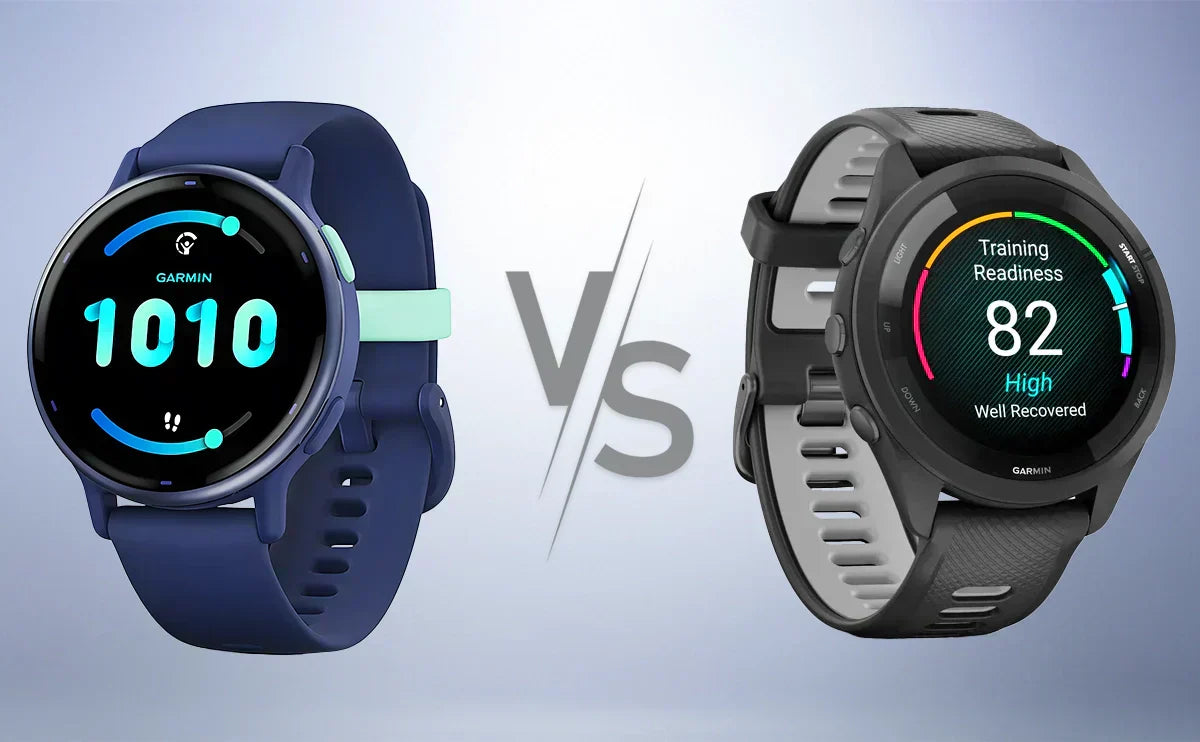
The main difference in the Garmin Vivoactive 5 vs Forerunner 265 comparison is how much help you want with training. Vivoactive 5 covers daily health tracking, gym sessions and regular runs in a light, compact watch. Forerunner 265 adds multi-band GPS, Training Readiness, course navigation and dedicated triathlon recording.
There is a third option worth considering: Forerunner 265S. It has the training features of the 265 in a smaller case, with a smaller display and different battery ratings. Choosing between these watches involves fit as well as features.
This comparison uses Garmin specifications and feature documentation. The recommendations explain what those differences mean for a purchase; they do not come from a controlled, side-by-side accuracy test.
In this guide
Quick verdict: Vivoactive 5 or Forerunner 265?
Choose Vivoactive 5 if you mainly want to track sleep, walks, gym workouts, pool swims and recreational runs. It includes built-in GPS, overnight HRV Status, music storage and Garmin Pay. It also supports compatible workouts and Garmin Coach plans, so choosing it does not mean giving up all training guidance.
Choose Forerunner 265 or 265S if you want your watch to help organize race preparation, monitor training load, suggest running workouts or follow a saved course. Both also record triathlon disciplines and transitions within a single activity. Those are useful differences for an amateur runner preparing for an event, not just someone competing professionally.
Choose the 265S when you want that training platform in a smaller watch. Its 41.7 mm case is slightly narrower than Vivoactive 5's 42.2 mm case, although it is thicker. The larger 265 provides more screen space.
For a broader Garmin Forerunner vs Vivoactive decision, compare the exact models you can buy. Features vary across generations, and a feature on another Forerunner or Vivoactive does not automatically apply to these watches.
Garmin Vivoactive 5 vs Forerunner 265: key specs
Below is a side-by-side comparison of the specifications that matter most when deciding between Vivoactive 5, Forerunner 265 and 265S specifications, especially for runners and fitness-focused users.
| Feature | Vivoactive 5 | Forerunner 265 | Forerunner 265S |
|---|---|---|---|
| Case dimensions | 42.2 × 42.2 × 11.1 mm | 46.1 × 46.1 × 12.9 mm | 41.7 × 41.7 × 12.9 mm |
| Weight with included band | 36 g | 47 g | 39 g |
| AMOLED display | 1.2 in; 390 × 390 | 1.3 in; 416 × 416 | 1.1 in; 360 × 360 |
| Controls | Touchscreen + 2 buttons | Touchscreen + 5 buttons | Touchscreen + 5 buttons |
| Multi-band GPS / SatIQ | No / No | Yes / Yes | Yes / Yes |
| Training Readiness | No | Yes | Yes |
| Barometric altimeter | No | Yes | Yes |
| Standard quick-release band | 20 mm | 22 mm | 18 mm |
| Smartwatch battery, up to | 11 days | 13 days | 15 days |
| GPS-only battery, up to | 21 hours | 20 hours | 24 hours |
| Water rating | 5 ATM | 5 ATM | 5 ATM |
| Device memory | 4 GB | 8 GB | 8 GB |
Design, size and band compatibility
Vivoactive 5: the lightest option
Vivoactive 5 has a fiber-reinforced polymer case, an anodized aluminum bezel and a 36 g weight with its supplied band. It is the thinnest and lightest watch in this comparison. That makes it worth trying if you want something unobtrusive under a sleeve or prefer less weight while sleeping.
Garmin lists a 125–190 mm wrist circumference for the included band. That range describes the supplied fit, rather than every possible replacement strap. Wrist shape, the position of the buckle and how far the case extends across your wrist still affect comfort.
Forerunner 265 vs 265S: size changes the choice
The 46.1 mm Forerunner 265 is noticeably larger on paper. The 41.7 mm 265S offers the same main training tools in a smaller case, weighing 39 g with its band. Garmin lists included-band wrist ranges of 135–205 mm for the 265 and 115–178 mm for the 265S.
The heavier 265 is not automatically more stable during exercise. A watch that is too large or poorly adjusted can move regardless of its weight. Try the fit with your wrist bent as well as straight, particularly if you lift weights or plan to wear the watch overnight.
Buttons and touchscreen during workouts
Vivoactive 5 combines two buttons with touch controls. Forerunner 265 and 265S combine touch with five physical buttons. The Forerunner layout is useful when you want deliberate lap, start or stop inputs without relying on a swipe.
For gym sessions and routine navigation, the simpler Vivoactive interface may be enough. For intervals, races or training in wet conditions, consider how often you need to operate the watch while moving. That control preference can matter more than an extra item on a feature list.
What band size does each watch use?
The Garmin Vivoactive 5 watch band size is 20 mm. Forerunner 265 uses 22 mm, and Forerunner 265S uses 18 mm. All three use standard quick-release attachments, as described in Garmin's band replacement instructions.
These bands are not interchangeable across the three watches. Match the exact model, attachment and wrist range when browsing Garmin watch bands. Width alone does not establish compatibility: Garmin QuickFit and standard quick release are different systems. Our QuickFit vs quick-release guide explains the distinction.

Display: 1.2 inches versus 1.3 or 1.1 inches
All three watches use AMOLED displays with optional always-on operation. Vivoactive 5 sits between the two Forerunner sizes: its 1.2-inch screen is smaller than the 265's 1.3-inch screen and larger than the 265S's 1.1-inch screen.
The larger 265 gives you more display area for workout fields, charts and course guidance. The 265S reduces case size and screen size together. It is a mistake to describe both Forerunners as having a larger screen than Vivoactive 5.
Readability depends on the information you display
When comparing them, look at the screens you would actually use: pace and distance during a run, a workout timer or a glance at a notification. Adding more fields can make the text harder to read even on a larger display. A simpler layout may be more useful than maximizing the number of metrics.
The listed resolutions are 390 × 390 for Vivoactive 5, 416 × 416 for the 265 and 360 × 360 for the 265S. These figures do not establish that one watch is always brighter, more colorful or faster to touch. Those claims would need a separate display test. Consider screen area, layout and fit together.

GPS, heart rate and running dynamics
Multi-system GPS and multi-band GPS are different
Vivoactive 5 offers GPS-only and All Systems tracking. Forerunner 265 and 265S add multi-band reception and SatIQ Auto Select. Using several satellite systems is different from receiving multiple signal frequencies, so “multi-GNSS” should not be treated as another name for multi-band GPS.
Multi-band reception can be useful where buildings, trees or terrain obstruct and reflect satellite signals. SatIQ automatically chooses the satellite mode according to conditions, balancing positioning and battery use. Garmin explains these options in its satellite settings documentation.
If most of your runs use open roads or parks, Vivoactive 5 may provide the activity records you need. If you regularly run between tall buildings or on routes with difficult reception, the Forerunners give you more options. A route test would be needed to quantify the difference in a particular location; neither specification supports a fixed meter-level accuracy guarantee.
Heart-rate accuracy is a separate question
Both watches use wrist optical heart-rate sensing. More training metrics on the Forerunner do not prove more accurate heart-rate readings for every activity or wearer. Movement, skin contact, temperature and how the watch is worn can affect optical measurements.
For interval sessions or another activity where you want an external measurement setup, check compatibility with a suitable chest strap or other heart-rate sensor. Keep the watch secure without overtightening it. If heart-rate precision drives your purchase, look for comparisons that disclose the workout, reference sensor and testing conditions, rather than assuming the more expensive watch will always measure better.
Running dynamics and course navigation
Forerunner 265 and 265S provide wrist-based running dynamics including cadence, stride length, vertical oscillation, vertical ratio and ground contact time. Ground contact time balance requires a compatible running-dynamics accessory. Garmin's running dynamics manual distinguishes watch-based and accessory-dependent metrics.
These measurements describe aspects of a run. They are not foot-strike analysis, an injury diagnosis or a guarantee that changing one number will improve your technique. Vivoactive 5 can record ordinary running data without offering the same running-dynamics package.
Forerunner also follows courses transferred from Garmin Connect. This is breadcrumb-style course navigation, not full onboard street or topographic mapping. You can follow a saved course without treating the watch as a detailed map browser.

Battery life: GPS, music and always-on display
Garmin publishes different ratings for different operating modes. Every figure below is up to, not a promise for a week that combines workouts, music, notifications and always-on display.
| Mode | Vivoactive 5 | Forerunner 265 | Forerunner 265S |
|---|---|---|---|
| Smartwatch, default display settings | 11 days | 13 days | 15 days |
| Smartwatch, always-on display | 5 days | 5 days | 5 days |
| GPS only, without music | 21 hours | 20 hours | 24 hours |
| All Systems, without music | 17 hours | — | — |
| Auto Select / SatIQ, without music | Not supported | 16 hours | 18 hours |
| All + Multi-Band, without music | Not supported | 14 hours | 15 hours |
| GPS only, with music | — | 7 hours | 7.5 hours |
| All Systems, with music | 8 hours | — | — |
| Auto Select / SatIQ, with music | Not supported | 6.5 hours | 7 hours |
| All + Multi-Band, with music | Not supported | 6 hours | 6 hours |
Smartwatch mode and always-on display
The 265S has the highest standard smartwatch rating here, despite its smaller case. With the display always on, the published maximum drops to five days for all three. That makes display settings important if you want to leave the screen visible throughout the day.
Compare the GPS mode you intend to use
Vivoactive 5's 21-hour GPS-only maximum is slightly higher than the larger 265's 20 hours. The 265S reaches 24 hours in that mode. A Forerunner using multi-band reception has a different limit, so the GPS-only figure should not be used to plan a multi-band outing.
Music playback reduces endurance
Vivoactive 5's eight-hour figure refers to All Systems GPS with music playback. The Forerunners have published music ratings too. Downloaded music playback is different from cellular streaming, and the table's different satellite modes prevent a simple eight-versus-seven-hour claim of overall superiority.
For a long event, use the rating for your intended settings and leave spare capacity. References: Vivoactive 5 battery modes, Forerunner battery modes and Forerunner always-on assumptions.

Health, fitness and training features
Shared health tools
Both watches support heart-rate tracking, Body Battery, sleep tracking, stress tracking, Pulse Ox and overnight HRV Status. Both also support menstrual-cycle and pregnancy tracking through Garmin's ecosystem. These shared features should not be presented as reasons that only the Forerunner can monitor recovery or women's health.
HRV Status builds a personal baseline from consistent overnight wear. It is different from Training Readiness, which combines several inputs into a training-focused score. Garmin's Vivoactive 5 HRV documentation confirms that the less expensive watch includes HRV Status.
Use sleep and recovery information to look for patterns across nights. This comparison does not establish that one model classifies sleep stages more accurately. Buying the Forerunner for its training platform is a different decision from paying for a proven improvement in sleep measurement.
Vivoactive 5 offers more than activity logging
Garmin lists more than 30 built-in GPS and indoor sports apps for Vivoactive 5, including running, cycling and pool swimming. It also offers workouts, compatible Garmin Coach plans, workout-benefit information and recovery time. A runner following a 5K, 10K or half-marathon plan can use guided training without buying a Forerunner.
For someone building a consistent routine, those tools may be enough. You can follow a plan and review activities in Garmin Connect without needing the full set of training-load screens. Decide which feedback you would use between workouts, as well as what you want recorded during them.
Where Forerunner adds training depth
| Training need | Vivoactive 5 | Forerunner 265 / 265S |
|---|---|---|
| Record runs and other individual workouts | Yes | Yes |
| Compatible Garmin Coach plans | Yes | Yes |
| Recovery-time information | Yes | Yes |
| Training Readiness | No | Yes |
| Training Status and acute load | No | Yes |
| Race widget and race-adapted daily suggested workouts | No | Yes |
| Wrist-based running-dynamics package | No | Yes |
| Built-in triathlon recording with transitions | No | Yes |
Forerunner Training Readiness uses sleep score, recovery time, HRV Status, acute load and recent sleep and stress history. That can provide another reference when deciding whether to do a demanding session or take an easier day.
Its triathlon activity combines disciplines and transitions in one event. Recording separate workouts on Vivoactive 5 is a different workflow. For a first triathlon or a structured running season, these differences can justify Forerunner even if you have no interest in professional competition.

Price and value: what are you paying for?
Launch prices are useful context, not today's offer
Garmin announced Vivoactive 5 at a US suggested retail price of $299.99 and the Forerunner 265 series at $449.99. These are historical launch prices, useful for understanding the original positioning of the watches. References: Vivoactive 5 announcement and Forerunner 265 announcement.
Actual offers can differ because of discounts, stock, condition and warranty. Compare the current checkout prices for the exact watches you are considering, including the 265S separately. A launch-price gap does not establish today's extra cost.
When the Forerunner premium makes sense
You are paying for multi-band GPS, training analysis, course following, multisport recording and five-button workout control. If you expect to use those features regularly, Forerunner has a clear purpose. If you mainly want activity records, sleep information and a few playlists, Vivoactive 5 may already meet the brief.
Before buying, check the seller, return policy, warranty and supplied band length. For a closer look at either model, read our Vivoactive 5 review or Forerunner 265 review. If an older Forerunner is also discounted, our Forerunner 265 vs 255 comparison covers that separate generation choice.

Smart features: music, notifications and payments
Notifications and phone calls
Both models display notifications from a compatible paired phone. Supported responses vary by phone operating system; Android message-response options should not be assumed to work the same way on iPhone.
Neither Vivoactive 5 nor Forerunner 265 has the built-in microphone and speaker needed for a conversation directly on the watch. An incoming-call alert or an option to accept a call is not the same thing as speaking through the watch. Neither is an LTE phone replacement. See Garmin's phone-call guidance.
Offline music and storage
Both support music storage and compatible provider downloads for playback through Bluetooth headphones. Service availability and subscription requirements vary. Download playlists before leaving your phone behind; this is not unrestricted music streaming over a cellular connection.
Vivoactive 5 lists 4 GB of device memory; the Forerunners list 8 GB. Software and other data also use storage, so those capacities are not a promise that all of the space is available for songs. Compare the playlists you want to carry rather than treating memory as a measure of overall watch performance.
Garmin Pay and compatible apps
Both offer Garmin Pay, subject to supported banks, cards and regions. Confirm your own card's eligibility. Both also work with compatible Connect IQ content and sync activity and health history to Garmin Connect. Smart features overlap enough that training tools, GPS options and fit are more useful purchase distinctions.
Which Garmin watch should you buy?
For sleep tracking, gym sessions, walks and regular recreational runs, Vivoactive 5 is a practical option when its fit and current price suit you. Its health features, workouts, music and built-in GPS cover much more than step counting.
For race preparation, triathlon recording, course following and training-load feedback, choose Forerunner 265 or 265S. The 265 provides the largest screen here; the 265S offers the same main training platform in a smaller case and has its own battery ratings.
If you are already considering newer generations, use our Forerunner 570 vs 265 or Vivoactive 6 vs 5 comparisons for that upgrade decision. Our Venu 4 vs Vivoactive 5 guide covers another option if a different feature mix is on your shortlist.
Garmin Vivoactive 5 vs Forerunner 265: FAQs
1. What is the main difference between Vivoactive 5 and Forerunner 265?
Forerunner 265 adds multi-band GPS, Training Readiness, training-load analysis, course following and dedicated multisport recording. Vivoactive 5 focuses on health and general fitness while still offering GPS, workouts, compatible Garmin Coach plans and recovery-time information.
2. Is Forerunner 265 worth the extra cost for a casual runner?
It can be if you want its navigation, satellite modes or training tools. A recreational runner preparing for a race may use those features extensively. If you mainly want distance, pace and activity history, Vivoactive 5 may already be enough. Compare actual selling prices.
3. How does Vivoactive 5 compare with Forerunner 265S?
The 265S has a slightly narrower but thicker case, a smaller 1.1-inch screen and Forerunner's training features. Vivoactive 5 has a 1.2-inch screen and is lighter. Their bands also differ: 18 mm for the 265S and 20 mm for Vivoactive 5.
4. Do both watches have HRV Status?
Yes. Both provide overnight HRV Status. Forerunner also includes Training Readiness, which uses HRV alongside other inputs. HRV Status, recovery time and Training Readiness are separate features.
5. Can Vivoactive 5 record a triathlon?
It can record individual supported activities, but it does not provide the Forerunner's dedicated triathlon workflow with transitions in one event. Choose Forerunner 265 or 265S if integrated multisport recording is a requirement.
6. Does Forerunner 265 have offline maps?
It follows saved courses with breadcrumb-style navigation. It does not provide full onboard street or topographic maps. Course following and multi-band GPS should not be confused with that mapping capability.
7. Which has better battery life?
It depends on the mode. Forerunner 265S has the highest standard smartwatch and GPS-only ratings here. Vivoactive 5 slightly exceeds the larger 265 in GPS-only mode. Always-on display, music and satellite settings change the comparison.
8. Are Vivoactive 5 and Forerunner 265 bands interchangeable?
No. Vivoactive 5 uses 20 mm standard quick release, Forerunner 265 uses 22 mm and 265S uses 18 mm. Confirm the exact model and connector before buying a replacement band.
Share:
Google Pixel Watch 4 vs Apple Watch Ultra 3 - The Ultimate Flagship Showdown
Garmin Vivoactive 6 vs. Forerunner 165 - Which Mid-Range Smartwatch is Perfect for You?