

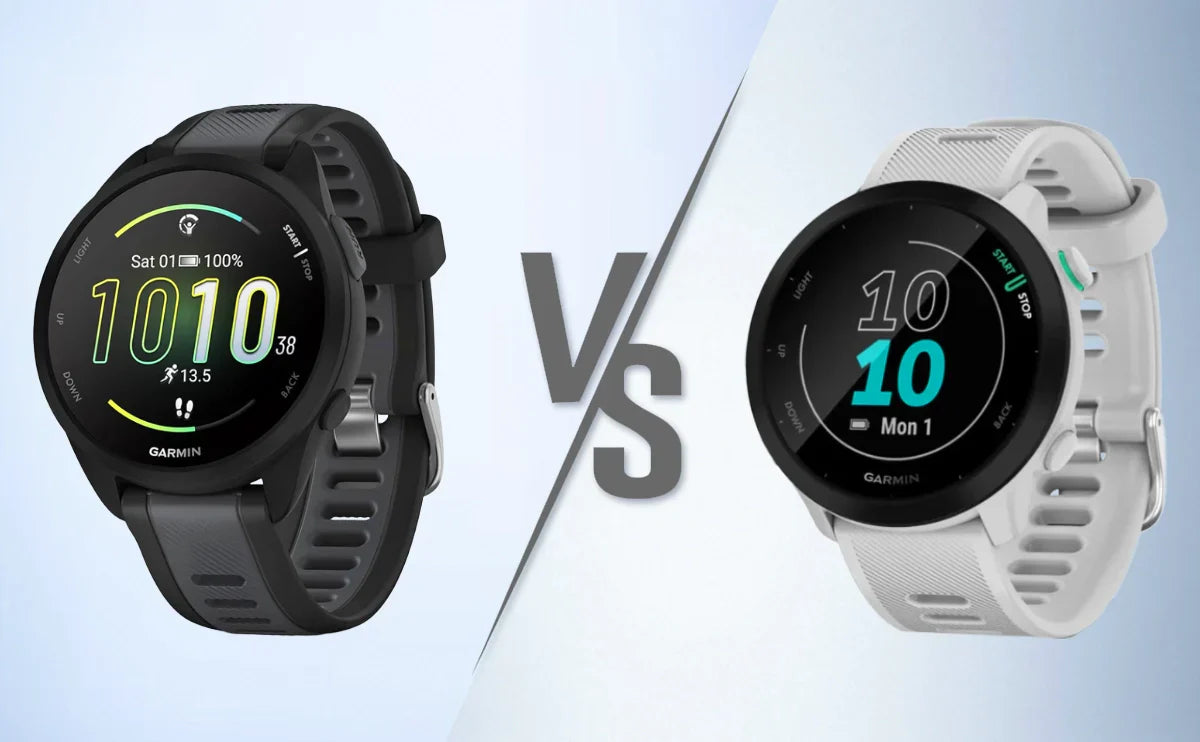
Explore the key performance trade-offs between the vibrant, AMOLED-equipped Garmin Forerunner 165 and the reliable, budget-friendly Forerunner 55. By analyzing health insights and smart features, this comparison helps you decide if the latest upgrades are worth the investment for your fitness journey.
Main content:
- Garmin Forerunner 165 vs. Forerunner 55 - Quick Verdict
- Garmin Forerunner 165 vs Forerunner 55 Design & Comfort
- Design and Size Differences
- Weight and All-Day Wearing Experience
- Watch Band and Wearing Comfort
- Daily Wear and Water Resistance
- Design & Comfort Verdict: Forerunner 165 vs Forerunner 55
- Garmin Forerunner 165 vs Forerunner 55 Display & Screen Experience
- Screen Technology Differences
- What This Means in Real Use
- Interaction and Convenience
- Display Verdict - Forerunner 165 vs Forerunner 55
- Garmin Forerunner 165 vs Forerunner 55 Running & Training Features
- Running Metrics and Tracking
- Training Plans and Guidance
- Heart Rate Monitoring
- Route Tracking and Navigation
- Race Predictions and Preparation
- Running & Training Verdict - Forerunner 165 vs Forerunner 55
- Garmin Forerunner 165 vs Forerunner 55 Health & Sleep Tracking
- Sleep Monitoring
- Stress Monitoring
- Body Battery & Recovery Insights
- Heart Rate Monitoring
- Health Tracking Verdict - Forerunner 165 vs Forerunner 55
- Garmin Forerunner 165 vs Forerunner 55 Battery Life & Performance
- Battery Performance in Daily Use
- Real Numbers & Scenarios
- Battery Verdict - Forerunner 165 vs Forerunner 55
- Garmin Forerunner 165 vs Forerunner 55 Smart Features & Music Experience
- Garmin Forerunner 165 vs Forerunner 55 - Who Should Buy Which
- Final Verdict
- FAQs about Garmin Forerunner 165 vs. Forerunner 55
In the entry-level to mid-range running watch market, the Garmin Forerunner series has long been a top choice for runners and fitness enthusiasts. Today, we will take an in-depth look at Garmin Forerunner 165 vs Forerunner 55, helping you quickly understand the key differences in features, user experience, and pricing.
While both watches can handle basic running tracking and daily health monitoring, they differ significantly in display quality, advanced running metrics, health monitoring depth, and battery performance.
In short, if you’re looking for advanced training metrics, a vibrant AMOLED screen, and music playback, the Garmin Forerunner 165 is the ideal choice. On the other hand, if you are a beginner runner or have a limited budget but still want reliable heart rate and GPS tracking, the Garmin Forerunner 55 is more suitable.
This guide will help you clearly compare the Forerunner 165 and 55 across running, health, smart features, and battery life, so you can make the best buying decision.
If you are interested, you can also read the latest articles in our website below:
Garmin Vivoactive 6 vs. Forerunner 165
Garmin Forerunner 165 vs. Forerunner 55 - Quick Verdict
For most users, balancing price and functionality is the top priority. Here’s a basic comparison of the two watches:
|
Model |
Version |
Price (USD) |
Music Function |
Best For |
|
Forerunner 165 |
Standard |
$249 |
❌ |
Advanced runners who want a vibrant screen and advanced training features |
|
Forerunner 165 |
Music Edition |
$299 |
✔︎ |
Runners who want music playback while training and richer running metrics |
|
Forerunner 55 |
Standard |
$199 |
❌ |
Beginner runners, budget-conscious users, or those prioritizing battery life |
Quick Recommendation:
- For those with a higher budget seeking more features → choose the Forerunner 165, especially the Music Edition.
- For beginner runners or budget-conscious users → the Forerunner 55 remains a solid choice.
Garmin Forerunner 165 vs Forerunner 55 Design & Comfort
When it comes to design and comfort, both the Garmin Forerunner 165 and Forerunner 55 follow the brand’s long-standing philosophy: lightweight construction built for all-day wear without disrupting daily life. Whether you’re running, working, or sleeping, neither watch feels bulky or intrusive.
Design and Size Differences
Although both watches share the same thickness, their overall visual presence is slightly different.
The Forerunner 165 features a 43×43 × 11.6mm case. With slimmer bezels and a larger visible display area, it looks more modern and closer to a lifestyle smartwatch - especially appealing for users who wear their watch beyond workouts.
The Forerunner 55, measuring 42 × 42 × 11.6mm, is marginally smaller. Its design leans toward a more classic, no-frills sports watch aesthetic, making it particularly suitable for users with smaller wrists or those who prefer a low-profile look.
Both models use fiber-reinforced polymer cases, keeping the watches lightweight while remaining durable enough for daily training, accidental bumps, and outdoor use.
Weight and All-Day Wearing Experience
The weight difference between the two is minimal but still worth noting:
- Forerunner 55: approximately 37 grams
- Forerunner 165: approximately 39 grams
In real-world use, this 2-gram difference is virtually unnoticeable during runs. However, for users who wear their watch all day, including during sleep tracking, the Forerunner 55 feels slightly more “invisible” on the wrist. That said, the Forerunner 165 remains very light for a GPS running watch and does not create any noticeable pressure or wrist fatigue.
Watch Band and Wearing Comfort
Both the Forerunner 165 and Forerunner 55 come with soft, skin-friendly silicone bands designed to follow the natural curve of the wrist. They perform well during long runs and sweaty workouts.
- The Forerunner 165 uses a slightly wider band, offering better stability for users with medium to larger wrists
- The Forerunner 55 features a narrower band, making it more comfortable for smaller wrists and easier to blend into everyday outfits
For sleep tracking, neither watch causes pinching or discomfort, but the lighter profile of the Forerunner 55 gives it a small advantage in overnight comfort.
Daily Wear and Water Resistance
In everyday use, neither watch looks overly “hardcore sports,” though their style direction differs.
- The Forerunner 165, with its colorful AMOLED display, transitions more naturally between workouts and casual or office settings, reinforcing its role as a running watch you can wear all day.
- The Forerunner 55 keeps things simple and understated, ideal for users who prefer a discreet look that doesn’t draw attention.
Both models support 5ATM water resistance, meaning they are suitable for swimming, running in the rain, and heavy sweating without concern.
Design & Comfort Verdict: Forerunner 165 vs Forerunner 55
- Choose the Forerunner 165 if you value a modern look, larger and brighter display, and a smartwatch-like daily wearing experience
- Choose the Forerunner 55 if you prioritize ultra-lightweight comfort, sleep-friendly wear, and a clean, low-profile design

Garmin Forerunner 165 vs Forerunner 55 Display & Screen Experience
When it comes to Garmin Forerunner 165 vs Forerunner 55, the display is one of the most noticeable differences, but it’s not just a matter of “AMOLED is better.” The two watches take different approaches, each designed for distinct user needs.
Screen Technology Differences
The Forerunner 165 features a 1.2-inch AMOLED display, which brings vibrant colors, high contrast, and sharp details. Whether you are checking running metrics, training suggestions, or notifications, the screen is easy to read and visually appealing, especially in indoor, office, or evening running settings. This AMOLED style is consistent with Garmin’s newer lineup, including models like the Garmin Forerunner 265 and Garmin Forerunner 965, which take the same display technology further with more advanced features.
The Forerunner 55, in contrast, uses a MIP (Memory-in-Pixel) reflective display, which focuses on practicality. Its strength lies in excellent visibility under bright sunlight and very low power consumption. This type of screen is favored in long-distance outdoor runs and by users who prioritize battery life over flashy visuals.
What This Means in Real Use
Both screens have advantages depending on your environment:
- The Forerunner 165 is ideal for daily wear, indoor activities, and viewing detailed data. The AMOLED display makes the interface feel more like a modern smartwatch.
- The Forerunner 55 excels outdoors, with a display that stays readable even in harsh sunlight without needing high brightness, helping preserve battery for long runs.
Interaction and Convenience
The Forerunner 165 supports both touch and button controls, making navigation through menus and health data intuitive. The Forerunner 55 relies solely on physical buttons, which reduces accidental touches during intense workouts or rainy conditions, providing a stable and reliable experience.
Display Verdict - Forerunner 165 vs Forerunner 55
- If you value a bright, colorful, and visually rich display for everyday use, the Forerunner 165 is the better choice. If your priority is outdoor readability, battery efficiency, and straightforward operation, the Forerunner 55 remains a reliable option.
- In short, both displays are designed with their target users in mind, and neither is universally “better.” Your choice should depend on whether you favor visual experience or practical performance.

Garmin Forerunner 165 vs Forerunner 55 Running & Training Features
When it comes to Garmin Forerunner 165 vs Forerunner 55, the differences in running and training functionality are clear. Both watches provide valuable data for runners, but the level of insight and guidance they offer varies significantly.
Running Metrics and Tracking
The Forerunner 55 covers the essentials. It tracks distance, pace, heart rate, and offers basic training suggestions. This is perfect for beginners who are establishing a running habit and mainly want to complete their runs while maintaining a steady pace.
The Forerunner 165, however, takes tracking to the next level. It measures advanced running dynamics such as cadence, stride length, ground contact time, and vertical oscillation, all of which help runners understand their form and optimize efficiency. Additionally, it can track wrist-based running power, giving insights into effort distribution and pacing strategy during workouts.
Training Plans and Guidance
Both watches support Garmin Coach training plans, but the depth differs. The Forerunner 165 provides personalized plans for 5K, 10K, and half-marathon goals, alongside PacePro pacing strategies that adjust recommendations based on course elevation. It also evaluates training effect, showing how workouts impact fitness, speed, and endurance.
The Forerunner 55 offers basic Garmin Coach plans and daily training suggestions, but lacks PacePro and detailed training effect analysis. For someone running 2–3 times per week casually, this is usually sufficient.
Heart Rate Monitoring
Both watches use Garmin Elevate technology, yet the Forerunner 165 benefits from improved algorithms that deliver more accurate heart rate trends during intense workouts. The Forerunner 55 provides reliable daily heart rate data but is less precise for high-intensity training.
Route Tracking and Navigation
Forersunner 165 supports syncing routes from Garmin Connect or third-party apps and provides navigation features such as route playback and distance alerts. Forerunner 55 can record basic routes and guide you along them, but it does not offer complex route planning or real-time navigation cues.
Race Predictions and Preparation
The Forerunner 165 can predict race times for 5K, 10K, and marathon distances based on your training and physical condition. It also offers pre-race plans and integrates PacePro strategies to help you optimize performance. The Forerunner 55 provides simpler race predictions but does not include pre-race planning or advanced pacing guidance.
Running & Training Verdict - Forerunner 165 vs Forerunner 55
- If you are a beginner, running a few times per week, or mainly want reliable pace, distance, and heart rate tracking, the Forerunner 55 is more than enough.
- If you are an experienced runner looking to analyze training data, refine running form, and optimize race performance, the Forerunner 165 provides the comprehensive metrics and guidance to support your goals.

Garmin Forerunner 165 vs Forerunner 55 Health & Sleep Tracking
When comparing Garmin Forerunner 165 vs Forerunner 55, health and sleep tracking is another area where their differences stand out. Both watches offer 24/7 heart rate monitoring, stress tracking, and sleep tracking, but the depth and insight vary.
Sleep Monitoring
The Forerunner 165 goes beyond basic tracking. It provides a sleep score out of 100, giving a clear picture of overall sleep quality. It can detect short naps during the day and records detailed sleep stages, including light, deep, REM, and awake periods. By wearing the watch for several nights, it also generates HRV (heart rate variability) data, helping runners understand the relationship between sleep quality and recovery.
The Forerunner 55 focuses on basic sleep duration tracking. While it records total sleep time, it does not provide sleep scores, stage breakdowns, or HRV analysis, which limits its insights for those seeking detailed recovery data.
Stress Monitoring
Both watches track stress levels, but again, the Forerunner 165 provides more advanced analysis. It calculates a stress score based on heart rate variability and shows historical trends over time, helping users understand how stress fluctuates throughout the day. The Forerunner 55 provides stress scores too, but without trend visualization or deeper analysis.
Body Battery & Recovery Insights
The Forerunner 165 offers detailed Body Battery tracking, showing how energy levels fluctuate based on sleep, activity, and stress. It helps users plan workouts, rest periods, and daily activities more effectively. The Forerunner 55 displays only a current energy value, without explaining changes or trends.
Heart Rate Monitoring
Both watches use Garmin’s optical heart rate sensors, but the Forerunner 165 features the latest generation for higher accuracy, capturing heart rate changes more precisely during both rest and exercise. The Forerunner 55’s sensor is slightly less advanced but still sufficient for basic heart rate monitoring during runs or daily life.
Health Tracking Verdict - Forerunner 165 vs Forerunner 55
- If you value detailed insights, recovery analysis, and advanced sleep tracking, the Forerunner 165 is the clear choice. It can detect naps, analyze sleep stages, provide stress trends, and monitor energy levels in depth.
- If you only need basic health and sleep tracking and prefer a simple, lightweight watch, the Forerunner 55 still covers your needs without overwhelming features.
In short, the 165 is suited for users who want a comprehensive view of their health trends over time, while the 55 is ideal for those looking for reliable, easy-to-understand basic tracking.

Garmin Forerunner 165 vs Forerunner 55 Battery Life & Performance
When comparing Garmin Forerunner 165 vs Forerunner 55, battery life is another area where the differences are noticeable, and it mostly comes down to display technology.
Battery Performance in Daily Use
The Forerunner 55 benefits from its MIP reflective display, which consumes very little power. As a result, it offers more stable and extended battery life, ideal for runners who prefer not to charge their watch frequently.
The Forerunner 165, on the other hand, features a bright AMOLED display, which greatly enhances visual experience and readability, but naturally consumes more battery. Despite this, the watch still meets daily usage needs for most runners without issues.
Real Numbers & Scenarios
- Forerunner 165: Up to 11 days in smartwatch mode, approximately 19 hours in GPS mode
- Forerunner 55: Up to 14 days in smartwatch mode, approximately 20 hours in GPS mode
The Forerunner 55 slightly outperforms the 165 on paper, mainly because the MIP screen is highly energy-efficient. Other factors, such as processor and sensor usage, also play a role.
In real-world usage, even with features like always-on display or frequent GPS runs, the Forerunner 165 can easily last about a week, which is sufficient for most training routines.
Battery Verdict - Forerunner 165 vs Forerunner 55
If longest possible battery life is your priority, the Forerunner 55 holds a slight advantage. If you prefer a brighter, more colorful display and don’t mind slightly shorter battery performance, the Forerunner 165 still offers enough endurance for daily and weekly running activities.

Garmin Forerunner 165 vs Forerunner 55 Smart Features & Music Experience
When comparing Garmin Forerunner 165 vs Forerunner 55, smart features and music capabilities are important considerations, especially for runners who value convenience and motivation during workouts.
Music Features
For many runners, long-distance runs and music go hand-in-hand. The Forerunner 165 Music Edition allows you to store music directly on the watch and connect Bluetooth headphones, letting you leave your phone behind while training. It supports platforms like Spotify, Deezer, and Amazon Music, providing full offline playback during runs.
The Forerunner 55, however, does not support local music storage or playback, relying on your phone for music control. If music is a must-have feature, the 165 (Music version) is clearly the better choice.
Smart Notifications & Convenience
The Forerunner 165 also offers enhanced smart features beyond music:
- Receive notifications for calls, emails, and messages
- NFC and Garmin Pay for contactless payments
- Audio prompts for pace, heart rate, and other key metrics during workouts
The Forerunner 55 provides basic notifications only, without payment options or audio prompts. It is suitable for users who primarily want a simple watch for running and basic smartphone alerts.
Verdict - Is It Worth Paying More?
- If offline music, audio feedback, and richer smart features are important for your workouts and lifestyle, the Forerunner 165 Music Edition justifies the higher price.
- If you are a budget-conscious beginner or don’t require music playback, the Forerunner 55 covers essential running and notification features without extra cost.

Garmin Forerunner 165 vs Forerunner 55 - Who Should Buy Which
Choosing between the Garmin Forerunner 165 and Forerunner 55 isn’t about which watch is “better” overall - it’s about which one fits your running habits, goals, and lifestyle.
Who Should Choose the Forerunner 165
The Forerunner 165 is best suited for runners who:
- Already have a running habit and want to improve performance
- Prefer a vibrant AMOLED display for easier data reading
- Want advanced training insights, including running dynamics and recovery metrics
- Need offline music playback during runs
- Appreciate richer smart features like notifications, Garmin Pay, and audio prompts
In short, the 165 fits those looking for a more complete, smartwatch-like running companion.
Who Should Choose the Forerunner 55
The Forerunner 55 is ideal for beginners or budget-conscious users who:
- Are just starting their running journey
- Want a lightweight, simple watch that tracks pace, distance, and heart rate reliably
- Prioritize battery life and ease of use over advanced metrics or flashy displays
- Prefer straightforward operation with physical buttons
It’s a solid choice if your goal is to establish a running habit without getting overwhelmed by extra features.
Final Verdict
When deciding between Garmin Forerunner 165 vs Forerunner 55, focus on your own needs rather than which model is technically “more advanced.”
- Forerunner 165: Suited for runners who want detailed training data, recovery insights, music on the go, and a vibrant daily-wear display.
- Forerunner 55: Perfect for those who prefer a reliable, simple, and lightweight watch that covers essential running and health tracking.
The key is knowing your priorities. Whether you choose the 165 or the 55, both watches provide excellent value within their target users, ensuring a rewarding running experience.
FAQs about Garmin Forerunner 165 vs. Forerunner 55
What’s the main difference between Garmin Forerunner 165 and Forerunner 55?
The 165 has a brighter AMOLED screen, advanced training metrics, and music storage (Music edition). The 55 focuses on basic running features and longer battery life.
Is the AMOLED display on the Forerunner 165 worth it compared to the 55’s MIP screen?
AMOLED offers richer colors and better indoor viewing, while the 55’s MIP screen excels in bright sunlight and consumes less battery.
Does the Forerunner 55 support offline music playback?
No, the Forerunner 55 cannot store music locally. Only the Forerunner 165 Music edition supports offline music via Bluetooth headphones.
Which GPS accuracy is better on the Forerunner 165 vs Forerunner 55?
Both watches provide reliable GPS, GLONASS, and Galileo tracking, but the 165’s newer GPS may respond slightly faster in some situations.
How do battery lives compare between Forerunner 165 and Forerunner 55?
The 55 lasts longer: ~14 days smartwatch, ~20h GPS. The 165 lasts ~11 days smartwatch, ~19h GPS due to its AMOLED display.
Is Forerunner 165 worth the extra cost over the Forerunner 55?
If you want a vibrant screen, offline music, and advanced metrics, 165 is worth it. For basic running tracking and battery, the 55 is a solid value.
Which watch is better for beginners vs experienced runners?
55 suits beginners with simple tracking and long battery life. 165 is better for experienced runners seeking deeper training insights and advanced features.
Will the Forerunner 55 still get updates compared to the 165?
The 55 may receive fewer software updates over time, while the newer 165 is likely to get longer support and new feature improvements.
Share:
Garmin Descent G2 vs Garmin Descent Mk3i - Which Dive Watch Is Right for You?
Garmin Forerunner 165 vs Forerunner 265 - Is the $150 Upgrade Worth It?