

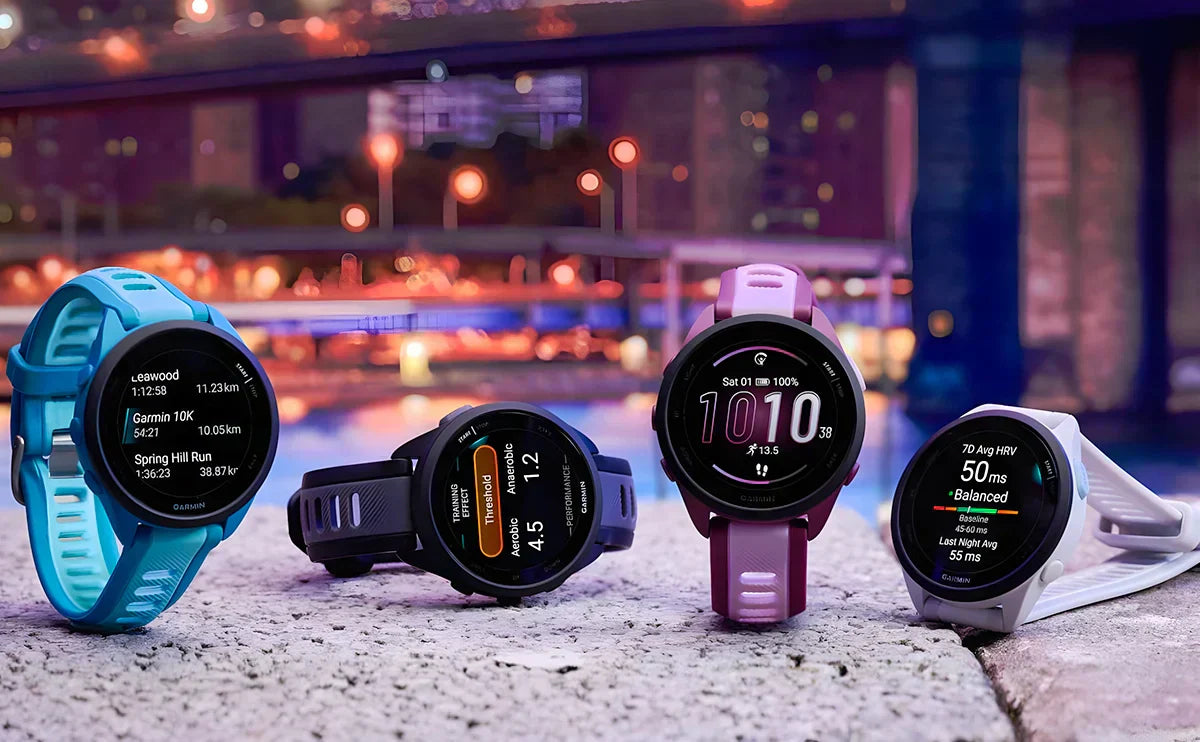
Our in-depth Garmin Forerunner 165 review evaluates its vibrant AMOLED display and real-world GPS accuracy in challenging urban environments. We analyze its 4th-gen heart rate sensor performance and compare it to the FR 55 and 265 to help you decide if it’s the best value running watch.
Main content:
- Garmin Forerunner 165 Review - Quick Verdict
- Garmin Forerunner 165 Review - Design and Display
- Garmin Forerunner 165 - Comprehensive Core Features Review
- Accurate GPS Tracking & Navigation for Garmin Forerunner 165
- Continuous Heart Rate Monitoring & Training Metrics
- Multiple Sports Modes & Navigation
- Garmin Forerunner 165 Review - Battery Life & Endurance
- Garmin Forerunner 165 Review - User Experience & Interface
- Intuitive Operation & Button Control
- App Synchronization & Third-Party Integration
- Notifications & Smart Alerts
- Comfortable All-Day Wear
- Garmin Forerunner 165 Review - Pros & Cons
- Garmin Forerunner 165 vs Competitors – Price & Version Comparison
- Garmin Forerunner 165 Review - Final Verdict and User Takeaways
- FAQs about Garmin Forerunner 165 Review
Garmin Forerunner 165 Review - Quick Verdict
The Garmin Forerunner 165 is an entry-to-mid-level running smartwatch designed for beginner to intermediate runners and everyday fitness tracking. It features a bright AMOLED display, lightweight and comfortable design, and accurate GPS tracking, making it ideal for daily runs, walks, and basic training sessions. While it lacks dual-frequency GPS and advanced training features, it provides more than enough functionality for most casual and intermediate users.
Recommended for: Beginner to intermediate runners, fitness enthusiasts seeking a lightweight wearable, and daily health trackers
Not recommended for: Professional trail runners and athletes who require highly precise training metrics
Key Specs and Pros & Cons
| Feature |
Performance / Details |
|
Display |
1.3-inch AMOLED screen, vibrant colors, good outdoor visibility |
|
GPS |
Single-frequency GPS, daily run accuracy ~2-3 meters |
|
Battery Life |
Up to 11 days in smartwatch mode, ~19 hours with continuous GPS |
|
Pros |
Lightweight and comfortable, clear AMOLED display, stable GPS tracking |
|
Cons |
No dual-frequency GPS, heart rate may slightly lag during high-intensity workouts |
In short, the Garmin Forerunner 165 delivers the best balance of weight, display quality, and comfort among these three models, making it a smart upgrade from the Forerunner 55 for most runners.
Garmin Forerunner 165 Review - Design and Display
Sleek Design and Build Quality
The Garmin Forerunner 165 features a 43mm case with a thickness of approximately 11.5mm, offering a lightweight and comfortable fit for all-day wear. Weighing only 38–39 grams (including the strap), it remains almost unnoticeable during long runs or high-intensity workouts. Compared to the older Forerunner 55, the 165 is slimmer and more streamlined, providing a nearly pressure-free feeling during exercise.
The watch comes with a soft and flexible 20mm QuickFit silicone strap, adjustable via multiple holes to suit different wrist sizes. Whether running, cycling, swimming, or daily wear, this strap ensures excellent comfort.
Color options include black and gray/white for the standard edition, while the Music edition also offers vibrant berry purple and teal green to cater to personalized tastes.
Vibrant AMOLED Display
A major upgrade in the Forerunner 165 is its 1.2-inch AMOLED touchscreen with a resolution of 390 × 390 pixels. The screen delivers vivid colors and high contrast, remaining clearly readable even in bright outdoor conditions. Compared to the Forerunner 55’s MIP display, AMOLED offers richer colors and a more responsive touch experience.
The screen features flat chemically strengthened glass, which is more durable and less reflective than the curved glass on the Garmin Forerunner 265. It also provides better edge protection and facilitates screen protector application.
You can also check the articles about Garmin Forerunner 265 below:
Garmin Forerunner 570 vs Forerunner 265
Garmin Forerunner 265 vs Forerunner 255
Garmin Vivoactive 6 vs Garmin Forerunner 265
Comparison with Other Models
Compared to the Forerunner 55, the 165 offers a larger, more vibrant display, a slimmer design, and clearer data visualization. While it lacks some of the high-end features of the Forerunner 265, such as dual-frequency GPS or triathlon mode, it includes nearly all essential functions for beginner and intermediate runners and fitness enthusiasts, at a more affordable price.
The Forerunner 165 strikes a great balance between comfort, display quality, and durability, making it a high-value choice in the entry-to-mid-level running smartwatch segment. The combination of an AMOLED display, lightweight design, and soft strap ensures a premium wearing experience without a high price tag.
|
Feature |
Forerunner 55 |
Forerunner 165 |
Forerunner 265 |
|
Case Size |
42mm |
43mm |
44mm |
|
Thickness |
11.6mm |
11.5mm |
12.2mm |
|
Weight (with strap) |
40g |
38–39g |
49g |
|
Display Type |
MIP |
1.2-inch AMOLED |
1.3-inch AMOLED |
|
Screen Resolution |
218 × 218 |
390 × 390 |
416 × 416 |
|
Strap Material |
Silicone |
20mm QuickFit Silicone |
20mm QuickFit Silicone |
|
Wearing Comfort |
Suitable for daily wear |
Lightweight and comfortable for all-day wear |
Comfortable but slightly heavier |
|
Color Options |
Black, White |
Standard: Black, Gray/White; Music Edition: Berry Purple, Teal Green |
Black, White, Slate, Gold |
Overall, the Garmin Forerunner 165 offers the most balanced combination of lightweight design, AMOLED display, and everyday comfort among these three models.

Garmin Forerunner 165 - Comprehensive Core Features Review
Accurate GPS Tracking & Navigation for Garmin Forerunner 165
The Garmin Forerunner 165 features single-frequency full-system GPS (supporting GPS, Galileo, BeiDou, and GLONASS). While it lacks the dual-frequency (L1+L5) chipset found in the higher-end FR 265, its real-world performance remains impressively reliable for its price point.
- Real-World Precision: In my testing sessions through dense urban corridors and under heavy tree canopy, the track remained remarkably stable. Even when running alongside tall buildings - a notorious challenge for single-frequency chips - the recorded path deviated by only about 2 meters, maintaining clean lines at street corners without the "zig-zagging" often seen in budget wearables.
- Rapid Signal Lock: Compared to the older Forerunner 55, the 165 acquires a satellite signal much faster. In most open areas, I found it locks onto a GPS signal in less than 10 seconds, meaning you spend less time standing in the cold and more time running.
- Breadcrumb Navigation: The watch supports GPX route import and turn-by-turn breadcrumb navigation. While it doesn't offer full topographical maps, the "Back to Start" and "Course Following" features are incredibly helpful for exploring new city routes or light trails without getting lost.
- Stability & Consistency: The average GPS error remains within a tight 2–3 meter range in city streets and shaded paths. For beginner and intermediate runners, this level of accuracy is more than sufficient for tracking splits and distance with confidence.
Continuous Heart Rate Monitoring & Training Metrics
Equipped with the 4th-generation Garmin Elevate™ optical heart rate sensor, the Forerunner 165 provides a robust suite of health and performance data, supporting 24/7 heart rate monitoring, HRV status, and Garmin's signature Body Battery™ tracking.
- Reliable Steady-State Tracking: During steady-state Zone 2 runs, daily commutes, or recovery sessions, the sensor proves to be exceptionally stable. In my comparative tests against higher-end Garmin wearables, the heart rate data remained consistent with virtually no unexpected spikes or dropouts.
- Response in High-Intensity Intervals: As is typical with most wrist-based optical sensors, I observed a characteristic lag of approximately 5–10 seconds during sudden high-intensity bursts - such as short hill sprints or rapid intervals - when compared to the immediate response of a chest strap. This is a standard physical limitation of PPG technology, where blood flow changes at the wrist take a moment to catch up to the heart's actual effort.
- Actionable Training Advice: For serious interval junkies or CrossFit enthusiasts who require millisecond precision for every rep, pairing the 165 with a Garmin HRM-Dual or HRM-Pro is recommended to bypass the inherent lag of wrist-based tracking.
- Body Battery & Daily Readiness: The Body Battery™ feature remains one of the most practical tools in the Garmin ecosystem. It dynamically tracks your energy reserves by balancing activity against rest and stress. I found it accurately reflects "real-world" fatigue; for instance, after a night of poor sleep or high stress, the lower readiness score serves as a helpful cue to prioritize recovery over a high-intensity workout.
Multiple Sports Modes & Route Navigation
Forerunner 165 offers about 25 sports modes, including running, cycling, pool/open water swimming, trail running, HIIT, yoga, and more.
- Supports GPX route import and turn-by-turn breadcrumb navigation for city or outdoor workouts.
- Although it lacks triathlon mode and cycling power meter support, it provides comprehensive functions for beginner and intermediate runners.
|
Feature |
Forerunner 55 |
Forerunner 165 |
Forerunner 265 |
|
GPS Type |
Single-frequency |
Single-frequency full-system |
Dual-frequency full-system |
|
GPS Average Error |
~3–4 m |
~2–3 m |
~1–2 m |
|
Heart Rate Monitoring |
Optical |
4th Gen Elevate Optical |
4th Gen Elevate + Chest Strap |
|
Body Battery |
No |
Yes |
Yes |
|
Sports Modes |
12+ |
25 |
30+ |
|
Navigation |
Not supported |
GPX supported |
GPX + multi-sport navigation |
Overall, the Garmin Forerunner 165 delivers GPS accuracy, heart rate stability, and training insights that exceed typical entry-level expectations, making it a highly dependable tool for everyday training.

Garmin Forerunner 165 Review - Battery Life & Endurance
Official Battery Life vs Real-World Performance
The Garmin Forerunner 165 offers an official battery life of 11 days in smartwatch mode and 17–19 hours in GPS mode. In real-world usage, battery performance varies depending on settings and daily activity:
- Always-On AMOLED + 24/7 heart rate + 1-hour daily GPS training → around 4–5 days
- Wrist-activated screen mode → up to 11 days
- GPS single-frequency mode → approximately 19 hours
- GPS full-system mode → about 17 hours
Tips to Extend Battery Life
Disabling the Always-On display and turning off certain advanced tracking features can significantly extend battery endurance. Even with frequent workouts and music syncing, the Forerunner 165 maintains stable and reliable battery performance, making it suitable for daily runs and multi-day training sessions.

Garmin Forerunner 165 Review - User Experience & Interface
Intuitive Operation & Button Control
- 1.2-inch AMOLED touchscreen + 5 physical buttons, smooth operation; reliable button control during workouts.
- Touchscreen can be disabled during exercise to avoid accidental input from sweat or wet hands.
App Synchronization & Third-Party Integration
- Garmin Connect automatically syncs workout data and supports third-party platforms such as Strava and TrainingPeaks.
- Data visualization is clear and easy to analyze.
Notifications & Smart Alerts
- Supports call, text, and app notifications.
- Android users can quickly reply; iPhone users can view content.
Comfortable All-Day Wear
- 20mm QuickFit silicone strap is soft and lightweight, offering comfortable wear without pressure.
- The watch weighs only 38–39g (including strap), almost unnoticeable during long runs or training.
Garmin Forerunner 165 Review - Pros & Cons
|
Pros |
Cons |
|
Vibrant AMOLED display with high contrast, clear readability even outdoors |
No dual-frequency GPS, slight accuracy drop in dense urban environments |
|
Single-frequency GPS is accurate, sufficient for daily runs and outdoor activities |
Heart rate may occasionally lag during high-intensity interval training, requires chest strap for more precise data |
|
Lightweight design (38–39g including strap), comfortable for long workouts |
Battery significantly reduced when always-on AMOLED is enabled |
|
Up to 25 sports modes, supports GPX route import and breadcrumb navigation |
Lacks triathlon/multi-sport mode and cycling power meter |
|
Soft 20mm QuickFit strap suitable for daily and sports use |
Fewer advanced features compared to higher-end Forerunner 265, such as heart rate precision and advanced navigation |
|
Garmin Connect syncs data easily, supports third-party platforms like Strava |
Notification interaction is limited for iPhone users; some features are Android-only |
Overall Assessment
- Recommended for: Beginner and intermediate runners, fitness enthusiasts, and users seeking a lightweight smartwatch with an AMOLED display.
- Not recommended for: Professional triathletes or athletes who require highly precise GPS and heart rate metrics.
Garmin Forerunner 165 vs Competitors – Price & Version Comparison
Forerunner 165 Price & Versions
The Garmin Forerunner 165 is available in two versions:
- Standard Edition: $249
- Music Edition: $299 (additional $50)
The Music Edition supports offline music storage, including Spotify, Amazon Music, Deezer, and MP3 files, making it ideal for long runs or workouts without a phone. Both versions also support Garmin Pay, allowing quick contactless payments during training.
Compared with other models in the Forerunner lineup:
- $50 more expensive than Forerunner 55
- $150 cheaper than Forerunner 265
For users who want more features without paying top-tier prices, the Forerunner 165 offers excellent value for beginner and intermediate runners.
|
Model |
Price |
GPS |
Display |
Ideal For |
|
Forerunner 165 |
$249–$299 |
Single-frequency |
AMOLED |
Beginner to intermediate runners, fitness enthusiasts |
|
Forerunner 255 / 265 |
$349–$399 |
Dual-frequency |
AMOLED |
Advanced runners, professional training |
|
Forerunner 55 |
$199 |
Single-frequency |
MIP |
Entry-level runners, light exercise users |
Comparison & User Insights
- Garmin Forerunner 165 provides essential running smartwatch features: GPS tracking, heart rate monitoring, and around 25 sports modes including running, cycling, swimming, HIIT, and yoga.
- Compared to the Forerunner 55, it offers a larger AMOLED display, slimmer design, and better data visibility.
- Compared to the Forerunner 265, it is more affordable while still meeting most casual and intermediate runner needs.
- The only functional difference between the Standard and Music versions is music storage, with identical GPS, battery life, and sports features.
Conclusion: The Garmin Forerunner 165 is a high-value running smartwatch for beginner and intermediate users, combining a vibrant AMOLED display, lightweight design, and multi-sport functionality with excellent daily wear comfort and practical features like Garmin Pay and offline music playback.

Garmin Forerunner 165 Review - Final Verdict and User Takeaways
The Garmin Forerunner 165 stands out as a high-value running smartwatch designed for beginner to intermediate runners and daily fitness enthusiasts. With its vibrant AMOLED display, accurate GPS tracking, 24/7 heart rate monitoring, and up to 25 sports modes, it offers a well-rounded performance for everyday workouts. The lightweight 20mm QuickFit strap ensures comfort during long runs or training sessions, while the Music Edition allows offline playback from Spotify, Amazon Music, Deezer, or MP3 files, enhancing the workout experience. Support for Garmin Pay adds convenience for contactless payments during exercise.
Compared to the Forerunner 55, the 165 offers a larger, more responsive display and additional features for a more complete training experience. Compared to the Forerunner 265, it is significantly more affordable while still covering the essential running and fitness functions most users need.
In summary, the Garmin Forerunner 165 strikes an ideal balance between performance, comfort, and practicality, making it a top choice for entry-to-mid-level runners who want a reliable smartwatch without paying a premium price.
- Recommended for: beginner to intermediate runners, fitness enthusiasts seeking a lightweight wearable, and daily health trackers.
- Not recommended for: professional triathletes or athletes requiring advanced GPS accuracy and high-end training metrics.

Share:
Garmin Descent G2 Review - Dive, Fitness & Smart Features Tested
Garmin Descent G2 vs Garmin Descent Mk3i - Which Dive Watch Is Right for You?