

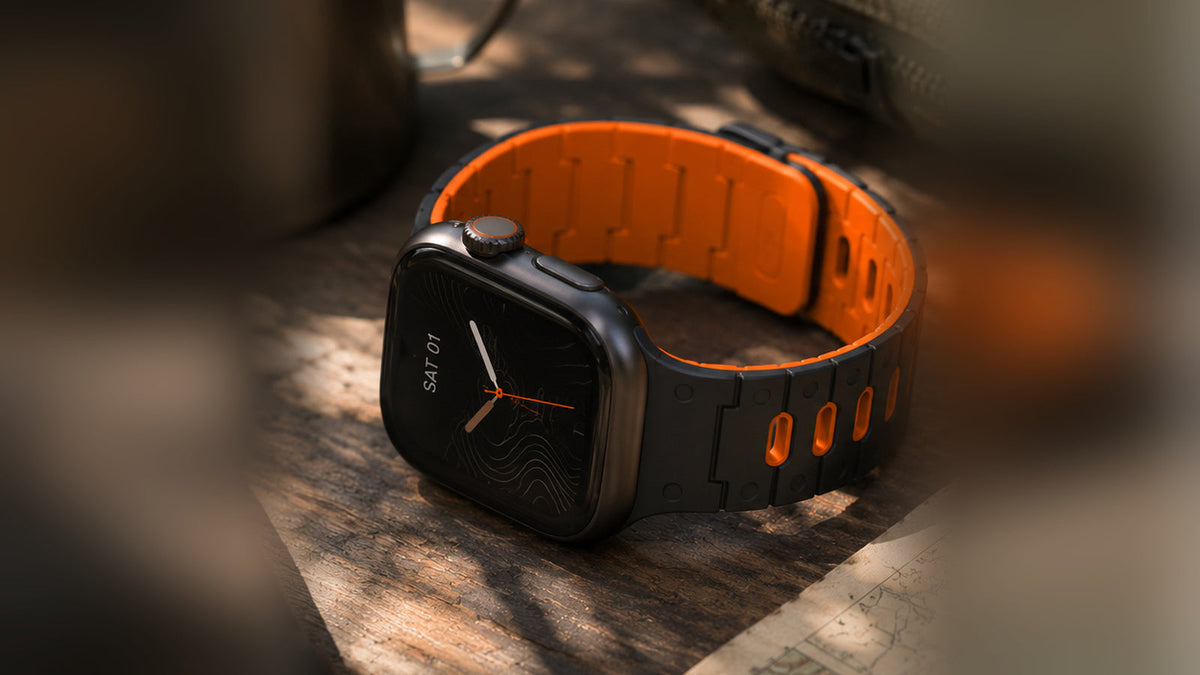
Finding an Apple Watch band that looks good is easy. Finding one that actually fits a small wrist can be more frustrating.
Maybe your watch slides toward your hand throughout the day. Maybe the band is already on its tightest setting, but there's still a gap underneath. Or perhaps the strap fits, yet leaves so much excess material that it feels bulky around your wrist.
These are common reasons to look for Apple Watch bands for small wrists. Fortunately, you don't necessarily need to change your watch. You may just need a band with a shorter minimum length or a more suitable adjustment system.
The key is to check three things: your wrist circumference, your Apple Watch case compatibility, and the band's actual adjustment range.
Here's how to find a band that fits comfortably without feeling loose, awkward, or overly tight.
What Is Considered a Small Wrist for an Apple Watch?
There's no universal definition of a small wrist, but 130–160mm (approximately 5.1–6.3 inches) is a useful range to focus on when shopping for smaller Apple Watch bands.
Some wrists measure less than 130mm, while others fall near the upper end of that range and still have trouble with standard-length straps.
The important distinction is that a "small" label doesn't guarantee a good fit.
For example, Apple's current 42mm Sport Band comes in two lengths:
-
S/M: Fits wrists measuring 130–180mm.
-
M/L: Fits wrists measuring 150–200mm.
If your wrist measures 135mm, the S/M option falls within its published range. The M/L option doesn't.
And if your wrist measures 125mm, neither version lists a suitable minimum.
This is why the actual wrist measurement matters more than labels such as S/M, small, universal, or one-size-fits-all.
Apple Watch Band Size Guide for Small Wrists
| Your Wrist Size | What to Look For |
|---|---|
| Below 130mm (5.1") | Extra-small bands explicitly rated for your measurement |
| 130–139mm (5.1–5.5") | Short bands with a 130mm or smaller minimum |
| 140–149mm (5.5–5.9") | Small-size adjustable bands; check the closure range |
| 150–160mm (5.9–6.3") | A wider range of styles, but check excess strap length |
These are practical shopping guidelines, not official Apple sizing categories.
A band with a published 140mm minimum may work for someone measuring 145mm, but it shouldn't be recommended to someone whose wrist measures 130mm.
How to Measure Your Wrist for an Apple Watch Band
Before shopping for a replacement, take a minute to measure your wrist.
You only need a flexible measuring tape. If you don't have one, use a strip of paper or non-stretch string and a ruler.
Step 1: Find the right position.
Measure around the part of your wrist where you normally wear your Apple Watch, just above the wrist bone toward your elbow.
Step 2: Wrap the tape around your wrist.
Keep it flat against your skin without pulling it too tightly. You want your natural wrist circumference, not the smallest measurement you can force.
Step 3: Record the measurement in millimeters.
For example, your wrist might measure 138mm, 145mm, or 157mm.
Step 4: Compare it with the band's published size range.
If your wrist measures 145mm, a band rated for 140–180mm includes your measurement. A band rated for 150–200mm does not.
For the most accurate choice, also check whether you'll be fastening the band near the end of its adjustment range.
One more thing: Your wrist size may fluctuate slightly during the day or after exercise. A band with some usable adjustment room is generally more convenient than one that only just reaches your measurement.
For a broader explanation of sizing across different models and strap types, see our Apple Watch band size guide.

Apple Watch Case Size vs. Band Size: Why Both Matter
One of the easiest mistakes to make when buying a small Apple Watch band is confusing the case size with the wrist size.
The numbers aren't interchangeable.
A 42mm Apple Watch refers to the watch's case size, not the circumference of the wrist or the length of the band.
There are two separate questions to answer:
-
Will the band connect correctly to your Apple Watch?
-
Will the band tighten enough to fit your wrist?
A band can pass the first test and fail the second.
Apple Watch Band Compatibility by Case Size
For standard removable Apple Watch bands, the connector sizes generally fall into two groups.
| Connector Group | Watch Case Sizes |
|---|---|
| Smaller connector group | 38mm, 40mm, 41mm, and newer 42mm models (Series 10, 11, 12) |
| Larger connector group | Older 42mm models (Series 1–3), 44mm, 45mm, 46mm, and compatible 49mm Ultra bands |
Pay particular attention to 42mm Apple Watch models.
A 42mm Apple Watch Series 3 and a 42mm Apple Watch Series 12 do not belong to the same band connector group.
The newer 42mm models use the smaller connector family, while the older Series 1–3 42mm models use the larger family.
If you own a newer watch and aren't sure whether an older band will fit, our Apple Watch Series 12 band compatibility guide explains these differences.
Once you've confirmed the correct connector, you still need to check the strap's wrist range.
A smaller Apple Watch connector doesn't automatically mean a shorter band.
Best Apple Watch Band Styles for Small Wrists
There isn't one band material or closure that works best for everyone.
For smaller wrists, the most useful difference is often how precisely you can adjust the strap and how neatly the remaining material sits once it's fastened.
Here are four styles worth considering.
1. Hook-and-Loop Bands: Fine Adjustment Without Fixed Holes
If traditional buckle holes always seem slightly too loose or too tight, a hook-and-loop design is a good place to start.
Instead of selecting from a row of fixed holes, you adjust how much of the strap overlaps before fastening it.
That gives you more control over the fit.
Apple's current 42mm Sport Loop, for example, uses a woven construction with hook-and-loop fastening and lists a wrist range of 130–200mm.
However, not every nylon loop band has the same minimum wrist size.
Some outdoor-oriented designs are built around longer straps, even though their closures are continuously adjustable.
Best for: People who prefer fine adjustment and don't want to rely on fixed buckle-hole positions.
Check before buying: Minimum wrist circumference, fastening overlap, and whether the excess strap can be secured neatly.
2. Silicone Sport Bands: Comfortable When the Length Is Right
Silicone bands are a popular choice for everyday wear because they're flexible and relatively easy to clean.
For a small wrist, though, the fastening design is just as important as the material.
Many sport bands use a pin-and-tuck closure. The pin secures the band through a selected hole, and the remaining strap end tucks underneath.
This helps create a clean appearance, provided the selected hole gives you the correct fit.
If even the tightest hole is too large, the watch will still move around.
And if you're between two adjustment holes, one setting may feel slightly loose while the next feels uncomfortable.
Best for: Everyday wear, workouts, and people who prefer a smooth, easy-to-clean strap.
Check before buying: Minimum length, hole spacing, closure position, and how the tucked end feels against your wrist.
3. Magnetic Bands: Convenient Adjustment With Closure Details to Check
Magnetic Apple Watch bands can offer a clean appearance and quick adjustment.
But not all magnetic bands work the same way.
Some rely primarily on magnetic overlap, while others use a mechanical fastening system with magnetic assistance.
The difference matters, particularly if you're trying to get a precise fit around a small wrist.
Check whether the strap can overlap sufficiently, whether the closure remains properly engaged, and whether the remaining material creates bulk underneath your wrist.
For workouts, also check the manufacturer's recommended activities rather than assuming every magnetic band is intended for intense exercise.
Best for: People who value easy adjustment and a streamlined appearance.
Check before buying: Minimum wrist size, closure construction, overlap, and activity guidance.
4. Solo Loop and Braided Solo Loop: Minimal Hardware, Precise Sizing
A Solo Loop-style band has no conventional buckle or adjustment holes.
That creates a clean, continuous shape around the wrist, but also makes the initial size selection especially important.
Unlike a hook-and-loop strap, you can't simply tighten a Solo Loop after putting it on.
If it's too loose, there isn't a smaller setting to switch to.
Apple provides dedicated sizing instructions for its Solo Loop and Braided Solo Loop bands. Follow the current guidance for your chosen model rather than assuming a previous loop size will always fit the same way.
Best for: People who prefer a minimal appearance and already know their correct loop size.
Check before buying: The manufacturer's exact sizing system and whether the band sits snugly without excessive stretching.

What Should You Check Before Buying Apple Watch Bands for Small Wrists?
A band isn't necessarily a good choice just because its published range includes your wrist measurement.
There are several practical details worth checking before you order.
1. Minimum Wrist Circumference
Start with the smallest supported wrist size.
If your wrist measures 140mm, don't choose a band rated for 150mm and above, even if the material stretches or the fastening looks adjustable.
Look for an explicitly compatible range instead.
2. Adjustment Range and Closure Position
Ideally, your band should have enough adjustment room to make small changes during the day.
If you have to use the very last possible fastening position, check whether the closure still works properly.
A band that's technically within range can still be awkward if its adjustment mechanism sits in an uncomfortable position.
3. Excess Strap Length
For smaller wrists, this is easy to overlook.
A band may tighten enough but still leave a long strap tail, a thick overlap, or a bulky section underneath your wrist.
That can be particularly noticeable when typing, resting your arm on a desk, or wearing long sleeves.
Look for product images showing the band fully fastened, not only laid flat.
4. Watch Case Proportions
The strap controls how the watch fits around your wrist, but it cannot change the size of the watch case.
If you're wearing a larger Apple Watch, including an Ultra, the case may occupy more of the top of your wrist.
A correctly sized strap can improve stability, but it won't necessarily solve discomfort caused by the case itself.
5. Closure Security
Whatever design you choose, make sure you can fasten it exactly as intended.
For a pin-and-tuck band, check that the pin is fully engaged.
For hook-and-loop fastening, ensure the fastening surfaces overlap properly.
For magnetic designs, check the complete closure and any additional fastening mechanism.
A band should stay secure without needing to be tightened beyond comfort.
Why Is My Apple Watch Band Still Too Loose?
If you've already tightened your Apple Watch band as far as it will go and it still moves around, the problem is often the band's minimum length.
There are a few signs to look for:
-
Your Apple Watch slides toward your hand when you lower your arm.
-
The case rotates around your wrist during normal movement.
-
You're using the smallest adjustment hole, but there's still a gap.
-
The strap leaves a long, awkward tail even when tightened.
-
The watch moves enough to lose consistent contact with your skin.
Apple recommends wearing your watch snugly but comfortably, with the back maintaining contact with your skin for features such as wrist detection and heart-rate monitoring.
Try moving your wrist normally, gently shaking your hand, and turning your palm upward.
If the watch moves excessively or loses contact, check its position and adjust the band.
If it remains loose at the smallest comfortable setting, you'll likely need a shorter band.
Don't try to compensate by fastening the strap in a way the manufacturer didn't intend.
For more on positioning and fit, see Apple's official wearing guidance.
Which Bandletic Apple Watch Bands Can Fit Smaller Wrists?
If you're looking for a replacement from Bandletic, the most useful starting point is the published wrist range, not just the material or appearance.
Several of our Apple Watch band designs offer smaller-size options, although not all support the same wrist circumference.
Here's how some current options compare.
| Bandletic Band | Published Wrist Range | Main Consideration |
|---|---|---|
| Track Dual Magnetic Sport Band | 140–180mm (small connector option) | Silicone with dual-sided magnets |
| Plank Dual Magnetic Sport Band | 140–180mm (small connector option) | Silicone with an n-shaped magnetic design |
| Cross Dual Magnetic Sport Band | 140–180mm (small connector option) | Silicone with dual-sided magnets |
| Cube Magnetic Sport Band | 145–210mm (current size selector) | Silicone, magnetic assistance and pin-and-tuck closure |
| Pack Outdoor Band | M: 165–180mm; L: 180–200mm | Nylon with hook-and-loop adjustment |
The ranges above are product-specific. Select the correct watch-size variant and confirm its wrist range before ordering.
Track Dual Magnetic Sport Band
The Track Dual Magnetic Sport Band is designed with silicone and dual-sided magnets.
Its smaller Apple Watch connector option is listed for 140–180mm wrists.
For someone with a wrist measuring 145mm or 150mm, this puts the product within its stated fit range.
The band also features track-shaped perforations and a reversible design with multiple color combinations.
If you prefer a similar style with a different magnetic arrangement, the Plank Dual Magnetic Sport Band is another option with the same published 140–180mm range in its smaller connector version.
The important consideration for both is how the closure feels and holds at your particular wrist size.
Cube Magnetic Sport Band
The Cube Magnetic Sport Band combines silicone with magnetic assistance and an aluminum pin-and-tuck closure.
Its current size selector lists a 145–210mm wrist range.
That makes it an option to compare if your wrist measures 150mm or 155mm, but not a confirmed choice for someone measuring 135mm.
The fastening pin is an important part of the design. When trying it on, make sure the pin sits properly in the selected hole and the remaining strap is tucked as intended.
Is the Pack Outdoor Band Suitable for Small Wrists?
Bandletic's Pack Outdoor Band has a nylon construction with hook-and-loop adjustment.
However, its current sizes start at 165mm.
That means it isn't the appropriate choice for a wrist measuring 135mm, 145mm, or 155mm, despite the adjustable closure.
It also currently offers the larger Apple Watch connector group rather than the newer 42mm small-case option.
This is an important example of why an adjustable strap doesn't automatically mean a small-wrist fit.
You can explore our full Apple Watch bands collection to compare more designs, but always check the actual fit range on the individual product page.
What if Your Wrist Measures 130mm, 140mm, or 150mm?
Small differences in wrist circumference can make a meaningful difference when choosing a band.
Here's how to approach three common measurements.
If Your Wrist Is 130mm
Start with a product that explicitly supports 130mm.
Apple's current 42mm Sport Loop and S/M Sport Band both list 130mm as their minimum wrist circumference.
By comparison, the Bandletic options discussed above begin at 140mm or more.
A 130mm wrist is therefore below the published range of those specific Bandletic designs.
If Your Wrist Is 140mm
You have more options, including smaller-size bands that begin at 140mm.
For example, the smaller connector versions of Bandletic's Track, Plank and Cross Dual Magnetic Sport Bands fall within this range.
Because 140mm is their published minimum, it's worth checking how the closure sits at that setting and whether the adjustment feels comfortable.
A band starting at 130mm may offer more room to tighten, depending on its construction.
If Your Wrist Is 150mm
A 150mm wrist falls within the listed ranges of several Bandletic sport bands, including Track, Plank, Cross and Cube.
You may have greater flexibility in choosing a material or fastening design.
However, you should still check how much excess strap remains and whether the watch sits comfortably during daily movement.
The goal isn't simply to find a band that closes. It's to find one that closes comfortably and stays in place.
Is Nylon or Silicone Better for Small Apple Watch Wrists?
Both materials can work well, but neither guarantees a good fit.
Nylon is often found in woven bands with hook-and-loop fastening, which can offer fine adjustment.
Silicone is commonly used in sport bands with pin-and-tuck or magnetic fastening designs.
The better choice depends on your preferences, how you'll use the watch, and the specific band's available sizes.
For a 145mm wrist, a correctly sized silicone band will generally be a more practical choice than an oversized nylon band that starts at 165mm.
Similarly, a properly sized nylon loop may be more comfortable than a silicone strap whose adjustment holes never quite give you the fit you need.
For a closer comparison of the materials themselves, read our nylon vs silicone watch band guide.
How Tight Should an Apple Watch Band Be?
Your Apple Watch should feel secure without squeezing your wrist.
According to Apple's wearing guidance, the watch should sit above your wrist bone, toward your elbow, with the back maintaining contact with your skin.
A good fit should allow you to move normally without the case sliding excessively or the strap creating uncomfortable pressure.
You may prefer a slightly snugger setting during exercise, then loosen the band afterward.
If you're wearing your Apple Watch while running, stability and fastening are especially important. Our Apple Watch band guide for running covers those considerations in more detail.
If a band causes persistent discomfort, pinching, or excessive pressure, don't keep tightening it simply to stop the watch from moving. Recheck the fit and consider a different size or closure.
Frequently Asked Questions
1. What is the best Apple Watch band for small wrists?
The best option is one whose published wrist range includes your measurement and whose fastening system allows a comfortable, secure fit.
Hook-and-loop bands are worth considering for fine adjustment, while shorter silicone sport bands can also work well. The right choice depends on the actual dimensions, not just the material.
2. What Apple Watch band fits a 130mm wrist?
Apple's current 42mm Sport Loop and S/M Sport Band both list a minimum wrist circumference of 130mm.
Check your Apple Watch's connector group before selecting either band. If your wrist measures below 130mm, look for a product that explicitly supports a smaller circumference.
3. Are Apple Watch bands available for wrists smaller than 130mm?
Some third-party manufacturers may offer shorter or custom-sized bands. However, you should confirm the published minimum rather than assume an ordinary S/M or adjustable band will fit.
4. Can I wear an Apple Watch Ultra with a small wrist?
Potentially, provided the case feels comfortable and you can find a compatible 49mm band that fits your wrist.
However, the Ultra's larger case may not suit every smaller wrist. A short strap cannot change the physical dimensions of the watch.
Check both the band's wrist range and how the case sits against your wrist.
5. Why does my Apple Watch keep sliding down my wrist?
The band may be too long, incorrectly adjusted, or positioned too close to your hand.
Move the watch above the wrist bone and check whether it stays in contact with your skin.
If it still slides at the tightest comfortable setting, look for a band with a smaller minimum wrist size.
6. Does S/M mean an Apple Watch band will fit small wrists?
Not necessarily.
S/M sizing varies between products. Apple's current 42mm Sport Band S/M fits 130–180mm wrists, but another brand's S/M option may use a different range.
Always compare the actual measurements.
7. Is a magnetic Apple Watch band good for skinny wrists?
It can be, if the band is rated for your wrist circumference and the closure fastens properly.
Check the magnetic design, any mechanical fastening components, and the manufacturer's activity recommendations before choosing one.
8. Can I shorten an Apple Watch band that is too long?
Some metal bracelets allow links to be removed, but many silicone, nylon and magnetic bands aren't intended to be cut or modified.
Use the manufacturer's adjustment instructions. If a band doesn't fit at its shortest setting, choosing a properly sized replacement is usually the better option.
Final Thoughts: The Right Fit Matters More Than the Size Label
If you're shopping for Apple Watch bands for small wrists, start with your actual wrist measurement.
Then check the band's minimum length, fastening design, and compatibility with your Apple Watch model.
A smaller watch case doesn't automatically come with a shorter strap. A continuously adjustable closure doesn't guarantee a small fit. And an S/M label doesn't tell the whole story.
What matters is whether the band can be fastened securely and comfortably at your exact wrist circumference.
Once you know your measurement, you can explore Bandletic's Apple Watch bands and compare compatible styles by fit, material, and closure.
Choose the fit first. The style comes next.
Share:
Garmin Forerunner 265 & 265S Band Size: 18mm vs 22mm