

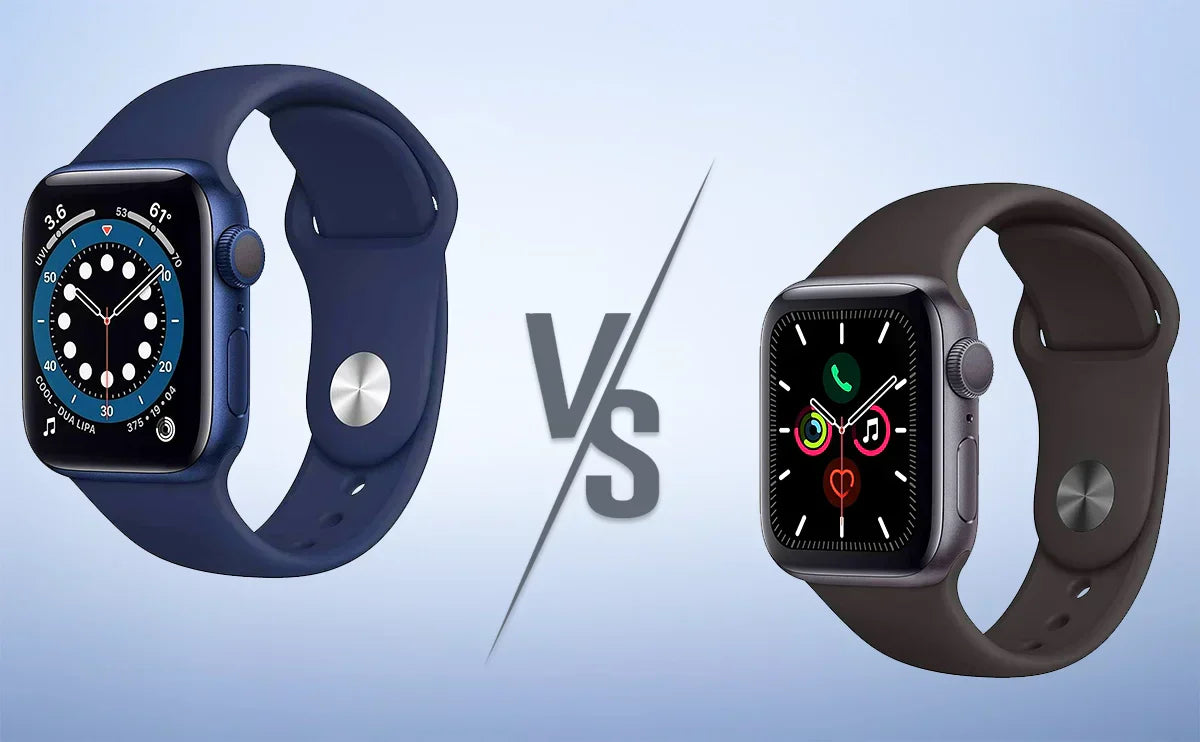
This article compares Apple Watch Series 6 and Series 5 in real-world use, focusing on battery life, charging speed, display visibility, health features, and fitness tracking. It helps you decide which model is worth buying today, especially when choosing between used or refurbished options.
Main content:
- Apple Watch Series 6 vs Series 5 – Real-World Differences That Matter (Quick Comparison)
- What You’re Really Deciding Between
- Display Brightness & Always-On Display: Where the “2.5× Brighter” Claim Actually Matters
- Battery Life & Fast Charging – The Upgrade Sleep-Tracking Users Feel Most
- Health Features – Blood Oxygen vs ECG: Who Actually Needs SpO₂?
- Performance and Longevity – Why the Series 6 Ages Better
- Fitness & GPS Tracking – Series 6 vs Series 5 in Real Use
- Hidden Differences – Small Details You Notice Over Time
- Design, Materials, and Band Compatibility: Style That Actually Affects Daily Use
- Who Should Choose Which? Quick Persona-Based Recommendations
- Final Takeaway
- FAQs about Apple Watch Series 6 vs Series 5
Short answer: if you’re buying used or refurbished and the price difference is small, the Apple Watch Series 6 is the better choice. But if the gap is noticeable - and you don’t care about fast charging or blood oxygen tracking - the Series 5 still delivers around 90–95% of the everyday experience.
Choose Series 6 if you:
- Track sleep and don’t want battery anxiety
- Value fast charging during short daily top-ups
- Care about blood oxygen tracking or longer software support
Choose Series 5 if you:
- Mainly use your watch for notifications and basic fitness
- Are price-sensitive and want the best value
- Don’t need fast charging or additional health sensors
This comparison focuses on real-world use – not just specs – covering always-on display visibility, overnight battery performance, and daily charging behavior to help you decide which model actually fits your usage. If you’re also comparing newer generations, you may want to check Apple Watch Series 6 vs 10 for what actually changes (and what doesn’t) in daily use.
Apple Watch Series 6 vs Series 5 – Real-World Differences That Matter (Quick Comparison)
|
Key Experience Factor |
Apple Watch Series 6 |
Apple Watch Series 5 |
|
Always-On Display (Outdoors) |
Noticeably brighter in strong sunlight when your wrist is down |
Dimmer outdoors, often requires raising your wrist |
|
Charging Speed |
Fast charging, about 80% in ~45 minutes |
Slower charging, about 80% in ~1.5 hours |
|
Blood Oxygen (SpO₂) |
Supported; useful for specific health or altitude needs |
Not supported |
|
Battery Experience |
More reliable for all-day use and sleep tracking |
Often ends the day with low battery when AOD is enabled |
|
Chip Performance (Daily Use) |
Slightly smoother animations and system transitions |
Still very fast for notifications and basic tasks |
|
U1 Ultra-Wideband Chip |
Yes; limited use today but more future-proof |
No |
|
Wi-Fi Support |
2.4GHz + 5GHz for faster syncing and updates |
2.4GHz only |
|
Altimeter |
Always-on altimeter, better for hiking and elevation tracking |
Non-continuous altimeter |
|
Colors & Materials |
New blue, red, and darker metal finishes |
Included discontinued ceramic editions |
|
Used Market Risk |
Generally better battery health due to younger age |
Higher risk of battery degradation |
Bottom line:
You only need to look at four rows to decide - charging speed, battery experience, outdoor always-on display visibility, and blood oxygen tracking.
What You’re Really Deciding Between
When comparing the Apple Watch Series 6 and Series 5, the question usually isn’t which one is better. It’s whether the extra money actually changes how the watch feels day to day.
Most people hesitate for the same reasons:
Is the price difference really worth it?
You’re trying to decide if paying more brings a noticeable daily benefit - or just nicer specs on paper.
Battery life matters more than numbers.
You want to wear the watch to sleep without worrying about charging it constantly.
Is the always-on display actually brighter?
The “2.5× brighter” claim sounds big, but many users don’t see much difference indoors and wonder where it shows up.
Is blood oxygen tracking a must-have or a novelty?
It’s essential for some people, but easy to ignore for others.
Will it still feel current next year?
Especially when buying used, no one wants a watch that feels outdated too quickly.
This comparison focuses on those real concerns - what you’ll notice every day, not just what looks better on a spec sheet.
Display Brightness & Always-On Display: Where the “2.5× Brighter” Claim Actually Matters
Apple promotes the Series 6 always-on display as up to 2.5× brighter, which sounds like a major upgrade. In real-world use, the improvement is real - but far more situational than most people expect.
Indoors and Normal Lighting – Why It Often Feels Unchanged
In typical indoor environments - homes, offices, gyms - the always-on display on the Series 6 looks nearly identical to the Series 5. Even at maximum brightness, both watches keep the always-on state dim to protect battery life.
Side-by-side comparisons consistently show that indoors, you still need to raise your wrist to clearly read the screen. This is where many users feel disappointed: the brightness increase exists, but it doesn’t meaningfully change everyday indoor use.
Bright Outdoor Light – The One Scenario Where You’ll Notice It
The advantage appears in strong sunlight, and only under specific conditions.
When your wrist is down and you want to quickly glance at the time without lifting your arm, the Series 6 holds contrast better and remains more readable. It doesn’t look fully bright, but it crosses from hard to read to usable at a glance.
If you often sit outdoors or want your watch to behave more like a traditional wristwatch in bright light, this improvement can matter. If you’re mostly indoors or constantly moving, the difference is easy to miss.
Night Driving and Dark Rooms – When Brighter Becomes a Drawback
Some users notice that the Series 6 is more sensitive to wrist movement, especially at night. While driving or watching a movie, the screen may light up more often than expected, which can be distracting.
This is easy to manage using Theater Mode or Focus modes, which restore the calmer behavior many users prefer in low-light situations.
How to Judge It for Yourself
Use the same watch face, maximum brightness, and always-on enabled. Compare with your wrist resting naturally indoors, then repeat outdoors in direct sunlight. Focus on readability without raising your wrist - that’s where the Series 6 shows its advantage.
The Bottom Line
The brighter always-on display on the Series 6 is real, but easy to overestimate. Indoors, the experience is nearly the same. Outdoors, in strong sunlight, the Series 6 is better - but only for quick, hands-down glances.
If you’re upgrading mainly for the always-on display, this is the context that should guide your decision.

Battery Life & Fast Charging – The Upgrade Sleep-Tracking Users Feel Most
On paper, both the Apple Watch Series 5 and Series 6 are rated for up to 18 hours of battery life. In real use, that number matters far less than how much battery you have left at the end of the day.
Why the “18-Hour” Rating Doesn’t Tell the Whole Story
The real difference comes down to battery condition, chip efficiency, and usage habits.
Many Series 5 users finish the day with very little charge left - often around 10%, especially with the always-on display enabled. That leaves little room for error and makes overnight wear stressful.
With the Series 6, users more commonly end the day with 35–40% remaining, enough to wear the watch through the night without planning around a charger. That extra buffer changes how the watch fits into daily life.
Fast Charging – Less Planning, More Freedom
Fast charging is the most practical upgrade on the Series 6.
If you track sleep, a 20–30 minute charge in the morning - while showering or eating breakfast - is often enough to get the battery back to a safe level for the rest of the day. The watch fits into your routine instead of controlling it.
With the Series 5, that same short window usually isn’t enough, which leads many users to either charge longer or skip sleep tracking altogether.
Buying Used – Battery Health Matters More Than the Generation
When buying second-hand, battery condition can matter more than the model itself.
A Series 6 with a healthier battery and fast charging feels noticeably easier to live with. A Series 5 in excellent condition can still perform well, but it leaves less margin if you forget to charge.
The Bottom Line
If you don’t wear your watch to sleep, the difference may feel small. But for sleep tracking users, the combination of better battery headroom and fast charging makes the Series 6 feel like a genuine quality-of-life upgrade.

Health Features – Blood Oxygen vs ECG: Who Actually Needs SpO₂?
Most health features on the Apple Watch Series 6 and Series 5 are the same. Both track heart rate, support ECG, and monitor daily activity.
The real difference is blood oxygen tracking - and whether it’s useful depends entirely on you.
Blood Oxygen Isn’t Medical-Grade, but It Can Be Meaningful
Blood oxygen readings on the Series 6 aren’t meant to diagnose conditions or replace medical advice. However, for some users, having access to oxygen trends provides real reassurance.
If breathing quality, illness recovery, or altitude training is something you think about regularly, this data can be genuinely valuable. For others, it’s simply a nice extra they rarely check.
Real-World Use – Fit Matters More Than You Expect
In practice, blood oxygen measurements don’t always succeed on the first try. It’s common to need a second attempt.
Fit plays a major role. A loose band often leads to failed or inconsistent readings, while a snug fit produces much more reliable results. When worn correctly, the feature works well - but it does require a bit of patience.
Who Should Pay for Blood Oxygen Tracking?
The Series 6 makes more sense if you:
- Have respiratory concerns or breathing-related anxiety
- Spend time at high altitudes or train in changing elevation
- Care about tracking long-term oxygen trends
The Series 5 is usually the better choice if you:
- Are healthy and already satisfied with heart rate and ECG
- Don’t plan to actively check blood oxygen data
- Prefer saving money over adding a feature you may rarely use
The Bottom Line
Blood oxygen tracking isn’t essential for everyone. But if it’s something you know you’ll use, it’s the clearest reason to choose the Series 6. If not, the Series 5 already covers the health features most people rely on every day.

Performance and Longevity – Why the Series 6 Ages Better
When comparing performance, it helps to be realistic. This isn’t a dramatic upgrade. The difference between the Apple Watch Series 6 and Series 5 is subtle - but that’s exactly why longevity matters.
Daily Use Today – Both Are Still Fast
In everyday tasks - checking notifications, replying to messages, tracking workouts - both watches feel smooth and responsive.
Many experienced Apple Watch users note that even much older models still handle basic smartwatch tasks reasonably well. That perspective matters here: the Series 5 is already fast enough for most people.
If you’re expecting a dramatic speed boost, you won’t find one.
Where the Series 6 Feels Better
The Series 6 shows its advantage in small, repeatable moments.
Animations are slightly smoother, watch face editing feels more responsive, and there’s less hesitation when moving through menus. These improvements aren’t obvious at first, but over time they make the interface feel more refined - especially after software updates.
Longevity Is the Real Upgrade
The biggest benefit of the Series 6 isn’t how it feels today, but how long it stays that way.
If you plan to keep your watch for another two to three years, the Series 6 offers more headroom for future updates and features. It’s less likely to feel constrained as watchOS evolves. If your real goal is longer-term smoothness, it can also help to compare Apple Watch Series 5 vs 10 to see how much of the “upgrade feeling” comes from generation jumps, not just minor refinements.
If you’re buying as a short-term option or plan to upgrade again soon, the Series 5 is still a solid choice. It works well today, just with less margin for the future.
The Bottom Line
Right now, both watches perform well. The difference isn’t dramatic.
The Series 6 makes more sense if you care about keeping your watch longer and avoiding early slowdowns. If you just need a reliable smartwatch today, the Series 5 is still more than capable.

Fitness & GPS Tracking – Series 6 vs Series 5 in Real Use
Short answer:
For most runners, cyclists, and gym users, GPS accuracy and workout tracking feel nearly identical on the Apple Watch Series 6 and Series 5. Neither model has a clear advantage in everyday fitness tracking.
GPS Accuracy – What Actually Affects Your Route
Both Series 6 and Series 5 deliver reliable GPS tracking for outdoor workouts.
In real-world use, environment matters far more than the generation:
- Tall buildings (urban areas)
- Dense tree cover
- Tunnels or sharp direction changes
- Starting a workout before GPS fully locks
On the same route, distance totals and GPS paths are usually close enough that most users won’t notice a difference.
If you’re upgrading purely for better GPS accuracy, the Series 6 alone isn’t a strong reason.
Fitness Tracking – Where the Experience Feels Different
Workout modes, heart-rate tracking, and activity rings work similarly on both models.
The difference isn’t tracking quality—it’s convenience:
- Series 6 is easier to live with thanks to better end-of-day battery headroom
- Fast charging makes it easier to top up before or after workouts
- This matters more if you train frequently or track sleep
Hiking & Elevation Tracking
The Series 6 includes an always-on altimeter, which continuously tracks elevation changes.
This is useful for hikers and trail runners who check elevation often, but less noticeable for gym-focused users.
The Fitness Buying Rule
- Choose Series 6 if you work out often, track sleep, or want less battery stress around training.
- Choose Series 5 if the price gap is large and the watch is in good condition—fitness and GPS tracking will still be excellent.
Bottom Line
For fitness and GPS accuracy, Series 6 vs Series 5 is not a major upgrade. Battery convenience and charging behavior matter far more than raw tracking performance.

Hidden Differences – Small Details You Notice Over Time
Beyond headline features, a few subtle differences between the Apple Watch Series 6 and Series 5 only become noticeable after weeks or months of use.
Taptic Engine: Clearer Silent Alerts
The Series 6 delivers stronger, more defined vibration feedback, making silent alarms and notifications easier to notice. Many users report noticing this immediately.
This isn’t just subjective - teardowns have shown a slightly larger Taptic Engine in the Series 6. If you rely on silent alerts or use your watch as a morning alarm, this small change adds up over time.
5GHz Wi-Fi – Faster When You Need It
The Series 6 supports 5GHz Wi-Fi, while the Series 5 does not. For most people, this won’t matter day to day.
However, syncing music, downloading apps, and installing updates can be noticeably faster on the Series 6, especially in crowded wireless environments.
Always-On Altimeter – Useful for Some, Invisible for Others
The Series 6 includes an always-on altimeter that continuously tracks elevation changes. This is genuinely helpful for hikers and trail runners.
If you rarely check elevation data, you may never think about this feature - but for the right user, it adds meaningful context to workouts.
Packaging Changes – A Small Cost to Watch For
The Series 6 no longer includes a power adapter in the box. You’ll still get a charging cable, but you may need to provide your own adapter.
When buying used or refurbished, this is worth checking, as it can add a small but unexpected cost.
The Bottom Line
None of these differences are major on their own. But together, they explain why the Series 6 tends to feel slightly more refined over time.
The Series 5 still performs well - but these details show where the Series 6 quietly improves the everyday experience.
Design, Materials, and Band Compatibility: Style That Actually Affects Daily Use
Design matters more than people admit. The Apple Watch is worn all day, and color, material, and band comfort directly affect how much you enjoy using it.
Series 6 Colors – A Real Visual Upgrade
The Series 6 introduced finishes not available on the Series 5, including blue, red, and darker metallic options. These colors give the watch a more modern, expressive look.
The blue model is clean and versatile, while the red version stands out more. If appearance plays a role in your buying decision, this is a clear advantage for the Series 6.
The Small Design Frustrations
Not everything is perfect. One common complaint - especially with the red model - is that the included sport band doesn’t perfectly match the watch case. The mismatch is subtle, but noticeable if you care about a cohesive look.
There are also bundle limitations. Some colors are only sold with specific bands, which reduces flexibility at checkout.
Band Compatibility – Where Personalization Happens
Both the Series 5 and Series 6 use the same bands, which gives you much more freedom than the in-box options suggest.
Many users choose to personalize their watch with third-party bands that focus on comfort, durability, and better color matching. For example, Bandletic Apple Watch Series 6 Bands and Apple Watch Series 5 Bands are often chosen by users who want a secure fit for workouts, breathable materials for all-day wear, or styles that better complement the watch case.
Why the Right Band Matters
The band is what you feel all day. A good one can make an older watch feel new again, while a poor fit can make even a new watch uncomfortable.
Choosing the right band - whether at purchase or later - can improve daily comfort more than upgrading the watch itself.
The Bottom Line
If you prefer neutral or discontinued finishes, the Series 5 still works well. But if you care about style and customization, the Series 6 offers more visual options - and pairing it with the right band can make that difference even more noticeable.

Who Should Choose Which? Quick Persona-Based Recommendations
Outdoor & Commuter Users → Series 6
If you often check the time outdoors or during commutes, the Series 6 is the better choice. Its always-on display is easier to read in strong sunlight when your wrist is down, reducing how often you need to raise your arm. Indoors the difference is small, but outdoors this extra glanceability can noticeably improve daily convenience.
Sleep Tracking Users → Series 6 (Battery Health Matters Most)
If you wear your watch to sleep, the Series 6 is easier to live with. Better end-of-day battery headroom and fast charging make overnight wear less stressful, especially with short morning top-ups. When buying used, battery condition is critical—an aging Series 5 can quickly turn sleep tracking into a hassle.
Notifications-Only / Light Users → Series 5 When the Price Gap Is Large
If you mainly use your Apple Watch for notifications, basic fitness, and checking the time, the Series 5 still performs extremely well. Daily performance differences are minimal. When the price difference is significant, a well-maintained Series 5 offers excellent value without sacrificing core functionality.
Health Data–Focused Users → Series 6 (Check SpO₂ Availability First)
Blood oxygen tracking is the main health feature that separates the two models. If you actively care about oxygen trends due to altitude, respiratory concerns, or training, the Series 6 is worth it. Otherwise, heart rate and ECG on the Series 5 already cover the needs of most users.
Budget-Conscious Buyers → Prioritize Condition Over Generation
For budget-focused buyers, overall condition often matters more than the model itself. A Series 5 with strong battery health can be a better purchase than a poorly maintained Series 6. However, the Series 6 offers longer software longevity, which may matter if you plan to keep the watch for several years.
Long-Term Users (2–3+ Years) → Series 6
If you plan to keep your watch long term, the Series 6 is the safer choice. Its newer internals provide more headroom for future watchOS updates and help the watch feel smooth for longer. The difference isn’t dramatic today, but it becomes more noticeable over time.
Final Takeaway
There’s no universally “right” choice.
- If the price gap is small, the Series 6 offers better convenience and longevity.
- If the gap is large, the Series 5 still delivers most of the everyday experience.
Still unsure because you’re considering the newest models? Read Apple Watch Series 11 vs Apple Watch Series 6 to understand what the latest upgrades actually add—and whether they matter for your routine. Choose the watch that fits your routine and budget, not just the newer model.
FAQs about Apple Watch Series 6 vs Series 5
Is Apple Watch Series 6 worth upgrading from Series 5?
Yes, if the price difference is small. Series 6 adds faster charging, better battery buffer, and longer software support, while Series 5 remains good value at a larger discount.
Does Apple Watch Series 6 have better battery life than Series 5?
Yes in daily use. Series 6 typically ends the day with more remaining battery and supports fast charging, making sleep tracking easier.
Is the always-on display brighter on Apple Watch Series 6?
Yes, mainly outdoors. Indoors the difference is minimal, but in strong sunlight Series 6 is easier to read without raising your wrist.
Is GPS accuracy better on Apple Watch Series 6 than Series 5?
No. Both models use similar GPS hardware, and real-world accuracy is affected more by environment than by generation.
Is blood oxygen tracking on Apple Watch Series 6 necessary?
Only for specific users. It’s useful for altitude training or health monitoring, but not essential for most everyday users.
Which is better to buy used: Apple Watch Series 6 or Series 5?
Condition matters more than the model. Series 6 is generally safer due to newer battery health, but a well-kept Series 5 can still be a smart buy.

Share:
Garmin Instinct 3 Amoled vs Solar - Which One Should You Actually Buy?
Garmin Enduro 2 vs 3 - The Upgrade Truth Every Endurance Athlete Needs