

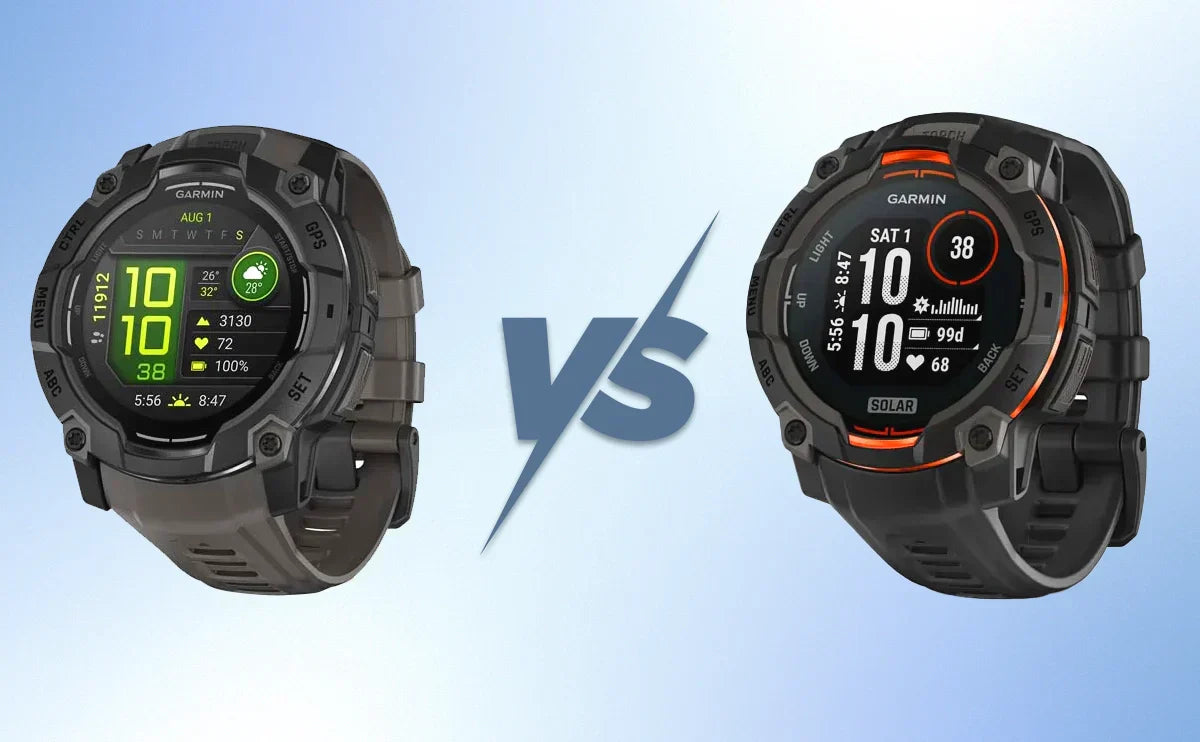
This guide breaks down the real differences between Garmin Instinct 3 AMOLED and Solar - not specs, but how they actually behave in daily life. In under three minutes, you’ll know which version fits your lifestyle, and which one you’re more likely to regret buying.
Main content:
- Quick Verdict – Choose in 3 Seconds
- Which User Profile Fits You?
- Who Is Most Likely to Regret Buying Instinct 3?
- This Isn’t a Screen Debate - It’s How Instinct 3 AMOLED and Solar Behave Differently
- Battery Reality – What “Unlimited” Really Means on Instinct 3
- Battery Decision Table (Real-World Use)
- Real-World Experience vs Official Claims
- Climate and Lifestyle Matter More Than Specs
- The Bottom Line on Battery Life
- Features and Hardware – Similar on Paper, Different in Daily Use
- Widgets – Information Density vs Instant Readability
- Activity Data Pages – More Detail or Faster Recognition?
- Built-In Flashlight – A Feature You’ll Actually Use
- What This Means for Your Choice
- Buy Before You Regret It: The 7 Most Debated Instinct 3 Issues - With Clear Answers
- Which One Should You Buy? The Short Answer, Based on How You Actually Live
- FAQs about Garmin Instinct 3 AMOLED vs Solar
Garmin Instinct 3 AMOLED vs Solar is one of the most difficult buying decisions in Garmin’s current lineup. This time, you’re not simply choosing a display - you’re choosing between battery life and tool-watch practicality versus visual clarity and information density.
The Solar version follows the traditional Instinct philosophy: always-on readability, extreme endurance, and minimal charging anxiety. The AMOLED version moves in a different direction, offering a brighter, richer, more modern smartwatch experience. In this guide, you’ll be able to identify the right version for your lifestyle in under three minutes, using a clear decision framework based on real-world use, not just specifications. If you want a broader perspective beyond AMOLED vs Solar, our Garmin Instinct 3 Review covers the full lineup, design changes, and real-world performance in more detail.
Quick Verdict – Choose in 3 Seconds
If you already know you want an Instinct 3, the choice is straightforward.
- Choose Instinct 3 Solar if battery life, always-on readability, and minimal charging matter most to you.
- Choose Instinct 3 AMOLED if you spend more time indoors, frequently check data at night, and want clearer, richer information on screen.
This isn’t about specs - it’s about which daily compromises you’re willing to accept.
Which User Profile Fits You?
|
User Type |
Best Choice |
|
Outdoor workers, long-distance hikers, ultrarunners |
Solar |
|
Commuters, gym users, night runners, weaker eyesight |
AMOLED |
|
Long-time Instinct fans (tool-watch mindset) |
Solar |
|
Coming from Apple Watch or AMOLED Garmins |
AMOLED |
In most cases, the correct choice becomes obvious once you identify your daily usage pattern.
Who Is Most Likely to Regret Buying Instinct 3?
Users who expect offline maps, touchscreen control, or onboard music are the most likely to be disappointed..At its current price, Instinct 3 prioritizes durability and battery efficiency over advanced smartwatch features - regardless of screen type.
If those features are critical, neither AMOLED nor Solar is the right solution. If you’re still unsure whether upgrading makes sense at all, a direct comparison like Garmin Instinct 2 vs Garmin Instinct 3 can clarify what actually changed - and what stayed the same.
This Isn’t a Screen Debate - It’s How Instinct 3 AMOLED and Solar Behave Differently
The Instinct series has always followed a tool-watch philosophy: a low-power MIP display, constant readability, and no concern about gestures, brightness settings, or charging routines. You glance, you read, and you move on. That simple, reliable behavior defines what an Instinct watch is meant to feel like.
With Instinct 3, Garmin introduced two distinct versions - Instinct 3 Solar and Instinct 3 AMOLED - and they behave very differently in everyday use. AMOLED doesn’t replace the Solar model’s approach; it introduces an alternative. While modern AMOLED panels now work well in sports watches, they prioritize visual richness, higher information density, and comfort in low-light conditions. That shift changes not just how the screen looks, but how and when you interact with the watch.
The result isn’t a question of better or worse, but a clear split in behavior: Instinct 3 Solar emphasizes constant, passive readability, while Instinct 3 AMOLED emphasizes clarity, detail, and modern visual comfort.
How Instinct 3 AMOLED and Solar Feel in Real Life
Bright outdoor conditions:
Instinct 3 Solar feels effortless. The MIP display becomes clearer in direct sunlight and requires no interaction, no backlight, and no thought. Instinct 3 AMOLED remains readable outdoors, but relies more on raise-to-wake or always-on settings, which adds intent and increases power usage.
Low light and indoor use:
Instinct 3 AMOLED is easier to live with. Contrast stays high, data fields are clearer, and information is readable without activating a backlight. Instinct 3 Solar often needs manual illumination to reach the same level of clarity, which feels more utilitarian in comparison.
Night use:
Instinct 3 AMOLED offers softer brightness control and night-friendly color modes, making frequent checks more comfortable during night runs, camping, or before sleep. Instinct 3 Solar depends on a functional backlight that works reliably, but feels more abrupt and purpose-driven.
The Real Decision Between Instinct 3 AMOLED and Solar
This isn’t about which screen looks better on paper.
It’s about how you want your Instinct 3 to behave throughout the day.
If instant readability, minimal interaction, and a true instrument-like experience matter most, Instinct 3 Solar aligns better with that philosophy. If clarity, comfort in low light, and richer on-screen information matter more, Instinct 3 AMOLED is the more natural choice - even though it changes how the watch is used.
If you’re still undecided at this point, the next question is simple: do you want your watch to work without you thinking about it, or do you want it to show you more every time you look at it?

Battery Reality – What “Unlimited” Really Means on Instinct 3
Garmin’s use of the word “unlimited” can be misleading if taken literally.
The real strength of Instinct 3 Solar isn’t solar charging alone - it’s the ultra-low power MIP display, with solar simply pushing the battery ceiling higher. Solar doesn’t eliminate charging in every situation; it reduces how often battery management enters your thinking at all.
Compared to Instinct 2 Solar, Instinct 3 Solar benefits from noticeably improved solar efficiency and better overall power management, making solar contribution more relevant in everyday outdoor use rather than a niche advantage.
Battery Decision Table (Real-World Use)
This table is designed for choice, not marketing numbers.
|
Usage |
AMOLED (Raise-to-Wake) |
AMOLED (Always-On) |
Solar (No Sun) |
Solar (With Sun) |
|
Daily smartwatch use |
Good, predictable |
Significantly shorter |
Very strong |
Near-maintenance-free |
|
GPS activities |
Reliable, finite |
Requires planning |
Excellent |
Exceptionally long |
|
Adaptive GPS (SatIQ) |
Balanced |
Noticeable drain |
Efficient |
Solar offsets long sessions |
Simple takeaway:
- AMOLED works best when charging is planned.
- Solar works best when charging is forgotten.
Real-World Experience vs Official Claims
In real use, AMOLED battery life is consistent and predictable - many users comfortably exceed a week even with multiple GPS workouts. Solar users, on the other hand, often report days where battery percentage barely changes at all with regular outdoor exposure.
The difference isn’t just technical; it’s behavioral. AMOLED requires awareness. Solar removes it.
Climate and Lifestyle Matter More Than Specs
Cloudy or high-latitude regions:
Solar charging is limited, but Solar still benefits from the MIP display’s extreme efficiency. “Unlimited” may not apply, but endurance remains excellent.
Mostly indoor use:
Solar charging adds little. The gap narrows, though Solar still maintains lower baseline drain.
Outdoor-heavy routines:
This is where Solar truly shines. Even modest daily exposure compounds over time, making charging infrequent or unnecessary.
The Bottom Line on Battery Life
If you’re comfortable charging your watch periodically and want a richer display, Instinct 3 AMOLED offers dependable battery life.
If you want battery anxiety to disappear from daily use altogether, Instinct 3 Solar delivers a level of stress-free endurance that AMOLED simply can’t match, even under imperfect conditions.

Features and Hardware – Similar on Paper, Different in Daily Use
Instinct 3 AMOLED and Instinct 3 Solar share almost the same core features. GPS modes, health tracking, and training tools are largely identical. What changes is not what they do, but how information is presented and how it feels to use day to day.
That difference comes entirely from the display.
Widgets – Information Density vs Instant Readability
T On Instinct 3 AMOLED, widgets feel richer. Color and higher resolution allow more context to appear at once. Metrics like HRV status, training load, and sunrise/sunset are easier to interpret without scrolling.
On Instinct 3 Solar, widgets are more utilitarian. You usually see the primary number first, with less surrounding detail. This makes information faster to absorb at a glance, especially when you don’t want visual distractions.
In short: more context per screen, or faster, cleaner readouts?
Activity Data Pages – More Detail or Faster Recognition?
During workouts, the difference becomes clearer.
AMOLED supports richer layouts and visual elements. This benefits structured workouts and strength training, where features like muscle group maps and animated guidance add clarity.
Solar favors simplicity. Fewer elements on screen make key metrics quicker to read while moving, which suits running, hiking, and long endurance sessions.
The trade-off is simple: more data on screen, or faster recognition under effort?
Built-In Flashlight – A Feature You’ll Actually Use
Both Instinct 3 AMOLED and Solar include a built-in LED flashlight on all sizes, not just the largest models. It’s useful daily - finding keys, moving around at night, or setting up camp - and works identically on both versions. For everyday comfort and long outdoor sessions, strap choice matters more than most people expect - especially on the 45mm Solar model. You can see suitable options in our guide to Garmin Instinct 3 Solar 45mm Watch Bands.
It doesn’t change which model you should buy, but it reinforces what Instinct is about: practical features that matter outside of workouts.
What This Means for Your Choice
- You’re not choosing between more or fewer features.
- You’re choosing how information reaches you.
If you prefer richer visuals and guided detail, Instinct 3 AMOLED makes shared features feel more expressive. If you prefer speed, clarity, and minimal distraction, Instinct 3 Solar keeps everything direct and efficient.
Same hardware - very different experience.

Buy Before You Regret It: The 7 Most Debated Instinct 3 Issues - With Clear Answers
Forums and Reddit are full of arguments about Instinct 3 AMOLED vs Solar.
The table below turns those debates into clear, decision-ready conclusions.
The 7 Biggest Pitfalls - Simplified
|
Debate Topic |
What People Argue About |
You’ll Regret It If… |
How to Avoid It |
Best Choice |
|
Raise-to-wake vs Always-on |
Raise-to-wake feels slow |
You rely on quick, passive glances |
Choose true always-on |
Solar |
|
AMOLED too bright at night |
Screen feels harsh in darkness |
You check your watch often at night |
Use low brightness + night color modes |
AMOLED (with setup) |
|
Sunlight readability |
AMOLED vs MIP outdoors |
You expect zero interaction in sun |
Accept AMOLED needs intent |
Solar |
|
Charging tolerance |
Weekly charging annoyance |
Charging feels stressful |
Minimize battery awareness |
Solar |
|
Design & aesthetics |
Orange accents vs clean black |
Looks matter to you daily |
Treat as style preference |
Personal |
|
Price vs features |
“Too expensive for what it offers” |
You expect maps or touch |
Consider Fenix / Epix instead |
Not Instinct |
|
Maps, music, touchscreen |
Missing premium features |
These are must-haves |
Don’t compromise |
Choose another model |
How to Use This Table
You don’t need to overanalyze every row. Look at the patterns instead.
- If Solar appears repeatedly in the “Best Choice” column, Solar is the safer and more stress-free option for your usage.
- If AMOLED (with setup) feels acceptable across most rows, AMOLED will suit your daily routine just fine.
- If “Choose another model” shows up more than once, Instinct 3 may not be the right watch for you - regardless of screen type.
Most buyer’s remorse doesn’t come from choosing Solar or AMOLED.
It comes from ignoring the trade-offs this table makes clear. If offline maps, touchscreen control, or premium navigation are must-haves, a comparison like Garmin Fenix 8 vs Garmin Instinct 3 may lead you to a better long-term choice.
Which One Should You Buy? The Short Answer, Based on How You Actually Live
By now, the differences between Instinct 3 Solar and Instinct 3 AMOLED should be clear.
This final section isn’t about features - it’s about recognizing yourself in one of these scenarios.
If one of them sounds like you, that’s your answer.
Extreme Outdoor Use / Ultramarathons / Multi-Day Hiking
→ Buy Instinct 3 Solar
If your watch needs to last for days, handle long GPS sessions, and stay readable without any interaction, Solar is the correct choice. This is exactly what the Instinct line was built for, and it’s where Solar has no real substitute.
Verdict:
If battery life and reliability matter more than visuals, choose Solar without hesitation.
Commuting, Gym Training, Night Runs, Mostly Indoor Use
→ Buy Instinct 3 AMOLED
If most of your interactions happen indoors or in low-light environments, and you actively look at your watch to read data, AMOLED will feel better every single day. Charging periodically is a fair trade for clearer text, higher contrast, and richer information. Because many users choose the AMOLED version in the larger case size, comfort and balance become more noticeable over time. If you’re considering that option, our Garmin Instinct 3 AMOLED 50mm Watch Bands guide can help optimize the fit.
Verdict:
If readability and visual comfort matter more than maximum endurance, choose AMOLED.
Long-Time Instinct Users / Hate Charging / Love Quick Glances
→ Buy Instinct 3 Solar
If you fell in love with Instinct because it behaves like a tool - always on, always readable, never demanding attention - Solar is the version that preserves that experience. It’s the model you stop thinking about once it’s on your wrist.
Verdict:
If you want your watch to disappear and just work, Solar is the right choice.
Coming From Apple Watch or AMOLED Garmins / Eyesight Is a Concern
→ Buy Instinct 3 AMOLED
If you’re used to bright, high-contrast displays and information-rich screens, AMOLED will feel immediately familiar and more comfortable. It makes Instinct easier to live with day to day, especially if you check data often.
Verdict:
If you expect your watch to communicate clearly at a glance, choose AMOLED.
Final, No-Nonsense Take
If you’re buying Instinct because of what makes Instinct different,
Instinct 3 Solar is the one you should buy.
Instinct 3 AMOLED is still an excellent watch, but it behaves more like a modern Garmin sports watch wrapped in a tougher shell.
In other words:
- Solar is the pure Instinct experience.
- AMOLED is Instinct adapted for modern daily use.
Once you’re clear on why you want an Instinct in the first place, the decision stops being hard.
FAQs about Garmin Instinct 3 AMOLED vs Solar
Can you see Instinct 3 AMOLED clearly in bright sunlight?
Yes. It’s readable outdoors, but relies on raise-to-wake or always-on display, while the Solar version is passively readable and more effortless in strong sunlight.
Does Instinct 3 Solar really have “unlimited” battery life?
Only under ideal conditions with regular strong sunlight. In real use, it greatly reduces charging frequency but doesn’t eliminate charging for everyone.
Why doesn’t Instinct 3 AMOLED have a touchscreen? Is that a problem?
It’s button-only by design. Navigation works well, but users who prefer touchscreen interaction may find it limiting.
Is GPS accuracy different between AMOLED and Solar?
No. Both versions use the same GPS hardware and deliver essentially identical tracking accuracy.
Is AMOLED too bright at night?
It can be if left unadjusted. With low brightness and night color modes enabled, it’s comfortable for night use.
Is Solar worth it in cloudy or high-latitude regions?
Yes. Solar charging is weaker in these conditions, but the MIP display is extremely power-efficient, so battery life remains excellent.
What if I need maps, music, or touchscreen control?
Instinct 3 doesn’t offer these features. If they are essential, models like Fenix, Epix, or Forerunner are better choices.
Is upgrading from Instinct 2 or Instinct 2X worth it?
Upgrade if you want the built-in flashlight, improved Solar efficiency, or an AMOLED display. Otherwise, Instinct 2 and 2X still perform well.

Share:
Apple Watch Series 5 vs 10 - Should You Upgrade or Skip It?
Apple Watch Series 6 vs Series 5 - Is the Upgrade Worth the Extra Money?