

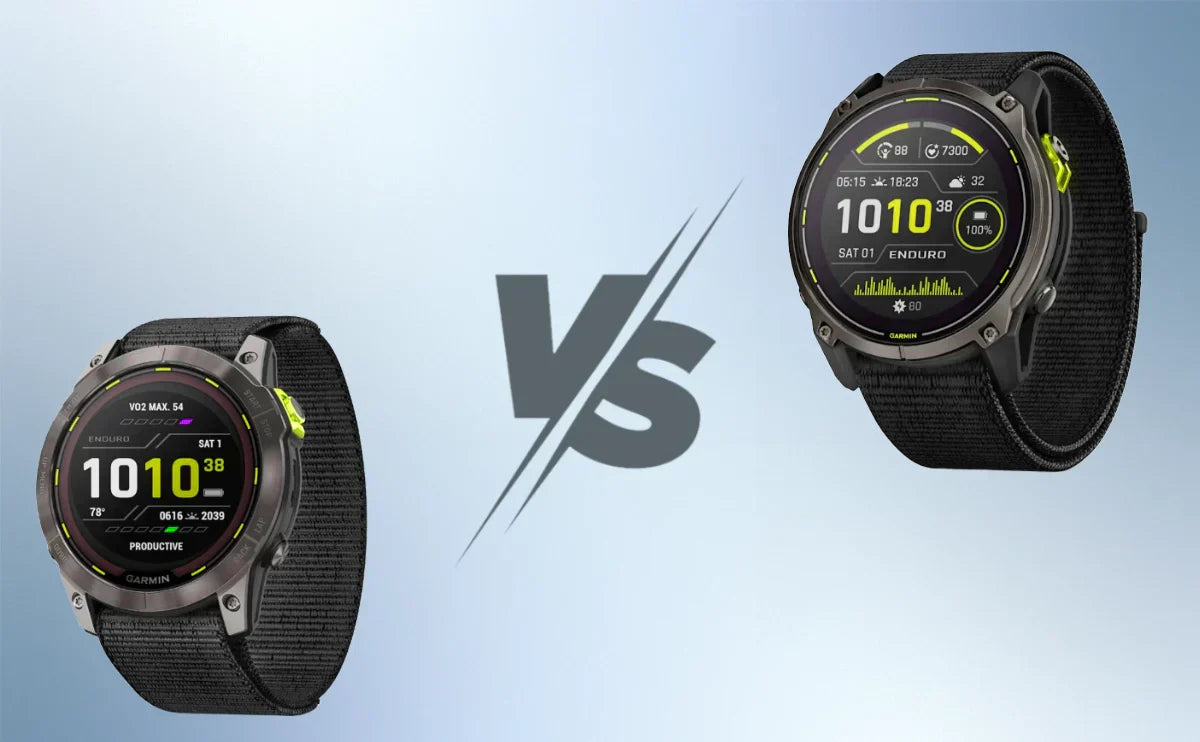
This article compares the Garmin Enduro 2 and Enduro 3, focusing on real-world upgrades like improved battery life, lighter design, and advanced health sensors. It helps you decide if upgrading to Enduro 3 is worthwhile based on your needs.
Main content:
- Quick Verdict (TL;DR) - Which One Should You Choose?
- Garmin Enduro 2 vs Enduro 3 - Specifications
- Garmin Enduro 3 vs 2 - Design, Weight & Comfort for Long-Distance Runners
- Enduro 3 vs 2 Battery Life - Real GPS Performance & Solar Limits
- Enduro 3 vs Enduro 2 Sensors & Health Features - Why Gen 5 Matters
- Software & Navigation - Key Upgrades on Enduro 3 vs Enduro 2
- Garmin Enduro 2 vs 3 Price & Value Comparison
- Conclusion - Should You Upgrade? Make Your Decision
- TL;DR: Enduro 2 vs Enduro 3 – Should You Upgrade?
- FAQs about Garmin Enduro 2 vs 3
If you’re comparing Garmin Enduro 2 vs Enduro 3, chances are you’re either already using the Enduro 2 or seriously considering whether the jump to the third generation is actually worth it.
What makes this decision difficult isn’t the spec sheet. The real question is much more practical: does the Enduro 3 deliver a meaningful upgrade in real-world use, or is it simply a costly iteration with marginal gains? If you want a deeper hands-on breakdown of daily use, battery behavior, and long-term wearability, you can read our Garmin Enduro 3 review.
Most comparison articles focus on listing official specifications side by side. What’s often missing is an upgrade analysis from the perspective of existing Enduro users - one that weighs real performance improvements against price, opportunity cost, and long-term usability.
This article takes a different approach. Instead of repeating numbers, it evaluates the Enduro 2 and Enduro 3 through actual endurance and ultra-distance use cases, clearly outlining:
- which upgrades you will genuinely notice in daily and race conditions
- which changes make little practical difference
- and in which scenarios upgrading simply doesn’t make sense
If your priorities include battery life, weight, sensor accuracy, and whether this generation change truly justifies the investment, this guide is designed to help you reach a clear decision - without unnecessary complexity.
Quick Verdict (TL;DR) - Which One Should You Choose?
If you’re already using the Garmin Enduro 2 and you’re satisfied with its battery life and GPS reliability:
- The Enduro 3 focuses mainly on hardware refinement and algorithm improvements. It’s a noticeable experience upgrade, but not a necessity - sticking with the Enduro 2 is still a perfectly solid choice.
If you prioritize GPS stability, heart rate accuracy, or long-distance wearing comfort:
- The Enduro 3’s updated sensors and reduced weight deliver tangible benefits in ultra-distance races and multi-day outdoor activities.
If you’re buying into the Enduro series for the first time:
- Assuming budget allows, the Enduro 3 offers better long-term value and is the smarter starting point.
Garmin Enduro 2 vs Enduro 3 - Specifications
|
Key Metric |
Garmin Enduro 2 |
Garmin Enduro 3 |
Notes |
|
Case Size |
51 mm |
51 mm |
Same overall footprint |
|
Display |
1.4″ transflective MIP |
1.4″ transflective MIP (improved clarity) |
Clearer display due to removal of overlay |
|
Weight |
~69 g |
~63 g |
Lighter for extended wear |
|
Case Material |
Metal back + titanium bezel |
Polymer back + titanium bezel |
Reduces weight |
|
Heart Rate Sensor |
Previous generation Elevate |
Elevate Gen5 (ECG capable) |
Newer, more efficient sensor |
|
Solar Charging |
Standard solar |
Enhanced solar efficiency |
Better harvesting |
|
GPS |
Multi-band GNSS |
Multi-band GNSS (more stable) |
Slightly better stability |
|
Battery – Smartwatch |
Up to ~34 days / with solar ~46 days |
Up to ~36 days / with solar ~90 days |
Larger solar boost |
|
Battery – GPS Only |
Up to ~110 hrs / with solar ~150 hrs |
Up to ~120 hrs / with solar ~320 hrs |
Big solar impact |
Quick Summary (TL;DR)
The Garmin Enduro 3 retains the same 51 mm display size and core multi-band GNSS, but adds enhanced solar charging, a lighter build, and the newer Gen5 heart rate sensor.
It delivers noticeably stronger solar‑assisted GPS endurance and improved wearable comfort, while everyday smart features and basic tracking remain similar to Enduro 2.
Garmin Enduro 3 vs 2 - Design, Weight & Comfort for Long-Distance Runners
At first glance, the Enduro 3 looks almost identical to the Enduro 2, sharing the same 51 mm case and 1.4‑inch Power Sapphire lens. However, subtle refinements bring meaningful differences for endurance athletes.
Weight Difference → Long-Distance Comfort
Enduro 3 weighs 63 g, down from Enduro 2’s 70 g. While seven grams may seem minor, ultra-distance runners notice less wrist fatigue and reduced arm swing strain on 50K+ trails or multi-day events. Every gram matters in long races, making long-term wear noticeably more comfortable.
Material Changes → Psychological vs Actual Impact
The polymer back in Enduro 3 replaces the Enduro 2’s metal back, while the titanium bezel and Power Sapphire lens maintain durability. Some users initially worry about “premium feel,” but real-world usage confirms scratch resistance and impact protection remain intact. The lighter materials also enhance all-day comfort.
Buttons, Straps & Stability
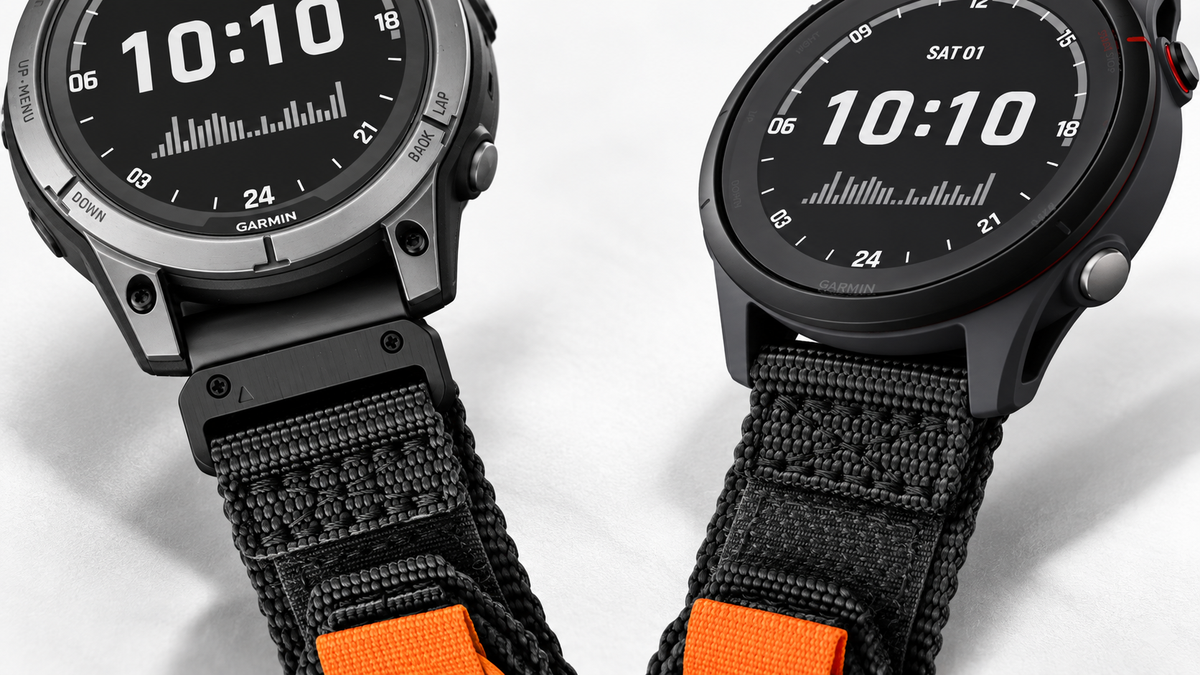
Enduro 3 retains the five-button layout plus a responsive touchscreen. Button feedback is crisp even after hours of continuous activity. The strap is refined for better wrist grip without pressure points, keeping the watch stable during intense movement. For athletes who care about fit and long-term comfort, choosing the right strap also matters — see our guide to Garmin Enduro 3 Watch Bands. For ultra-marathoners and multi-day hikers, this stability is a subtle but essential upgrade.
Quick Summary (TL;DR)
Enduro 3 improves ultra-distance comfort with lighter weight, maintains durability through Power Sapphire lens and refined materials, and enhances wrist stability via updated strap design.

Enduro 3 vs 2 Battery Life - Real GPS Performance & Solar Limits
Official Battery Life vs Real-World Use
Battery life is arguably the most critical feature for endurance athletes. Garmin Enduro 2 set a high bar with GPS mode up to 150 hours and smartwatch mode up to 46 days. Enduro 3 takes this to a new level, claiming GPS mode up to 320 hours and smartwatch mode up to 90 days, more than double the previous generation.
|
Feature |
Enduro 2 |
Enduro 3 |
Real-World Notes |
|
GPS Mode |
150h |
320h |
~6 days vs ~13+ days of continuous GPS use |
|
Smartwatch Mode |
46d |
90d |
Typical smartwatch usage |
|
Solar Boost |
Standard |
2x collection area |
Extends GPS by ~15–20%, not a charger |
Note: Official battery life is measured under ideal conditions. Actual performance depends on GPS usage, heart rate monitoring, and environmental factors.
GPS Full-On Difference
When GPS is fully enabled, battery drain becomes significant. Both Enduro 2 and Enduro 3 feature Garmin SatIQ technology, which optimizes GPS tracking based on your environment - dense forests, open fields, or mountainous trails.
- Enduro 3 GPS full-on: ~320 hours ideal, ~13+ days real-world
- Enduro 2 GPS full-on: ~150 hours ideal, ~6 days real-world
SatIQ ensures accurate location tracking without unnecessary battery drain, making Enduro 3 more dependable for multi-day events and off-grid adventures.
Solar Charging Reality & Limits
Garmin Enduro 3 doubles the solar collection area compared to Enduro 2, using thicker edge solar rings for improved efficiency and better sunlight visibility.
However, it’s important to remember: solar is not a charger - it’s a battery extender.
- Under bright sunlight, solar panels can extend GPS usage by roughly 15–20%
- Solar energy reduces charging frequency but cannot fully recharge the battery
Solar is most useful for long outdoor activities, giving extra hours of tracking and peace of mind, especially in remote environments.
Quick Summary (TL;DR)
Enduro 3 doubles GPS and smartwatch battery life vs Enduro 2, improves reliability with SatIQ, and solar panels extend usage in bright sunlight - but solar is a battery extender, not a charger.

Enduro 3 vs Enduro 2 Sensors & Health Features - Why Gen 5 Matters
Key Hardware Upgrade: Elevate Gen 5 Sensor
The Enduro 3 introduces Garmin’s Elevate Gen 5 optical heart rate sensor, a hardware upgrade that Enduro 2 cannot match.
- Tracks heart rate more accurately during long-distance runs and multi-day hikes.
- Measures wrist temperature, providing insights into stress, recovery, and overall endurance performance.
- Real-world advantage: ultra-endurance athletes report more reliable heart rate readings in varied environments compared to Enduro 2.
FDA-Certified ECG Application
The Enduro 3 supports an FDA-approved ECG app in select regions, a feature unavailable on Enduro 2:
- Users can check for atrial fibrillation (AFib) signs directly from the watch in seconds.
- Data syncs to Garmin Connect for tracking, sharing, and medical review.
- This hardware-limited upgrade is a major reason for athletes or health-conscious users to consider upgrading from Enduro 2.
SatIQ GPS & Environmental Adaptation
Both Enduro 2 and 3 feature Garmin SatIQ, but combined with Gen 5, Enduro 3 delivers more consistent performance:
- Open fields: GPS automatically switches to low-power mode.
- Dense forests/mountains: GPS shifts to high-accuracy mode without excessive battery drain.
- Ensures precise tracking for multi-day hikes, ultra-endurance events, or off-grid adventures.
Additional Upgrades Borrowed from Fenix 8
Enduro 3 incorporates several features from Garmin’s Fenix 8 series:
- Enhanced navigation and mapping tools.
- Dynamic round-trip routing for long outdoor activities.
- Advanced training plans and strength workout tracking.
These improvements, combined with Gen 5 sensor data, give users more actionable health and performance insights. If you’re deciding between these two flagship models, our detailed Garmin Enduro 3 vs Fenix 8 comparison breaks down which watch fits endurance racing versus all-round training better.
Quick Summary (TL;DR)
- Gen 5 sensor + FDA-approved ECG = Enduro 2 cannot match.
- Wrist temperature + heart monitoring = new layer of health insights.
- SatIQ GPS ensures accuracy with minimal battery drain.
- Perfect for ultra-endurance athletes, multi-day hikers, and users focused on heart health.

Software & Navigation - Key Upgrades on Enduro 3 vs Enduro 2
Dynamic Round-trip Routing (New to Enduro 3)
One of the standout features of Enduro 3 is its Dynamic Round-trip Routing, a game-changer for long outdoor adventures. This feature allows the watch to automatically adjust your route based on your progress, ensuring that even if you veer off course, you can still complete the intended distance.
- Enduro 2: Lacks this functionality.
- Enduro 3: Always recalculating the best path, making it more adaptable during ultra-endurance activities.
- User benefit: This feature adds a layer of flexibility for athletes on extended treks, ensuring they don’t get lost or stranded. It’s ideal for adventurers needing a reliable navigational tool.
Next Fork & Up Ahead Navigation (Enduro 3 Only)
Enduro 3 introduces more detailed navigation with features like Next Fork, which tells you the distance and path name of the upcoming fork. Additionally, the Up Ahead feature highlights upcoming checkpoints like rest stations, water supplies, and food.
- Enduro 2: Does not have these features.
- Enduro 3: Gives clear, advanced guidance, crucial for maintaining pace during long-distance activities.
- User benefit: These navigation tools offer a more intuitive experience, reducing the likelihood of getting off-track during long adventures.
Enhanced GPS Accuracy with SatIQ (Both Enduro 2 & 3)
Both models benefit from SatIQ technology, which dynamically adjusts GPS performance based on environmental conditions.
- Enduro 2 & 3: Automatically switches to low-power GPS in open spaces and to higher-accuracy mode in challenging environments (dense forests, mountainous areas).
- User benefit: This ensures battery life optimization without sacrificing location precision, making these watches reliable for multi-day adventures and tough terrain.
Strength Training & Activity Tracking Enhancements (Enduro 3 vs Enduro 2)
Enduro 3 is more focused on overall fitness tracking with its upgraded strength training plans and activity countdown applications. These new additions, alongside a revamped user interface, ensure data is easy to access and analyze.
- Enduro 2: Lacks integrated strength training features.
- Enduro 3: Adds a comprehensive workout tracking suite, ideal for athletes combining endurance training with strength workouts.
- User benefit: For multi-sport athletes or those seeking a more detailed fitness plan, this upgrade supports cross-discipline training, pushing performance to the next level.
UI & Training Metrics (Enduro 3's Fenix 8 Features)
Enduro 3 borrows some of the best features from the Garmin Fenix 8, including an updated UI, new maps, and improved training metrics.
- Enduro 2: Does not include Fenix 8’s enhanced features.
- Enduro 3: Delivers an upgraded UI and more detailed performance analysis, including VO2 Max, training load, and recovery time.
- User benefit: For athletes focused on detailed performance analysis, these metrics allow for tailored recovery and efficient training, providing more value over time.
Quick Summary (TL;DR)
- Dynamic Round-trip Routing & Next Fork are exclusive to Enduro 3, improving navigation in challenging terrains.
- SatIQ ensures battery-saving GPS adjustments, available on both models.
- Strength training and advanced fitness features are new on Enduro 3, expanding its capabilities beyond just endurance tracking.
- Enduro 3: Ideal for those seeking comprehensive fitness tracking, superior navigation, and advanced training support.
- Enduro 2: Still powerful for basic endurance tracking but lacks key software and navigational advancements.

Garmin Enduro 2 vs 3 Price & Value Comparison
Garmin Enduro 3 is now available at £769.99 in the UK and $899.99 in the US. Interestingly, the US launch price is actually lower than Enduro 2’s original $999.99 release, making the newer model more accessible. In the UK, Enduro 2 is only slightly cheaper at £729.99, narrowing the price gap.
Considering the substantial upgrades - lighter weight, extended battery life, improved health monitoring, and FDA-certified ECG - the modest price difference makes Enduro 3 a clear choice for most buyers.
For current Enduro 2 users, upgrading depends on whether these improvements matter to you. If extreme endurance performance, ultra-long battery life, and advanced health tracking are priorities, the Enduro 3’s value justifies the investment.
With Enduro 3 already on the market, Enduro 2 is now often available at discounted prices, providing an alternative for users who are less concerned with the newest features or extreme endurance requirements.
Quick Summary (TL;DR):
Enduro 3 offers significant upgrades for a modest price increase, especially in the US. Enduro 2 remains a cheaper alternative, but lacks the enhanced battery, health sensors, and ECG support.
Conclusion - Should You Upgrade? Make Your Decision
Both the Enduro 2 and Enduro 3 are high-performance Garmin watches designed for endurance athletes and outdoor adventurers, but their features and focus differ significantly. If you are an Enduro 2 owner and are satisfied with its battery life and GPS performance, upgrading to the Enduro 3 is appealing but not essential. The main improvements - lighter design and enhanced health monitoring, including ECG - may not be critical if you don’t need them, and the Enduro 2 remains perfectly capable for extreme challenges.
For Fenix series users, who prioritize professional health monitoring and longer battery life, the Enduro 3 is worth considering. Runners coming from lighter performance watches may also want to see how it compares in our Garmin Enduro 3 vs Garmin Forerunner 970 guide. The new Gen 5 heart rate sensor and FDA-approved ECG app provide valuable insights for heart health, while improvements in GPS accuracy and solar charging efficiency make it more reliable for multi-day adventures.
If you are an ultra-marathoner or spend extended periods outdoors, the Enduro 3 is tailored for you. Its lighter build, extended battery, and reliable GPS and health tracking are critical for extreme endurance sports, helping you perform efficiently in challenging conditions.
One-Sentence Takeaway
If you are an Enduro 2 user and your battery and GPS needs are met, the Enduro 3 is an experience upgrade, not a necessity. If you need longer battery life, advanced heart monitoring, and stronger navigation features, the Enduro 3 is ideal, especially for Fenix users and ultra-distance athletes. For first-time buyers, the Enduro 3 offers better long-term value and higher overall performance.
TL;DR: Enduro 2 vs Enduro 3 – Should You Upgrade?
Enduro 3 offers enhanced solar-assisted battery, a Gen 5 heart rate sensor, and FDA-approved ECG, making it the best choice for ultra-distance athletes and those spending long hours outdoors. Compared to Enduro 2, it delivers noticeable improvements in GPS stability, heart health monitoring, and endurance performance.
If you are already an Enduro 2 user and your battery and GPS performance are sufficient, upgrading is mainly about the experience, and the price difference is modest. For Fenix users or multi-day adventurers, Enduro 3 is clearly the smarter choice, offering more value, comfort, and advanced features for extreme endurance and performance tracking.
FAQs about Garmin Enduro 2 vs 3
What’s the main difference between Garmin Enduro 2 and Enduro 3?
Enduro 3 features a lighter build, improved solar charging, longer battery life (up to 320 hours GPS), and advanced sensors like the Gen 5 heart rate sensor with ECG, which Enduro 2 lacks.
Is it worth upgrading from Enduro 2 to Enduro 3?
If you prioritize longer battery life, more accurate sensors, and ECG tracking, Enduro 3 is a worthwhile upgrade. If basic endurance tracking suffices, Enduro 2 still performs well.
How much better is the battery life on Enduro 3 compared to Enduro 2?
Enduro 3 offers up to 320 hours in GPS mode and 90 days in smartwatch mode, a significant upgrade over Enduro 2's 150 hours and 46 days, respectively.
Do Enduro 2 and Enduro 3 use the same heart rate sensor?
No, Enduro 3 uses the newer Elevate Gen 5 sensor with ECG and wrist temperature tracking, while Enduro 2 has an older sensor.
How do the prices of Enduro 2 and Enduro 3 compare?
Enduro 3 launched at $899.99 in the US and £769.99 in the UK, priced lower than Enduro 2’s original $999–$1099. Enduro 3 now offers more features at a competitive price.
Is the display on Enduro 3 better than Enduro 2?
Enduro 3 has a clearer display due to the removal of the solar layer overlay, making it easier to read in sunlight, though both use a 1.4″ transflective MIP screen.
Are there any downsides to the Enduro 3 build compared to Enduro 2?
Some users prefer the premium feel of Enduro 2’s metal back. Enduro 3 uses a polymer back, but still maintains durability, with a lighter overall weight for comfort.
Will Enduro 2 receive Enduro 3 features through software updates?
No. Key features like the new Gen 5 sensor, enhanced solar efficiency, and ECG support are hardware-dependent and cannot be added to Enduro 2 via software updates.

Share:
Apple Watch Series 6 vs Series 5 - Is the Upgrade Worth the Extra Money?
Garmin Fenix 8 Pro vs Fenix 7 Pro - Which One Is Worth Buying in 2026?