

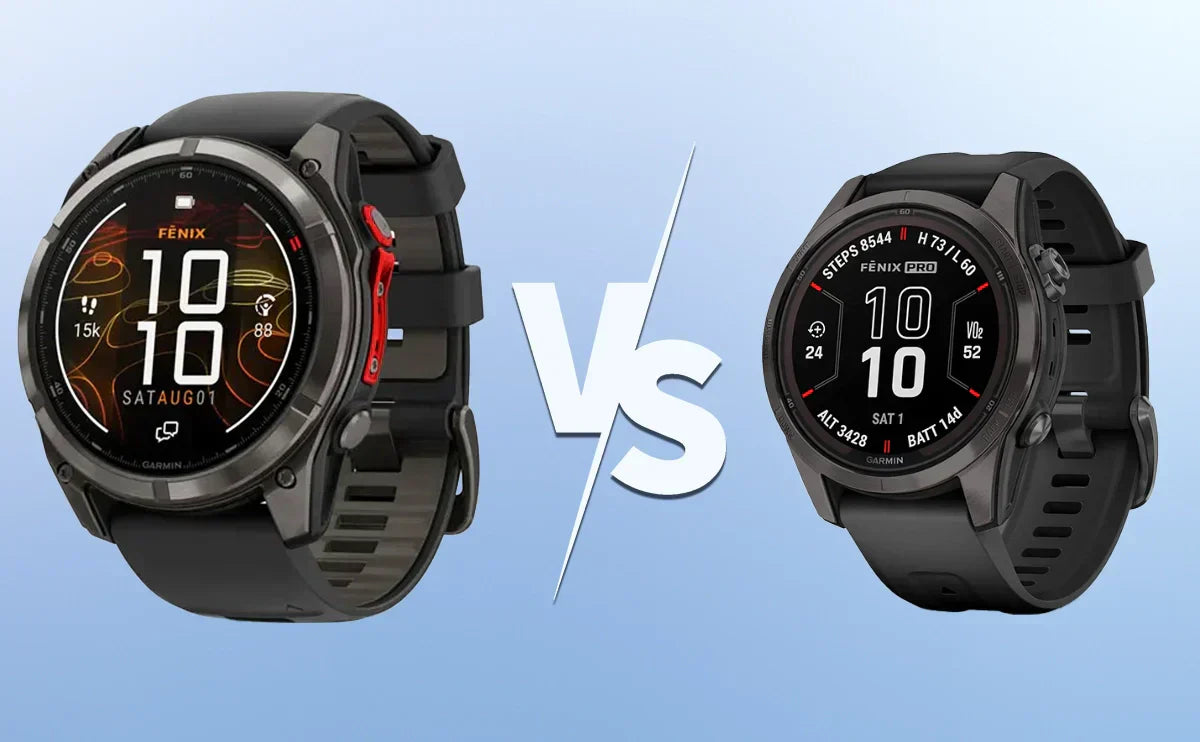
This article compares Garmin Fenix 8 Pro and Fenix 7 Pro from a real-world decision perspective, not just specs. It focuses on who should buy which model in 2026 based on safety, battery life, display technology, and value.
Main content:
- Quick Verdict
- The 30-Second Buying Decision Table
- Price & Value — What Are You Paying For?
- Breaking the Premium Into Three Clear Costs
- Safety & Communication (Satellite + Cellular)
- Display & Daily Experience (AMOLED / MicroLED)
- The Trade-Offs
- Price Reality Check
- Core Differences at a Glance — Garmin Fenix 8 Pro vs Fenix 7 Pro
- Which Screen Should You Choose? AMOLED vs MIP Solar
- Strong Sunlight (Mountains, Snow, Long Outdoor Exposure)
- Daily Use & Training (City, Running, Gym)
- Battery Trade-Offs in Real Life
- A Subtle but Important Upgrade — Buttons
- Quick Recommendation
- Connectivity & Safety — What Problem Does the Fenix 8 Pro Actually Solve?
- What can the Fenix 8 Pro do without a phone?
- Real-world scenario: why this matters
- Costs and practical considerations
- One-sentence takeaway
- Diving & Durability — Who Does the 40 m Dive Rating Actually Matter For?
- Button Feel, Fit, and Long-Term Reliability
- Why some users describe the buttons as “soft”
- Fit and practical upgrades
- How to interpret these differences
- Training, GPS, and Health Sensors — Where Do Most People Actually Feel the Difference?
- Running, Cycling, Trail Use — Will You Notice the Difference?
- If you’re detail-oriented about data
- If you just want reliable training
- When the Fenix 7 Pro Is Actually the Smarter Choice
- Bottom line
- Software & Long-Term Support — What Does a New Platform Really Mean?
- Why newer models usually have a longer software runway
- Why some users still prefer the Fenix 7 Pro
- How to think about this decision
- Final Recommendation — Which Garmin Fenix Should You Buy?
- FAQs about Garmin Fenix 8 Pro vs Fenix 7 Pro
If you’re deciding between Garmin Fenix 8 Pro and Fenix 7 Pro, the real question isn’t specs- it’s whether the $300–$400 price difference is worth paying.
The answer is straightforward- Fenix 8 Pro is better suited for users who need standalone communication and maximum safety, while Fenix 7 Pro remains the smarter choice for most runners and outdoor athletes. The 8 Pro focuses on independent calling, two-way messaging, and SOS, whereas the 7 Pro stands out for its proven stability, excellent battery life, and increasingly attractive pricing. If you want the full breakdown, see our Garmin Fenix 8 Pro Review.
This article skips spec-sheet noise and helps you avoid overpaying, match the watch to your real needs, and choose the right Fenix in 2026.
Quick Verdict
If you need off-grid communication without your phone — including voice calls, two-way messaging, and SOS — or you want the best possible display experience with the MicroLED version, the premium price of Garmin Fenix 8 Pro is justified.
But if your main use cases are running, hiking, and structured training, and you care more about battery life, proven stability, and better value, then Fenix 7 Pro remains the more cost-effective choice — especially at today’s discounted prices.
In short, Fenix 8 Pro is about maximum safety and next-gen features, while Fenix 7 Pro is about efficiency, maturity, and value.
Buy Fenix 8 Pro if
You need standalone communication, SOS safety features, diving support, or the clearest possible display in harsh environments.
Buy Fenix 7 Pro if
You prioritize battery life, firmware stability, and the best value for running and outdoor training. For a deeper look at why it still holds up, see our Garmin Fenix 7 Pro Review.
The 30-Second Buying Decision Table
This is the fastest way to decide which Garmin Fenix you should buy, without reading the entire article.
Which Type of User Are You? Match Yourself Below
|
If this sounds like you… |
You should choose |
|
You often hike solo, go off-grid, or do long backcountry trips and want communication even without phone signal |
Fenix 8 Pro |
|
You want the brightest, most readable screen for harsh sunlight and quick glances |
Fenix 8 Pro (MicroLED) |
|
You mainly do daily training, running, or hiking, and care about battery life and price |
Fenix 7 Pro |
|
You don’t want to be an early adopter and prefer mature firmware and stability |
Fenix 7 Pro (or wait for later 8 Pro updates) |
Price &Value — What Are You Paying For?
The price gap between Fenix 8 Pro and Fenix 7 Pro is significant. What matters is how that premium translates into real value, not just a higher spec sheet.
Breaking the Premium Into Three Clear Costs
Safety & Communication (Satellite + Cellular)
Fenix 8 Pro adds standalone voice calls, two-way messaging, and SOS without a phone. This is the core upgrade- and the main reason for the higher price.
Keep in mind- these features require a service subscription, so the total cost goes beyond the watch itself.
Display & Daily Experience (AMOLED / MicroLED)
You’re also paying for a brighter, more modern display. AMOLED improves everyday readability, while MicroLED excels in strong sunlight. It looks better, but it doesn’t directly improve training or fitness outcomes.
The Trade-Offs
The premium comes with much higher launch pricing, possible battery-life compromises versus the solar-focused 7 Pro, and less long-term firmware maturity.
Price Reality Check
- The Fenix 7 Pro, now two years old, is commonly discounted to around £579 (47mm) and £659 (51mm).
- The Fenix 8 Pro starts at about £1,119 for the 47mm AMOLED model, with MicroLED versions reaching roughly £1,729.
Bottom line- you’re paying for communication independence and display technology. If you don’t need those, the value drops fast.

Core Differences at a Glance — Garmin Fenix 8 Pro vs Fenix 7 Pro
This table focuses on real-world decisions- each row starts with a usage scenario, shows what each model does best, and ends with who it’s actually for.
Decision-Focused Comparison Table
|
What affects you most (real scenario) |
Fenix 8 Pro |
Fenix 7 Pro |
Who it fits best |
|
You need to call or message without carrying your phone |
Standalone satellite + cellular communication- voice calls, two-way messaging, SOS |
Phone-dependent for calls and messages |
Solo, off-grid users → 8 Pro |
|
You want a screen that’s easy to read at a glance in strong light |
AMOLED or MicroLED options with higher brightness and contrast |
MIP Solar-focused- always readable, very power-efficient |
Screen clarity → 8 Pro; endurance → 7 Pro |
|
You care most about battery life on long trips |
Battery life varies with display type and always-on use |
More predictable endurance, especially with Solar editions |
Long expeditions → 7 Pro |
|
You plan to swim frequently or do recreational diving |
Dive-rated to 40m (new capability highlighted in reviews) |
Not dive-rated in the same way |
Water-heavy use → 8 / 8 Pro |
|
You prefer stability over being an early adopter |
Newer platform with more features, more complexity |
Mature, well-tested firmware |
“Set and forget” users → 7 Pro |
Quick takeaway
Choose Fenix 8 Pro for communication independence, display quality, and new capabilities; choose Fenix 7 Pro for battery endurance, stability, and value.
Which Screen Should You Choose? AMOLED vs MIP Solar
Between Fenix 7 Pro and Fenix 8 Pro, the screen is the single biggest factor that changes everyday experience. The right choice depends less on specs and more on where and how you use the watch.
Strong Sunlight (Mountains, Snow, Long Outdoor Exposure)
MIP Solar (Fenix 7 Pro) is easier to live with.
Strong Sunlight (Mountains, Snow, Long Outdoor Exposure)
In direct sunlight, MIP displays rely on ambient light reflection, meaning the brighter it gets, the clearer the screen looks. Visibility is stable even with polarized sunglasses, and power consumption stays extremely low. For hiking, mountaineering, and long days outdoors, this translates into less distraction and fewer battery concerns.
Daily Use & Training (City, Running, Gym)
AMOLED (Fenix 8 Pro) looks noticeably better.
Colors are richer, contrast is higher, and the interface feels more modern. A quick wrist raise is usually enough to read data, especially during early-morning runs, night workouts, or indoor training. The trade-off is higher power draw- always-on display significantly reduces battery life compared with MIP.
Battery Trade-Offs in Real Life
- MIP Solar (7 Pro)- Always-on by design, extremely power-efficient, and ideal if you don’t want to think about charging.
- AMOLED (8 Pro)- Turning off always-on display restores solid battery life, but usability depends more on wrist-gesture responsiveness.
A Subtle but Important Upgrade — Buttons
Fenix 8 Pro introduces sealed, pressure-sensitive buttons, addressing a long-standing issue on earlier models where sand, mud, or water could degrade button feel over time. For users who train or travel in wet, snowy, or dirty conditions, this improves long-term reliability more than it might seem on paper.
Quick Recommendation
- Strong sunlight + maximum battery confidence → Fenix 7 Pro (MIP Solar)
- Everyday wear + visual clarity → Fenix 8 Pro (AMOLED)
- Considering the MicroLED version? It only makes sense if extreme sunlight readability is a top priority and price or battery life is secondary.
This isn’t about which screen is “better”- it’s about which one fits your environment and habits.

Connectivity & Safety — What Problem Does the Fenix 8 Pro Actually Solve?
Connectivity and safety are a fundamental, hardware-level advantage of Fenix 8 Pro over Fenix 7 Pro. If you’re comparing the two 8-series models, see Garmin Fenix 8 vs. Garmin Fenix 8 Pro.
What can the Fenix 8 Pro do without a phone?
The Fenix 8 Pro is the first Fenix watch to fully integrate Garmin’s inReach satellite technology directly into the watch. Without relying on a smartphone, it can connect via satellite or LTE to perform the following:
- Voice calls directly from the wrist
- Two-way messaging with contacts
- LiveTrack location sharing
- SOS emergency alerts
When SOS is activated, the watch contacts the Garmin Response Center, which maintains communication with the wearer, notifies emergency contacts, and coordinates rescue services. Garmin also notes that satellite communication devices may be subject to regulatory restrictions, and availability can vary by country or region.
By comparison, Fenix 7 Pro relies entirely on Bluetooth pairing with a phone. While its GPS performance and SatIQ positioning are excellent, it offers no built-in satellite or standalone communication capability.
Real-world scenario: why this matters
In remote areas, if your phone has no signal or battery, Fenix 8 Pro can still send messages or trigger SOS, share your location, and alert the Garmin Response Center- keeping you connected when your phone fails.
Costs and practical considerations
It’s important to be clear: satellite and standalone communication typically require an active service or subscription, and coverage varies by region. The higher price of the Fenix 8 Pro reflects not only the hardware, but access to this safety and connectivity ecosystem.
If you rarely venture beyond cellular coverage or almost always carry a working phone, the practical value of these features drops significantly.
One-sentence takeaway
The Fenix 8 Pro isn’t more expensive because it trains you better- it’s more expensive because it can keep you connected when your phone can’t.

Diving & Durability — Who Does the 40 m Dive Rating Actually Matter For?
The 40-meter dive rating on the Fenix 8 Pro is not a cosmetic upgrade. It represents a clear functional difference between the Fenix 8 Pro and Fenix 7 Pro, especially for users who regularly operate underwater.
Who actually needs it?
If you do scuba diving, freediving, or spend significant time underwater, the Fenix 8 Pro offers meaningful advantages.
It supports dives down to 40 meters, meets the EN13319 dive accessory standard, and can record basic dive metrics such as depth and duration through Garmin’s Dive app. Just as important, it uses sealed, pressure-sensitive buttons, which are easier to operate underwater and reduce the risk of water intrusion.
Who doesn’t?
If your water use is limited to swimming, occasional snorkeling, or river crossings, the dive rating itself adds little practical value. Both the Fenix 7 Pro and Fenix 8 Pro are rated to 100 meters of water resistance, which already covers most non-diving activities.
Why dive capability changes the design
Achieving true dive certification requires engineering trade-offs. To improve underwater reliability, the Fenix 8 Pro uses a more tightly sealed case, thicker construction, revised button mechanisms, and a metal sensor guard to protect exposed components. These changes prioritize sealing consistency and durability over traditional mechanical feel.
Button Feel, Fit, and Long-Term Reliability
Design decisions made for water resistance and durability directly affect everyday interaction.
Why some users describe the buttons as “soft”
The Fenix 8 Pro replaces traditional mechanical buttons with inductive, pressure-sensitive inputs, eliminating moving parts that could allow water ingress. As a result, button presses feel less crisp than on the Fenix 7 Pro, and actions like double-pressing to activate the flashlight may require more deliberate input.
By comparison, the Fenix 7 Pro’s physical buttons offer clearer tactile feedback, which many users still prefer for daily navigation.
Fit and practical upgrades
The Fenix 8 Pro sits slightly closer to the wrist, making it easier to wear under sleeves. It also adds a built-in microphone and speaker, enabling calls and voice interactions directly from the watch- useful when your hands are occupied.
How to interpret these differences
- Fenix 8 Pro prioritizes underwater reliability and structural sealing, with some compromise in button feel.
- Fenix 7 Pro favors traditional controls and tactile feedback, without support for diving or advanced sealing requirements.

Training, GPS, and Health Sensors — Where Do Most People Actually Feel the Difference?
When it comes to training features, GPS accuracy, and health sensors, the gap between Fenix 7 Pro and Fenix 8 Pro is much smaller than many spec sheets suggest. The real question isn’t which one is stronger, but whether the differences will actually affect your training.
Running, Cycling, Trail Use — Will You Notice the Difference?
If you’re detail-oriented about data
You’re more likely to notice differences in areas like heart rate stability, pace consistency, and GPS drift in difficult environments such as dense forests, deep valleys, or urban areas with tall buildings.
In these situations, Fenix 8 Pro’s broader satellite support and dual-frequency positioning can deliver slightly more stable tracks. Features like dynamic round-trip routing, strength-focused training plans, and ski run timing also add value if you enjoy experimenting with new training tools.
If you just want reliable training
For most runners, cyclists, and hikers, both watches already perform at a very high level. They share Garmin’s mature training and health ecosystem, including endurance and hill scores, recovery guidance, training load analysis, ECG, sleep coaching, and SatIQ GPS optimization.
In day-to-day use, the training experience is far more similar than different- and for most users, screen choice, connectivity, and battery strategy matter much more than marginal training upgrades.
When the Fenix 7 Pro Is Actually the Smarter Choice
There are clear cases where Fenix 7 Pro makes more sense:
- You value proven firmware and long-term stability over new features
- You want Garmin’s full training and health experience without paying for the latest additions
- You prioritize battery life and value, especially with the Fenix 7 Pro Solar, which remains highly competitive for long trips and multi-day activities
With current pricing, the 7 Pro often delivers better performance per dollar, while sacrificing very little in real-world training capability. If you’re also deciding between the two 7-series options, see Garmin Fenix 7 vs Fenix 7 Pro.
Bottom line
- Fenix 8 Pro is better suited for users who want the newest training tools and slightly stronger performance in complex GPS environments
- Fenix 7 Pro remains a top-tier training watch, and for most people, the difference in training quality is minimal
If your main concern is whether one will make you train significantly better than the other, the answer is simple: they won’t. The biggest differences between these two watches still lie outside training- in connectivity, display technology, and battery philosophy, not in core athletic performance.

Software & Long-Term Support — What Does a New Platform Really Mean?
When choosing between Fenix 7 Pro and Fenix 8 Pro, long-term software support is an understandable concern. Garmin doesn’t publish fixed update timelines, so the best approach is reasoned expectation rather than promises.
Why newer models usually have a longer software runway
In practice, newer hardware platforms tend to be where new features first appear and continue to evolve. Capabilities like standalone communication, diving support, and revised input systems don’t arrive fully finished on day one- they are refined through ongoing updates.
That doesn’t mean older models are immediately left behind. But it’s reasonable to expect that Fenix 8 Pro will receive more frequent feature refinements and deeper system-level updates, simply because it is the platform Garmin is actively building on.
This is not a guarantee of update length- it’s a reflection of how product lifecycles typically work.
Why some users still prefer the Fenix 7 Pro
The flip side of a new platform is maturity.
Early in a product’s life, firmware updates often focus on stability, edge cases, and interaction refinement. That adjustment period is normal, but not everyone wants to be part of it.
Fenix 7 Pro benefits from a well-established software base that has already been tested by a large user community over time. Features are predictable, bugs are well understood, and day-to-day behavior is consistent.
For users who value stability over future expansion, or who simply want a watch that feels “settled,” the 7 Pro can be the safer and more comfortable choice.
How to think about this decision
- Fenix 8 Pro favors long-term evolution and new capabilities, with the understanding that early software may continue to mature.
- Fenix 7 Pro favors proven reliability and a stable experience, with fewer surprises.
- Neither approach is inherently better- the right choice depends on whether you prioritize future flexibility or immediate certainty.

Final Recommendation — Which Garmin Fenix Should You Buy?
After comparing price, display, connectivity, durability, training features, and long-term support, the choice between Garmin Fenix 8 Pro and Fenix 7 Pro becomes very clear once you map those differences to how you actually use the watch.
Use the profiles below to make the final call.
You go solo outdoors and prioritize safety
→ Choose: Fenix 8 Pro
If you hike, trail run, or explore remote areas alone, standalone voice calls, two-way messaging, location sharing, and SOS without a phone are not “nice to have” features- they’re the reason to buy the 8 Pro.
You dive or spend meaningful time underwater
→ Choose: Fenix 8 Pro
The 40 m dive rating and dive-specific design are real functional upgrades. If scuba or freediving is part of your routine, the 7 Pro simply isn’t built for this.
You struggle with screen readability in harsh light
→ Choose: Fenix 8 Pro (MicroLED)
If you’re often in snow, desert, or high-glare environments and screen clarity matters more than price or battery life, the MicroLED version exists specifically for this use case. It’s expensive, but purpose-built.
You’re budget-sensitive and want the best value
→ Choose: Fenix 7 Pro
With frequent discounts and a mature, reliable platform, the 7 Pro delivers nearly the full Garmin experience at a much lower cost- especially if you don’t need standalone communication. For strap options and sizing, see Garmin Fenix 7 Pro Watch Bands.
You run ultras or prioritize extreme battery life
→ Choose: Fenix 7 Pro Solar
For multi-day events, long expeditions, or anyone who hates charging, the Solar MIP display and predictable endurance remain hard to beat.
You’re switching from Apple Watch to Garmin
→ It depends
If you rely heavily on calls and smartwatch-style interaction, the Fenix 8 Pro will feel more familiar thanks to built-in voice calling and a modern display.
If your goal is to move away from phone dependence and focus on training and outdoors, the Fenix 7 Pro is already more than sufficient.
The simplest way to decide
- Fenix 8 Pro is about safety, communication, and future-facing capabilities
- Fenix 7 Pro is about stability, battery life, and value
Neither choice is wrong. The right one is the watch that solves your problem- without paying for features you won’t use.
FAQs about Garmin Fenix 8 Pro vs Fenix 7 Pro
Is the Fenix 8 Pro worth the extra money?
Yes, but only if you need standalone communication, advanced safety features, or the newest display technology; otherwise, the Fenix 7 Pro offers better value.
Who is the MicroLED version actually for?
The MicroLED version is best for users who spend a lot of time in extreme glare environments like snow or desert and need maximum readability regardless of cost or battery life.
Is the Fenix 8 Pro still worth buying without a subscription?
Yes, because you still get the hardware, display, dive rating, and training features, but its biggest advantage—satellite communication—loses much of its value without a service plan.
Will the Fenix 7 Pro be outdated soon?
No, the Fenix 7 Pro is a mature platform that will remain fully functional for years, even if it receives fewer new features over time.
Is the battery life on the Fenix 8 Pro bad?
Battery life depends heavily on display settings, and enabling always-on display on AMOLED or MicroLED will significantly reduce runtime compared to MIP Solar models.
Can I use my Fenix 7 Pro bands on the Fenix 8 Pro?
Yes, as long as the case size matches, both models use Garmin’s standard QuickFit bands. If you’re shopping straps, see Garmin Fenix 8 Pro Watch Bands.
Does the diving feature matter if I only swim?
No, casual swimmers won’t benefit much from the 40 m dive rating, since both watches are already water-resistant enough for swimming.
If I mainly run or work out, is the Pro overkill?
For most runners and gym users, the Pro features won’t improve training results, making the Fenix 7 Pro the more sensible choice.

Share:
Garmin Enduro 2 vs 3 - The Upgrade Truth Every Endurance Athlete Needs
Garmin Forerunner 265 vs 265s - Which Size, Battery Life, and Screen Fits Your Wrist Best