

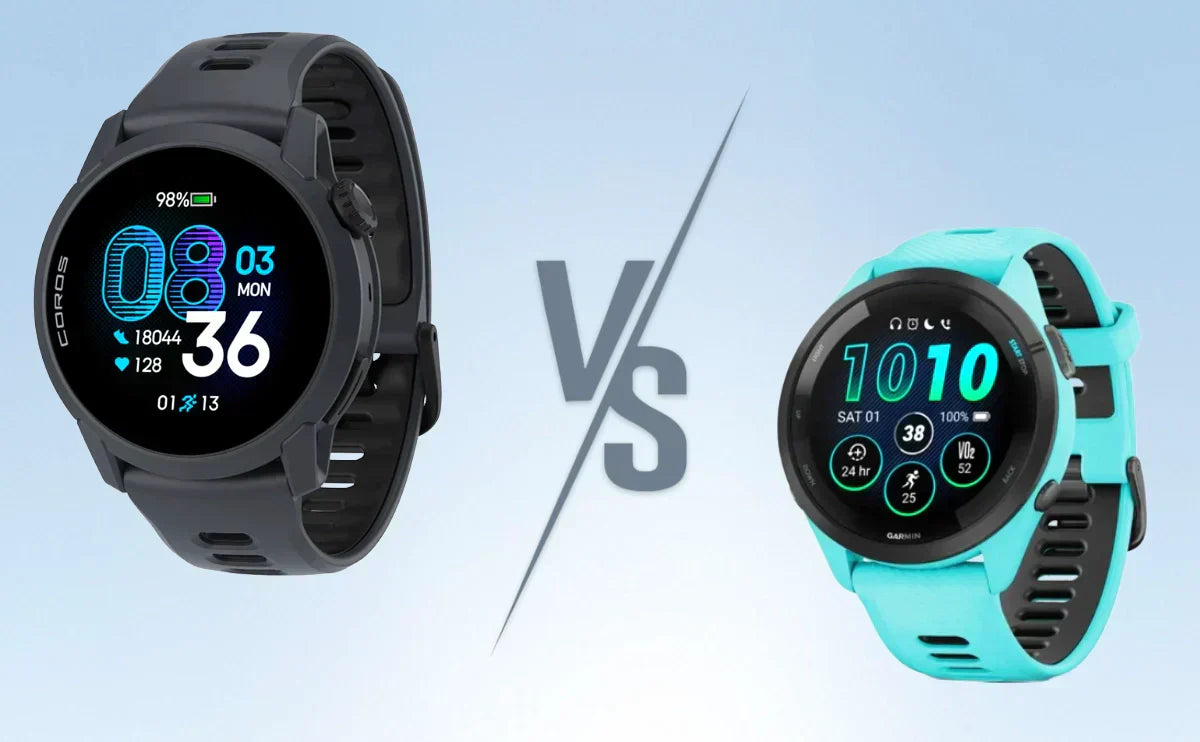
This comparison evaluates Coros Pace 4 and Garmin Forerunner 265 across GPS accuracy, heart rate tracking, battery performance, training metrics, and smart features. Coros emphasizes battery efficiency and value, while Garmin provides deeper recovery insights and ecosystem integration.
Main content:
- Quick Verdict – Coros Pace 4 vs Garmin Forerunner 265
- Specs Comparison – Coros Pace 4 vs Garmin Forerunner 265
- GPS Accuracy – Which Watch Tracks Distance Better?
- Multi-Band GPS & Satellite Support
- City Running – Stability in Dense Environments
- Trail & Elevation Tracking Performance
- Final GPS Accuracy Verdict
- Design & Comfort – Which Feels Better on the Wrist?
- Display Visibility & Outdoor Use (AMOLED Performance)
- Weight, Fit & Control System
- Design & Comfort Verdict
- Heart Rate & Training Metrics – Accuracy and Algorithm Depth
- Heart Rate Accuracy & Chest Strap Use
- Training Algorithms, VO2 Max & Marathon Support
- Final Verdict on Heart Rate & Training Metrics
- App & Ecosystem – Garmin Connect vs Coros App
- Smart Features – Beyond Running Performance
- Battery Life – Real-World Endurance vs Official Claims
- Battery Life Comparison (Real-World Use)
- Marathon & Ultra-Endurance Performance
- Charging Speed & Efficiency
- Battery Life Verdict
- Long-Term Value & Real-World Feedback
- Software Updates & Ecosystem Longevity
- Durability, Resale & Why Runners Switch
- Real-World Pros & Cons
- Long-Term Value Verdict
- Final Conclusion – Which Should You Actually Buy?
- FAQs about Coros Pace 4 vs Garmin Forerunner 265
If you're choosing between the Coros Pace 4 and Garmin Forerunner 265, you're likely looking for the best balance of performance, battery life, and training intelligence — without overspending.
Both watches offer dual-band GPS, advanced running metrics, and marathon-ready features. Both watches offer dual-band GPS, advanced running metrics, and marathon-ready features — and if you want a deeper breakdown of Garmin’s training tools, display, and day-to-day experience, check our Garmin Forerunner 265 review. On paper, they seem close. In real-world use, however, they serve different types of runners.
This guide breaks down GPS accuracy, heart rate reliability, training algorithms, battery life, smart features, and long-term value — so you can confidently choose the right watch for how you actually train.
Let’s get straight to the answer.
Quick Verdict – Coros Pace 4 vs Garmin Forerunner 265
Best value performance watch → Coros Pace 4
Delivers excellent dual-band GPS accuracy, long battery life, lightweight comfort, and strong core training metrics at a lower price.
Best all-in-one running smartwatch → Garmin Forerunner 265
Adds advanced recovery tools, Training Readiness, race prediction features, music streaming, and Garmin Pay within a broader ecosystem.
Which Is Better for You?
Choose Coros Pace 4 if:
- You want maximum battery life and a lightweight feel
- You prioritize running performance over smartwatch extras
- You want strong training metrics without paying a premium
Choose Garmin Forerunner 265 if:
- You rely on recovery guidance and structured race preparation
- You want music streaming and contactless payments
- You prefer a deeper ecosystem with more analytics and integrations
Is Garmin 265 Worth the Extra $100+?
- Yes — if you actively use recovery metrics, race prediction tools, music features, and Garmin Pay.
- No — if your main priorities are accurate GPS tracking, reliable heart rate data, and long battery endurance for training.
There is no major difference in core GPS accuracy. The price gap reflects ecosystem depth and smartwatch features rather than raw tracking performance.
Best Use Case Breakdown
5K / 10K training → Coros Pace 4
Marathon training with recovery guidance → Garmin Forerunner 265
Daily wear with music and smart features → Garmin Forerunner 265
Ultra-distance or long battery priority → Coros Pace 4
Specs Comparison – Coros Pace 4 vs Garmin Forerunner 265
The table below compares Coros Pace 4 and Garmin Forerunner 265 across key specifications including battery life, GPS support, display type, connectivity, and smart features. If you’re deciding within Garmin’s lineup, our Garmin Forerunner 265 vs Forerunner 255 comparison explains what you actually gain (AMOLED, training tools, daily readiness) for the price jump.
|
Feature |
Coros Pace 4 |
Garmin Forerunner 265 |
|
Price (MSRP) |
~$249 |
~$449 |
|
Weight |
32g (nylon) / 40g (silicone) |
39g (265S) / 47g (265) |
|
Thickness |
~11.8 mm |
~12.9 mm |
|
Display Type |
1.2″ AMOLED |
1.1″ (265S) / 1.3″ (265) AMOLED |
|
Resolution |
390 × 390 |
360 × 360 (265S) / 416 × 416 (265) |
|
Battery – Smartwatch Mode |
Up to 19 days |
Up to 13–15 days |
|
Battery – GPS Mode |
Up to 31–41 hours (mode dependent) |
Up to 20–24 hours (mode dependent) |
|
Battery – Dual Band GPS |
Yes |
Yes |
|
GPS Support |
Multi-GNSS + Dual Frequency |
Multi-GNSS + Dual Frequency (SatIQ) |
|
Music Storage |
Yes (offline MP3 only; no streaming) |
Yes (8GB; Spotify, Deezer, Amazon Music support) |
|
Contactless Payment |
No |
Yes (Garmin Pay) |
|
External Sensor Support |
Bluetooth only |
Bluetooth + ANT+ |
|
Touchscreen |
Yes |
Yes |
GPS Accuracy – Which Watch Tracks Distance Better?
When it comes to GPS accuracy, both the Coros Pace 4 and Garmin Forerunner 265 operate at a very high level. Both support dual-frequency multi-GNSS, and in open-road running, the difference in recorded distance is minimal.
However, small differences appear in more challenging environments.
Multi-Band GPS & Satellite Support
Both watches use multi-band GNSS to improve signal stability and reduce drift.
Coros Pace 4 supports GPS, GLONASS, Galileo, BeiDou, and QZSS with dual-frequency tracking. Garmin Forerunner 265 supports GPS, GLONASS, Galileo, and dual-frequency positioning with SatIQ technology, which automatically adjusts tracking mode to balance accuracy and battery life.
In real-world terms, both deliver elite-level accuracy suitable for serious marathon training. The difference is not capability — it’s consistency under stress.
City Running – Stability in Dense Environments
Urban environments can challenge GPS systems due to signal reflection, obstruction from tall buildings, and frequent directional changes.
In dense city routes with tight turns and high-rise interference, small tracking differences may appear depending on satellite conditions and route layout.
In some urban environments:
- Coros Pace 4 may produce slightly smoother track lines.
- Corner tracking can appear more natural in complex routes.
- Distance drift generally remains minimal.
Garmin Forerunner 265 remains highly accurate overall, though minor variation can occasionally appear in narrow urban corridors where signal reflection is strongest.
For most runners, distance differences are typically minor over a 5–10 km run and unlikely to meaningfully affect training outcomes.
These observations should be viewed as tendencies rather than guarantees, as GPS performance can vary by city layout, weather conditions, and satellite visibility.
Trail & Elevation Tracking Performance
On open roads, park loops, and forest trails, performance becomes nearly identical.
Both watches:
- Maintain strong satellite lock under tree cover.
- Deliver consistent pacing data.
- Keep total distance errors within normal training tolerance.
Elevation tracking is reliable on both devices thanks to built-in barometric altimeters. Neither shows a meaningful advantage during marathon or long-distance road events.
Final GPS Accuracy Verdict
If your primary concern is pure GPS tracking:
- Coros Pace 4 has a slight edge in dense urban environments.
- Garmin Forerunner 265 is equally reliable in open and race conditions.
The difference is subtle rather than dramatic.
For city runners who frequently train in complex routes, Coros may feel marginally more stable. For marathon runners on open courses, both watches perform at a professional standard.
In short: you cannot go wrong with either — but Coros holds a small consistency advantage in challenging signal conditions.

Design & Comfort – Which Feels Better on the Wrist?
In daily wear and long-distance training, the difference between the Coros Pace 4 and Garmin Forerunner 265 comes down to weight, screen experience, and control style.
- Coros Pace 4 prioritizes ultra-light comfort and minimalist design.
- Garmin Forerunner 265 delivers a more premium display and traditional sports-watch controls.
Both are comfortable — but they serve slightly different preferences.
Display Visibility & Outdoor Use (AMOLED Performance)
Both watches use AMOLED displays, meaning brightness and contrast are strong in outdoor conditions.
Coros Pace 4 features a 1.2″ AMOLED screen with high peak brightness, remaining clearly readable in direct sunlight. It focuses on clarity and efficiency rather than visual richness.
Garmin Forerunner 265 offers a slightly larger and sharper AMOLED display with more saturated colors and a refined look. It also supports Always-On Display (AOD), which keeps metrics visible without wrist movement — useful during races or interval sessions.
However, enabling AOD reduces battery life noticeably. Coros prioritizes endurance instead of constant screen visibility.
Outdoor readability verdict:
Both are excellent in sunlight. Garmin looks more vibrant; Coros is more battery-efficient.
Weight, Fit & Control System
Weight is where the Coros Pace 4 clearly stands out.
- 32g (nylon strap)
- 40g (silicone strap)
It feels extremely light — often described as “barely noticeable” during marathon training or 24/7 wear.
Garmin 265 comes in two sizes:
- 265S (~39g)
- 265 (~47g)
While still comfortable, the larger 265 feels slightly more substantial on the wrist. Runners with smaller wrists may prefer the 265S or the lighter Pace 4.
Control style differs significantly:
- Coros Pace 4 uses a rotating digital crown with two buttons, allowing fast scrolling and simple one-hand operation.
- Garmin 265 uses a traditional five-button layout combined with touchscreen input — often preferred for reliability during intense workouts.
If you prioritize the lightest possible feel for long runs, Coros has the edge.
If you prefer classic button control and a more polished aesthetic, Garmin feels more refined.
Design & Comfort Verdict
- For marathon comfort and minimal weight → Coros Pace 4 wins.
- For display quality, size flexibility, and traditional sports-watch controls → Garmin Forerunner 265 wins.
The difference is not dramatic — but over long training cycles, it becomes noticeable.

Heart Rate & Training Metrics – Accuracy and Algorithm Depth
When comparing Coros Pace 4 and Garmin Forerunner 265, heart rate accuracy is only part of the story. The more meaningful difference appears in how each platform interprets that data through training algorithms and recovery insights.
In short:
- Garmin is slightly more responsive in high-intensity heart rate tracking and offers deeper daily readiness metrics.
- Coros delivers highly reliable steady-state accuracy with a progression-focused training system.
Heart Rate Accuracy & Chest Strap Use
For wrist-based optical heart rate tracking, both watches perform at a high level.
During steady runs (easy pace, tempo, marathon pace), readings from both devices typically stay within 0–2 bpm of a chest strap when worn properly. Differences are negligible for long-distance training.
During short intervals or sprint repeats:
- Garmin reacts slightly faster to sudden spikes.
- Peak readings may align more closely with chest strap data.
- Coros can show minor lag in very short bursts.
The difference is small — usually 1–2 bpm — but for interval-heavy training, Garmin is marginally more consistent.
In cold weather or non-running workouts (HIIT, cycling, strength), both watches can experience minor optical fluctuation. For maximum precision, pairing a chest strap remains the gold standard. Coros supports Bluetooth straps; Garmin supports both Bluetooth and ANT+.
Training Algorithms, VO2 Max & Marathon Support
Beyond raw heart rate accuracy, the bigger distinction lies in training interpretation.
Garmin Forerunner 265 uses Training Readiness, combining HRV status, sleep quality, recovery time, and recent training load into a daily readiness score. This system is designed to guide whether you should push hard or recover. If you're comparing Garmin’s mid-range and premium models for marathon preparation, our Garmin Forerunner 265 vs 965 comparison explains what extra training tools you actually get at the higher tier.
Coros Pace 4 uses EvoLab, which focuses on long-term performance trends, race fitness estimation, and progression metrics. Instead of daily readiness scoring, it emphasizes cumulative training adaptation.
In practical terms:
- Garmin feels more daily-readiness and race-preparation focused.
- Coros feels more progression-driven and streamlined.
Both watches estimate VO2 max using pace and heart rate data. Garmin’s VO2 max trends and race prediction tools are more detailed and widely validated, while Coros provides reliable estimates with fewer predictive overlays.
For marathon training:
- Garmin offers more comprehensive race-day guidance and recovery modeling.
- Coros provides structured training plans that are simpler but effective for steady progression.
Final Verdict on Heart Rate & Training Metrics
For pure heart rate accuracy, both watches are highly reliable, with Garmin holding a slight advantage during rapid interval efforts.
For training analytics:
- Choose Garmin if you want deeper recovery metrics, daily readiness scoring, and race prediction tools.
- Choose Coros if you prefer streamlined progression tracking and excellent performance value.
The gap is not dramatic — but data-driven athletes preparing for structured races may appreciate Garmin’s broader algorithm ecosystem.

App & Ecosystem – Garmin Connect vs Coros App
The most meaningful difference between the Coros Pace 4 and Garmin Forerunner 265 is ecosystem depth. While both track workouts reliably, Garmin Connect offers a broader and more mature training platform, whereas the Coros App focuses on streamlined performance data and simplicity.
For most runners, the choice comes down to this: do you prefer a clean, performance-first interface, or a more comprehensive training ecosystem?
Data Depth & Training Plans
The Coros App emphasizes clarity and efficiency. Key metrics such as training load, recovery status, and running power are presented in a clean, data-dense layout that is easy to navigate. Creating structured training plans — including marathon programs — is straightforward, and customization feels intuitive rather than overwhelming.
Garmin Connect delivers deeper analytical layers. Metrics like Training Readiness, HRV status, Body Battery, VO2 Max trends, and race prediction tools provide a more complete training picture. For athletes preparing for structured races or performance peaks, this ecosystem offers more insight — but also more complexity.
In practical terms:
- Coros keeps things focused and efficient.
- Garmin provides deeper analysis and race-oriented tools.
Third-Party Sync, Compatibility & Switching
Both platforms integrate with Strava, TrainingPeaks, and Apple Health, and day-to-day syncing is stable on both systems.
The key difference lies in ecosystem openness. Garmin supports both Bluetooth and ANT+ accessories and integrates widely with third-party sensors and apps. Coros relies mainly on Bluetooth and operates within a more controlled ecosystem. It remains stable and performance-focused, but less expandable.
For runners asking how to switch from Garmin to Coros: historical data does not transfer automatically into the Coros App. Activities can be exported as FIT files or synced via platforms like Strava. Once accounts are connected, future workouts sync without issue.
There are no widespread data sync reliability problems on either platform, though Garmin’s larger ecosystem offers broader hardware and software compatibility.
Ecosystem Verdict
Choose Coros Pace 4 if you want a streamlined, performance-first app with modern design and minimal friction.
Choose Garmin Forerunner 265 if you want deeper analytics, race-focused tools, smartwatch integration, and a more established ecosystem.
- Performance simplicity → Coros
- Ecosystem depth and flexibility → Garmin

Smart Features – Beyond Running Performance
When it comes to smartwatch features, the Garmin Forerunner 265 is significantly more comprehensive, while the Coros Pace 4 focuses on core essentials and battery efficiency.
In simple terms:
- Garmin 265 is a full-featured smartwatch with music, payments, and app support.
- Coros Pace 4 provides basic smart functions but prioritizes training and battery life.
The difference is not subtle — Garmin clearly offers more lifestyle integration.
Music, Payments & App Ecosystem
One of the most searched questions is: Does Coros Pace 4 have music?
Coros Pace 4 supports offline MP3 storage (approximately 4GB), allowing users to transfer music manually and listen via Bluetooth headphones. However, it does not support streaming services such as Spotify or Deezer.
Garmin Forerunner 265, by contrast, supports built-in music streaming and offline playlists from services like Spotify, Amazon Music, and Deezer. It also includes Garmin Pay for NFC contactless payments.
For runners who want to leave their phone at home:
- Garmin provides a complete music + payment solution.
- Coros offers basic offline playback only.
Garmin also benefits from the Connect IQ ecosystem, which allows additional watch faces and apps. Coros maintains a more lightweight, controlled environment with fewer third-party extensions.
If smartwatch versatility matters, Garmin clearly leads.
Notifications, Sleep & Daily Health Tracking
Both watches support smart notifications, including calls, messages, and app alerts. Garmin’s integration feels more refined and offers broader compatibility across platforms.
In terms of sleep tracking and HRV monitoring:
- Garmin provides deeper daily wellness insights, including HRV status trends and Body Battery scoring.
- Coros offers solid sleep tracking and recovery metrics but with fewer lifestyle-focused analytics.
Garmin’s ecosystem is built to blend performance training with all-day health tracking. Coros remains more performance-centered, with less emphasis on lifestyle metrics.
Smart Features Verdict
If you want a true smartwatch experience — including music streaming, contactless payments, deeper daily health insights, and app extensions — the Garmin Forerunner 265 is the stronger choice.
If your priority is running performance, long battery life, and essential smart notifications without extra complexity, the Coros Pace 4 is sufficient.
- Smartwatch completeness → Garmin
- Performance-focused simplicity → Coros

Battery Life – Real-World Endurance vs Official Claims
- Coros focuses on maximum runtime.
- Garmin trades some battery life for richer smart features.
Battery Life Comparison (Real-World Use)
| Mode |
Coros Pace 4 |
Garmin Forerunner 265 |
|
Smartwatch Mode |
19–20 days |
13–15 days |
|
Daily Use (with training) |
~5–6 days |
~4–5 days |
|
Standard GPS Mode |
Up to 41 hours |
20–24 hours |
|
Multi-band GPS |
~24 hours |
14–15 hours |
|
GPS + Music |
N/A |
~6–7 hours |
|
Charging Time |
~1 hour 20 min |
~1 hour 40 min |
Marathon & Ultra-Endurance Performance
For marathon runners, both watches easily last through race day — even with dual-band GPS enabled.
The difference becomes meaningful in longer efforts:
- Coros Pace 4 provides significantly more buffer for ultra-distance events or multi-day training blocks.
- Garmin 265 remains sufficient for standard marathon training but drains faster when using music or Always-On Display.
If you frequently run long trail races or prefer charging less often, Coros offers greater endurance margin.
Charging Speed & Efficiency
Charging times are similar, though Coros finishes slightly faster. In short pre-run charging sessions, this can make a small but practical difference.
Garmin’s shorter battery life is partly due to additional smart features such as music streaming, Garmin Pay, and its broader ecosystem. Coros prioritizes efficiency and endurance over those extras.
Battery Life Verdict
For pure endurance and fewer charging cycles, Coros Pace 4 is the superior choice.
For runners who want music streaming, payments, and richer smartwatch features — and don’t mind charging more frequently — Garmin Forerunner 265 remains practical but less endurance-focused.
- For marathon use, both are sufficient.
- For ultra-distance training or maximum efficiency, Coros clearly leads.

Long-Term Value & Real-World Feedback
Beyond specs, long-term value depends on software updates, durability, resale strength, and real-world user experience.
Here’s how Coros Pace 4 and Garmin Forerunner 265 compare over time.
Software Updates & Ecosystem Longevity
Coros has built a strong reputation for frequent firmware updates, often adding meaningful performance features to older models. This approach extends product lifespan and strengthens long-term value.
Garmin provides regular stability updates, but major new features are more commonly introduced in newer models rather than rolled out broadly.
In practical terms:
- Coros is more aggressive with feature updates.
- Garmin evolves more through new hardware cycles.
If long-term software value matters, Coros currently feels more generous.
Durability, Resale & Why Runners Switch
Both watches are durable and reliable for multi-year use.
Garmin benefits from stronger resale value due to brand recognition and larger market presence. Coros depreciates slightly faster but starts at a lower price point.
Why runners switch from Garmin to Coros:
Longer battery life
- Lighter weight
- Better price-to-performance ratio
Why some switch back to Garmin:
- Deeper training metrics
- Music and payment features
- Broader ecosystem integration
Real-World Pros & Cons
Coros Pace 4 – Common Praise
- Outstanding battery life
- Ultra-light comfort
- Excellent value
Common Complaints
- No NFC payments
- No music streaming
- Smaller ecosystem
Garmin 265 – Common Praise
- Advanced recovery and readiness metrics
- AMOLED display quality
- Music + Garmin Pay
Common Complaints
- Higher price
- Shorter battery life compared to Coros
There are no widespread reliability issues reported for either model.
Long-Term Value Verdict
- For long-term efficiency and performance value → Coros Pace 4
- For ecosystem depth, resale strength, and advanced smartwatch functionality → Garmin Forerunner 265
The decision ultimately comes down to whether you value endurance and simplicity, or ecosystem maturity and feature depth.

Final Conclusion – Which Should You Actually Buy?
Both the Coros Pace 4 and Garmin Forerunner 265 deliver excellent GPS accuracy and reliable heart rate tracking. The real difference lies in battery endurance, recovery analytics, and ecosystem depth.
Choose Coros Pace 4 if:
- You want maximum battery life and lightweight comfort
- You prioritize performance efficiency over smartwatch features
- You want the strongest price-to-performance value
Choose Garmin Forerunner 265 if:
- You rely on Training Readiness and recovery guidance
- You want music streaming and Garmin Pay
- You prefer a deeper ecosystem and race-focused analytics
There is no major gap in raw tracking performance.
The decision comes down to whether you value endurance simplicity or ecosystem intelligence.
- Performance value champion → Coros Pace 4
- All-in-one training smartwatch → Garmin Forerunner 265
Choose based on how you train — not just on specifications.
FAQs about Coros Pace 4 vs Garmin Forerunner 265
Which is better overall: Coros Pace 4 or Garmin Forerunner 265?
Garmin Forerunner 265 is better overall for training depth and smartwatch features. Coros Pace 4 is better for battery life and price-to-performance value.
Is the Garmin Forerunner 265 worth the extra money?
Yes, if you use recovery metrics, structured training tools, music streaming, and Garmin Pay. If you only need accurate GPS and long battery life, Coros Pace 4 offers better value.
Does Coros Pace 4 have music?
Coros Pace 4 supports offline MP3 storage but does not support streaming services like Spotify. Garmin Forerunner 265 supports both streaming and offline playlists.
Which watch is better for marathon training?
Garmin Forerunner 265 is better for structured marathon training due to Training Readiness, recovery insights, and race prediction tools. Coros Pace 4 remains fully capable for long-distance training.
Do both watches support dual-band GPS?
Yes. Both Coros Pace 4 and Garmin Forerunner 265 support multi-GNSS with dual-frequency GPS for improved tracking accuracy.
Can Coros Pace 4 connect to ANT+ sensors?
No. Coros Pace 4 supports Bluetooth sensors only, while Garmin Forerunner 265 supports both Bluetooth and ANT+ connectivity.
Which watch has better battery life?
Coros Pace 4 has significantly longer battery life, especially in GPS mode. Garmin Forerunner 265 offers shorter endurance due to its additional smartwatch features.
Which watch is better for small wrists?
Coros Pace 4 is lighter and more compact, making it comfortable for smaller wrists. Garmin Forerunner 265S is also a good option for users who prefer Garmin’s ecosystem in a smaller size.
Share:
How to Track Sleep on Apple Watch: Turn On Sleep Tracking and See Sleep Stages
Are Magnetic Apple Watch Bands Worth It?