

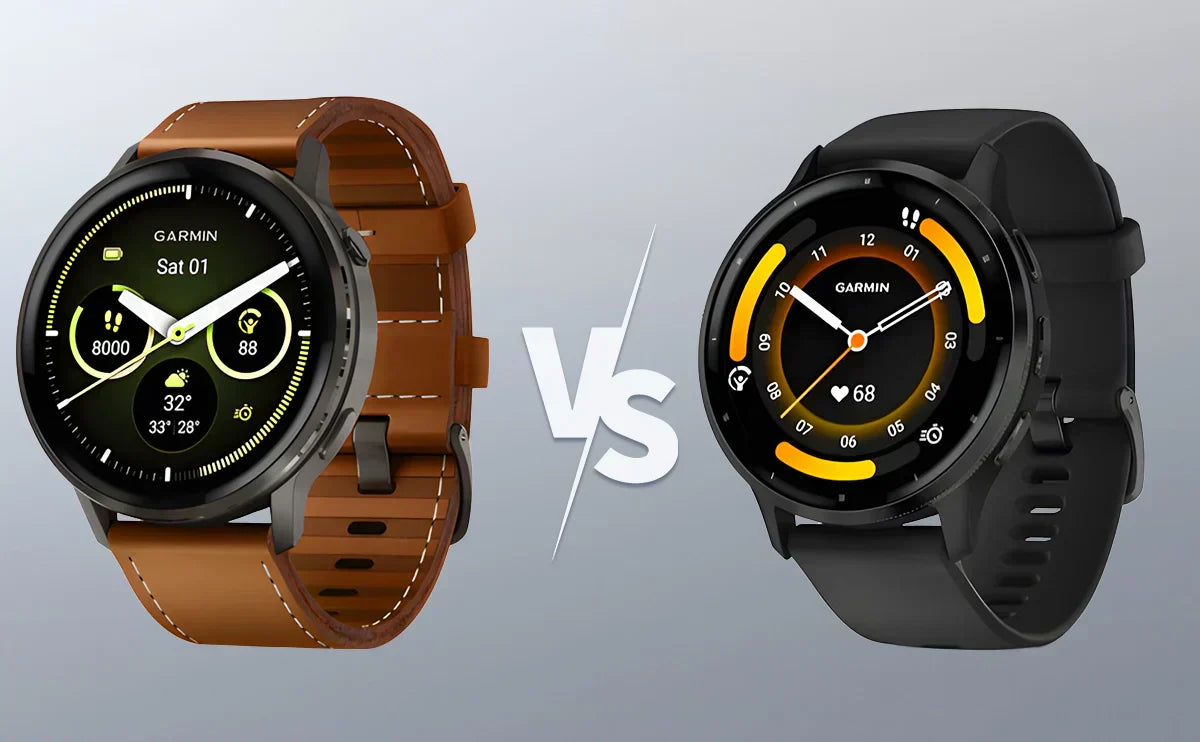
Garmin Venu 4 is the stronger choice for structured training, multi-band GPS and a built-in LED flashlight. Venu 3 remains a sensible choice for everyday fitness, especially at a meaningful discount; the 45mm Venu 3 also has a longer rated smartwatch battery life. If you already own a Venu 3, the upgrade makes most sense when you will use the added tools regularly.
The Garmin Venu 3 vs Venu 4 decision also depends on size. Venu 3 is the 45mm model, while Venu 3S is the 41mm version. Venu 4 offers 41mm and 45mm options under the same name. Compare matching sizes before judging battery life, wrist fit or replacement bands.
This guide compares Garmin's published specifications and current documentation. The practical recommendations are our interpretation of those differences, rather than results from a hands-on battery or GPS test.
Quick verdict: should you upgrade from Venu 3?
Keep your Venu 3 if your routine centers on walking, gym sessions, sleep tracking, notifications and occasional runs. It already supports sleep coaching, nap detection, HRV status, Body Battery, guided workouts and phone-connected calls. Those shared features are not reasons to replace an otherwise satisfactory watch. Garmin's Venu 3 overview describes that foundation.
Choose Venu 4 if you want more guidance on workout intensity and recovery, regularly run where satellite reception is difficult, or would use the dedicated flashlight. For a first purchase, a small price gap makes its extra capabilities more attractive. For an existing owner, the relevant question is whether those additions solve a recurring problem.
Comfort comes first for overnight tracking. A watch that stays in a drawer because it feels bulky cannot provide the same continuity of data as one you wear consistently.
Garmin Venu 3 vs Venu 4: key differences at a glance
| Feature | Venu 3 / Venu 3S | Venu 4 |
|---|---|---|
| Case options | Venu 3: 45mm; Venu 3S: 41mm | 41mm and 45mm |
| Display | AMOLED touchscreen; optional always-on mode | AMOLED touchscreen; optional always-on mode |
| Case construction | Fiber-reinforced polymer with stainless-steel bezel | Stainless steel and fiber-reinforced polymer |
| Physical buttons | Three | Two |
| Dedicated LED flashlight | No | Yes, both sizes |
| Satellite options | GPS Only and All Systems | Adds multi-band GNSS and SatIQ Auto Select |
| Training guidance | Garmin Coach running plans, workout benefit and recovery time | Adds training readiness, training status and broader performance tools |
| Everyday connected features | Calls through a paired phone, notifications, music and Garmin Pay | Retains these features; adds watch voice commands |
| Standard band widths | Venu 3S: 18mm; Venu 3: 22mm | 41mm: 18mm; 45mm: 22mm |
The table summarizes Garmin's specifications and manuals. The sections below explain the trade-offs rather than assigning one winner to every feature.
Design, display and controls: what changes on your wrist?
Materials, weight and size
Venu 4 combines stainless steel and fiber-reinforced polymer in its case. Venu 3 uses a polymer case with a stainless-steel bezel. Both generations use Gorilla Glass 3 and have a 5 ATM water rating. Garmin's comparison of the generations explains the construction changes.
The additional weight is worth considering for sleep and smaller wrists. With their included bands, Garmin lists Venu 3S at 40g and Venu 3 at 47g, compared with 46g for Venu 4 41mm and 56g for Venu 4 45mm. Different replacement bands change the total. These are specifications, not a judgment that one will feel uncomfortable. Sources: Venu 3S, Venu 3, Venu 4 41mm and Venu 4 45mm.

AMOLED screens and the two-button layout
The smaller versions have 1.2-inch displays; the larger versions have 1.4-inch displays. Moving from Venu 3S to Venu 4 45mm increases screen size, but that is also a move to a larger case. A like-for-like upgrade does not automatically give you a larger screen.
For readability, consider text size, brightness settings and gesture versus always-on display. If sunlight visibility is your priority, compare both watches under similar settings before buying. A higher price alone does not establish how much easier the screen will be to read on your usual routes.
Venu 4 uses START and BACK buttons alongside the touchscreen, compared with Venu 3's three-button arrangement. Garmin's Venu 4 controls guide explains the new layout. If you rely on familiar shortcuts during workouts, try the controls before buying; fewer buttons are a preference change, not an automatic improvement.

Battery life: compare the same size and GPS mode
Venu 4 is not a battery upgrade across the lineup. The 45mm Venu 3 has a longer smartwatch rating than Venu 4 45mm, while the smaller models share a 10-day rating with the display not always on.
| Model | Smartwatch mode | Always-on display | GPS Only | All Systems GPS |
|---|---|---|---|---|
| Venu 3S, 41mm | Up to 10 days | Up to 5 days | Up to 21 hours | Up to 15 hours |
| Venu 3, 45mm | Up to 14 days | Up to 5 days | Up to 26 hours | Up to 20 hours |
| Venu 4, 41mm | Up to 10 days | Up to 3 days | Up to 15 hours | Up to 13 hours |
| Venu 4, 45mm | Up to 12 days | Up to 4 days | Up to 20 hours | Up to 19 hours |
Sources: Venu 3 battery information, Venu 4 battery information and the size-specific Venu 4 specifications linked above for always-on ratings. These are manufacturer maxima, not measured results from our own testing.
Venu 4's All Systems plus multi-band mode is rated up to 12 hours on 41mm and 17 hours on 45mm. Do not compare those figures directly with Venu 3's GPS Only figures: they describe different modes. Music playback reduces runtime further.
For daily charging expectations, your display setting and workout routine matter more than one headline number. Someone using always-on display and frequent GPS sessions should plan around those modes. Garmin's battery-saving guidance identifies brightness, flashlight use, notifications and satellite settings as factors you can adjust.
Health tracking and sleep: shared features versus added insight
Venu 3 already covers the essentials of everyday wellness tracking: heart rate, stress, Body Battery, sleep coaching, naps and HRV status. Venu 4 builds on that foundation rather than making every familiar health feature new.
Its added tools include health status, lifestyle logging and sleep alignment. Health status compares overnight measurements with your typical ranges and needs three weeks of wear to establish its baseline. Lifestyle logging lets you record habits and review their relationship with recorded health metrics. Sleep alignment provides guidance about sleep timing, while sleep consistency looks at bedtime patterns. Garmin documents the sleep additions in its current Venu comparison.
The practical value depends on what you do with the information. If you are experimenting with an earlier bedtime or changing when you drink coffee, lifestyle logging can help organize those observations. A change in a watch metric does not, by itself, prove that a particular habit caused it.
ECG is not exclusive to Venu 4. Supported Venu 3, Venu 3S and Venu 4 models can use Garmin's ECG app, subject to software and regional requirements. Check Garmin's supported watches and regions for your market before treating ECG as a reason to upgrade.

Training features and GPS: the strongest reason to choose Venu 4
Recovery guidance and structured workouts
Venu 3 is capable of more than casual activity tracking. It supports Garmin Coach running plans, animated workouts, workout benefit and recovery time. You can also create workouts in Garmin Connect.
Venu 4 adds training readiness, training status and a broader set of performance tools. Its training readiness score uses sleep, recovery time, HRV, acute load and recent sleep and stress history. This gives an additional prompt when deciding how hard to train; it does not make that decision for you.
Garmin also lists training load and effect, PacePro pacing strategies, race prediction and coaching options covering running, cycling, strength and fitness. The Venu 4 manual details the supported tools. A runner building toward an event has more reason to use them than someone who follows the same uncomplicated gym routine every week.
Multi-band GPS and SatIQ
Venu 3 offers GPS Only and All Systems settings. Venu 4 adds All Systems plus multi-band and SatIQ Auto Select. Multi-band is designed to improve positioning in difficult reception conditions; SatIQ selects an appropriate system based on the environment. Sources: Venu 3 GPS settings and Venu 4 satellite settings.
If you often record routes near tall buildings or under dense tree cover, this is a relevant upgrade to consider. On an open route where your current tracks are satisfactory, it may be less compelling. We have not run paired route tests, so a fixed accuracy improvement or a promise that every track will be better would be unjustified.
Calls, music, flashlight and everyday use
Both generations support a speaker and microphone, smart notifications, onboard music and Garmin Pay. Calls require a paired compatible smartphone; neither watch should be bought on the assumption that it provides standalone cellular calling. Music service subscriptions and payment support also depend on the service or bank you use.
Venu 4 adds watch voice commands for tasks such as starting an activity or setting a timer without a connected phone. That differs from asking a paired phone's voice assistant to handle a message. Garmin explains this distinction in its Venu 4 announcement and lists supported actions in its voice command guide.
The dedicated LED flashlight is a separate hardware addition on both Venu 4 sizes. It can be useful for finding something in a dark room or getting ready for an early workout. Treat it as a convenient extra light, not as a replacement for lighting needed for a particular outdoor activity.
Venu 4 also adds a spoken watch face and color-filter options. These may matter more to a buyer who needs those accessibility settings than another training statistic. If your priority is simply calls, notifications and music, Venu 3 already provides the core features. For another Garmin option, see our Venu 4 vs Vivoactive 6 comparison.

Price and value: a new purchase is different from an upgrade
For context, Garmin announced US launch prices of $449.99 for Venu 3/3S and starting at $549.99 for Venu 4. These are historical launch prices, not a claim about today's checkout price. Compare the exact size, band configuration, seller, warranty and return terms before buying. Sources: Garmin's Venu 3 announcement and Venu 4 announcement.
For a new buyer, work out the actual price difference and list which Venu 4 additions you would use. A discounted Venu 3 can be excellent value when it meets your needs. A small saving is less persuasive if you specifically want training readiness or the flashlight.
For an existing Venu 3 owner, consider the whole replacement cost. Paying for another watch to retain mostly shared functions is harder to justify than paying a modest premium when choosing your first watch. Before upgrading for poor battery life, also review your settings and battery condition. Before upgrading for uncomfortable fit, assess the band.
If you are coming from an older model, our Venu 3 vs Venu 2 comparison helps separate the earlier generation changes from what Venu 4 adds.
Can you reuse Venu 3 bands on Venu 4?
Matching-size versions use the same nominal band width and standard quick-release system. Confirm the replacement band's stated model compatibility and connector fit, especially for shaped or rigid ends.
| Your current watch | Band width | Matching Venu 4 version |
|---|---|---|
| Venu 3S, 41mm | 18mm standard quick-release | Venu 4 41mm |
| Venu 3, 45mm | 22mm standard quick-release | Venu 4 45mm |
Garmin specifies these widths in its Venu 3 band instructions and Venu 4 band instructions. An 18mm band does not become compatible with a 22mm watch because both watches belong to the Venu family.
Also distinguish standard quick-release from Garmin QuickFit. Width alone is not enough to choose a different attachment system. After installation, check that both spring bars are securely seated before wearing the watch.
When browsing Bandletic Garmin watch bands, check the exact Venu model, width, connector and wrist adjustment range. For workout use, consider cleaning and drying requirements; for sleep, prioritize an adjustment that stays comfortable without excessive tightness. Those checks are useful whether you upgrade the watch or keep your existing Venu 3.
Which watch should you buy?
Choose Venu 3 or Venu 3S when you want everyday wellness tracking, guided workouts and connected features at a favorable price. Choose the size you can wear comfortably, and favor Venu 3 45mm if its longer rated smartwatch runtime is a priority.
Choose Venu 4 when you want the additional training guidance, multi-band GPS, flashlight or accessibility options and expect to use them. Compare its two sizes on wrist fit and battery modes rather than selecting the largest by default.
Keep your current Venu 3 when it already handles your routine well. The most useful upgrade is one with a clear purpose: better support for a training goal, a capability your current watch lacks, or a recurring problem you have identified. A newer model name alone does not establish that value.
FAQs about Garmin Venu 4 vs Venu 3
1. Is Garmin Venu 4 worth upgrading from Venu 3?
It can be if you will use its training readiness, additional performance tools, multi-band GPS or LED flashlight. For sleep tracking, general fitness and phone-connected calls alone, Venu 3 already covers much of the same routine.
2. Does Venu 4 have better battery life than Venu 3?
Not overall. Venu 3 45mm is rated up to 14 smartwatch days versus 12 for Venu 4 45mm. The smaller models both reach up to 10 days with the display not always on. Compare the same size and operating mode.
3. Is Venu 4 GPS more accurate?
Venu 4 adds multi-band GNSS and SatIQ, which are designed to improve positioning in challenging conditions. That hardware advantage does not establish the size of the improvement on your routes without comparable testing.
4. What training features does Venu 4 add?
The additions include training readiness, training status, training load and effect, PacePro and broader coaching options. Venu 3 already supports guided workouts, Garmin Coach running plans and recovery time; it is not limited to counting steps.
5. Does Venu 4 feel more premium?
Its metal design may appeal more to you, but appearance and feel are personal. The case combines stainless steel and fiber-reinforced polymer, and the included-band weight is higher than the corresponding Venu 3 model.
6. Is the two-button design a disadvantage?
It depends on your habits. Venu 4 combines START and BACK buttons with touch controls. If you depend on the Venu 3's familiar three-button shortcuts, try the new layout before committing.
7. Is the Venu 4 LED flashlight useful?
It offers a dedicated light on both sizes, useful for short tasks in the dark. Its value depends on how often you need it, and frequent use affects battery life.
8. Should I buy a discounted Venu 3 or Venu 4?
Choose the discounted Venu 3 if it meets your needs and the saving is meaningful. Choose Venu 4 if you specifically want its added capabilities. Compare warranty and condition as well as price, especially for used watches.
9. What about Garmin Venu 3S vs Venu 4?
The like-for-like comparison is Venu 3S against Venu 4 41mm: both use 18mm standard quick-release bands. Venu 4 45mm is a different size with a 22mm band. Our Venu 3 vs 3S guide explains the earlier size options.
10. Do both watches support ECG and phone calls?
Supported Venu 3/3S and Venu 4 models can use ECG in eligible regions with the required software. Both generations support calls through a paired compatible smartphone. Neither feature is exclusive to Venu 4.

Share:
Apple Watch SE 3 vs Series 11 - Is the $150 Upgrade Worth It in 2026?
Garmin Vivoactive 5 vs Garmin Forerunner 965 - Which One Is Worth the Price in 2026?