


The Garmin Venu 4 vs Forerunner 570 decision is closer than the names suggest. Both combine an AMOLED touchscreen, multi-band GPS, useful training tools and phone-connected calls. The Venu 4 adds ECG support and a built-in LED flashlight; the Forerunner 570 offers five physical buttons and a lighter case at each size.
Choose the Venu 4 if you want an everyday watch with those extra health and convenience features. Choose the Forerunner 570 if you prefer button-led operation for running, swimming and racing. Neither choice requires giving up structured exercise or daily wellness tracking.
This comparison uses Garmin's specifications and current owner manuals, checked October 9, 2026. Software matters: features available today can differ from launch-era comparisons.
Garmin Venu 4 vs Forerunner 570: key specifications
Compare the smaller models with each other, and then the larger models. A 41mm Venu 4 and 47mm Forerunner 570 differ in screen size and fit as well as features.
| Specification | Venu 4 41mm | Venu 4 45mm | Forerunner 570 42mm | Forerunner 570 47mm |
|---|---|---|---|---|
| Case dimensions | 41 × 41 × 12mm | 45 × 45 × 12.5mm | 42.4 × 42.4 × 12.9mm | 47 × 47 × 12.9mm |
| Weight, including supplied band | 46g | 56g | 42g | 50g |
| AMOLED display | 1.2 inches | 1.4 inches | 1.2 inches | 1.4 inches |
| Resolution | 390 × 390 | 454 × 454 | 390 × 390 | 454 × 454 |
| Touchscreen / physical buttons | Yes / two | Yes / two | Yes / five | Yes / five |
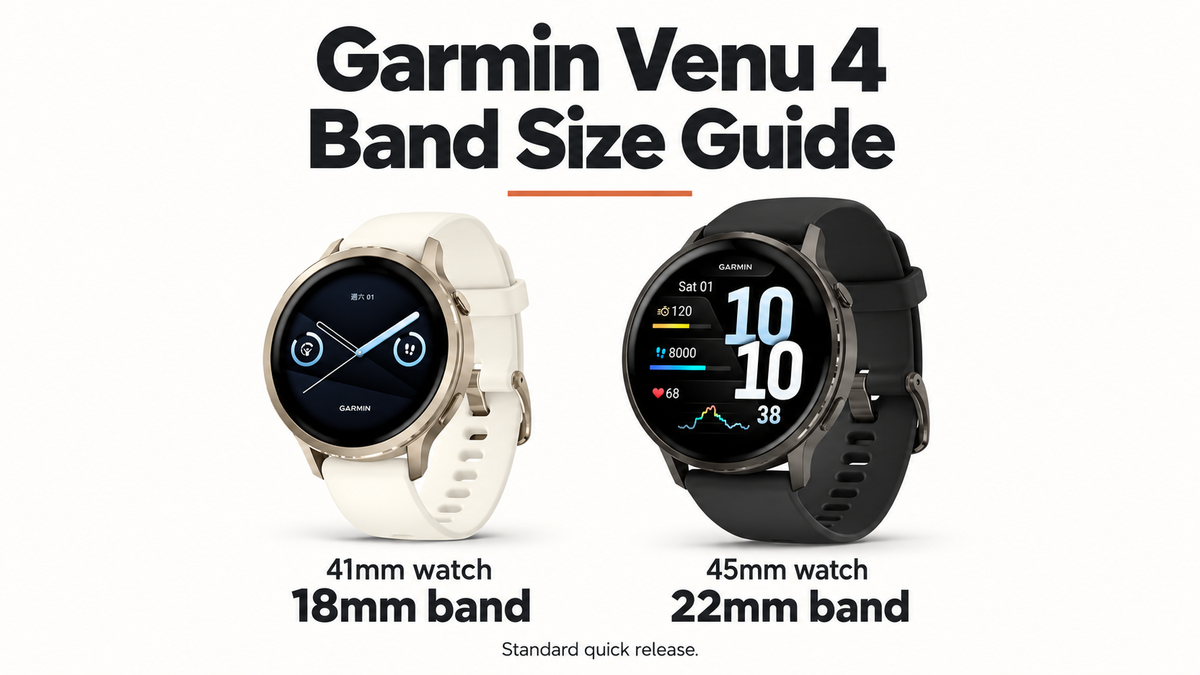
| Standard quick-release band width | 18mm | 22mm | 20mm | 22mm |
| Multi-band GNSS and SatIQ | Yes | Yes | Yes | Yes |
| ECG app support* | Yes | Yes | No | No |
| Built-in LED flashlight | Yes | Yes | No | No |
| Water rating | 5 ATM | 5 ATM | 5 ATM | 5 ATM |
ECG availability depends on country, compatible software and Garmin's eligibility requirements. The feature is not continuous ECG monitoring.
Sources: Garmin's smaller-model specification comparison, Forerunner 570 47mm specifications, and Venu 4 45mm specifications.
Design, size and all-day comfort

The Venu 4 combines stainless steel and fiber-reinforced polymer. It is not an entirely stainless steel watch. The Forerunner 570 pairs an aluminum bezel with a fiber-reinforced polymer case, giving it a more overtly sporty appearance.
The Forerunner is lighter in both comparable size groups: 42g versus 46g for the smaller watches, and 50g versus 56g for the larger ones, with their supplied bands. That difference may matter if you dislike wrist weight during sleep or long runs. Comfort also depends on the strap, buckle placement and how well the case sits on your wrist.
For a smaller wrist, start by trying the Venu 4 41mm and Forerunner 570 42mm. Check whether the lugs extend beyond your wrist, whether the sensor stays flat and whether you can bend your hand comfortably. For larger data fields, consider the Venu 4 45mm or Forerunner 570 47mm; the latter has a bigger case without a bigger display.
Both use Gorilla Glass 3 and carry a 5 ATM rating. Neither specification establishes that one will survive every impact better. Swimming suitability should not be interpreted as approval for scuba diving or every high-pressure water activity.
Display and controls: equal screen sizes, different interaction

At comparable sizes, both watches have the same display dimensions and resolution. The smaller models use a 1.2-inch, 390 × 390 panel; the larger models use a 1.4-inch, 454 × 454 panel. Resolution alone therefore does not make the Forerunner 570 the sharper choice.
The more useful distinction is operation. The Venu 4 uses two buttons alongside touch interaction. The Forerunner 570 offers five buttons alongside its touchscreen. If you regularly change data screens, mark laps or navigate menus during a workout, try those actions before buying.
Our practical preference for the Forerunner in races follows from its button layout, not a measured touchscreen reliability advantage. Wet hands, gloves, personal dexterity and familiarity all affect how a watch feels to operate.
Always-on display is convenient for checking the time without raising your wrist, but it changes the battery calculation. Neither screen should be judged only by smartwatch-mode endurance with always-on disabled. We have not verified a numerical brightness comparison, so there is no unsupported “twice as bright” claim here.
Battery life: compare the exact size and GPS mode
There is no universal battery winner. Garmin's published maximums show the Venu 4 45mm lasting longer in several modes, while the Forerunner 570 42mm has an advantage over the Venu 4 41mm in GPS-only and multi-band operation.
| Garmin-rated mode, up to | Venu 4 41mm | Venu 4 45mm | Forerunner 570 42mm | Forerunner 570 47mm |
|---|---|---|---|---|
| Smartwatch | 10 days | 12 days | 10 days | 11 days |
| GPS only | 15 hours | 20 hours | 18 hours | 18 hours |
| All systems + multi-band | 12 hours | 17 hours | 13 hours | 14 hours |
| All systems + multi-band + music | 6 hours | 9 hours | 8 hours | 8 hours |
These are manufacturer estimates, not our measured runtimes. Sources: Garmin's Venu 4 battery table and Forerunner 570 battery table.
For a long event, compare the mode you will actually use, including music. The Venu 4 41mm's six-hour multi-band-plus-music rating leaves less headroom than its headline ten-day smartwatch figure suggests. Conversely, the 45mm Venu 4 has a 17-hour multi-band rating versus 14 hours for the 47mm Forerunner.
Garmin also publishes Auto Select figures for the Forerunner and other satellite-mode figures for the Venu. Those should not be mixed into a table as though they were identical settings. SatIQ selects satellite behavior according to conditions; it does not promise the same consumption on every route.
Charging frequency will depend on display settings, GPS sessions, Pulse Ox, music and notifications. Leave a battery reserve for navigation and delays rather than planning an event around the advertised maximum.
Health, sleep and heart-rate tracking

Both cover core daily wellness needs, including wrist heart rate, stress, Body Battery, sleep information and HRV status. The Venu 4's clearest hardware-related health distinction is ECG app support. The Forerunner 570 does not support Garmin's ECG app.
ECG is a recording you deliberately take, subject to Garmin's instructions and regional availability. It should not be confused with the optical heart-rate sensor, and owning an ECG-capable watch does not make its workout heart-rate readings automatically more accurate. See Garmin's ECG compatibility and requirements.
Current software also changes the wellness comparison. The Forerunner 570's current manual lists Health Status and Lifestyle Logging, features sometimes described in older comparisons as Venu-only. Health Status uses a personal baseline; Lifestyle Logging relies on recording behaviors, rather than automatically detecting what you eat or drink. Sources: Forerunner Health Status and other glances and Lifestyle Logging.
The Forerunner also supports breathing variations during sleep with the relevant sleep Pulse Ox setting enabled. Do not buy the Venu solely because an outdated list says the Forerunner lacks that insight. Garmin's sleep-tracking instructions explain the setting. These wellness insights are not a sleep-apnea diagnosis.
For useful trends, choose a size and strap you can wear consistently overnight. One isolated sleep score is less informative than several weeks of comparable wear.
Running, swimming and triathlon: look beyond the product family

Running and structured training
The Forerunner 570 is a natural starting point for a runner who wants five-button operation and a race-oriented watch layout. However, the Venu 4 is not limited to casual step counting. Training readiness, training status and recovery-related tools overlap between the two models.
Training readiness is an estimate that combines inputs such as sleep, recovery and training history. It does not mean the watch has directly measured whether your body can safely complete a session. Nor does a feature name guarantee that two people will get equally useful results from it. See Garmin's Venu 4 training-readiness explanation.
For a regular runner, evaluate the actual workout screens and controls you use: starting an interval session, checking pace, marking a lap and reviewing recovery information. Those actions are more revealing than a generic “fitness versus performance” label. If a particular coaching plan or running-dynamics metric is essential, verify that exact feature and any required sensor before purchase.
Triathlon and mixed sessions
Both current manuals document multisport, including triathlon, sport transitions and mixed sessions. The Venu 4 can record a triathlon; it is incorrect to describe triathlon support as exclusive to the Forerunner 570. Garmin provides separate instructions for Venu 4 multisport and Forerunner 570 multisport.
We would still shortlist the Forerunner first for frequent racing because of its button layout. That is a usability recommendation, not a claim that the Venu lacks transitions or multi-sport recording. Practice the transition controls before race day on either watch.
Swimming and external sensors
Both support pool and open-water swimming. For more detailed swim training, inspect the precise features rather than assuming all swim tools match: Garmin's small-model feature comparison lists additional Forerunner swim options, including drill logging and critical swim speed.
Both also support compatible external sensors; the Forerunner is not the only option for a chest strap or cycling accessories. Compatibility must be checked by sensor and function. Pairing for basic heart rate does not automatically establish support for every running-dynamics field or stored swimming-heart-rate feature.
If you already own a training setup, list its sensors, required data fields and workout habits. Use that checklist to decide whether either watch actually requires changing your equipment.
GPS and navigation: both have multi-band, neither has full built-in maps
Both models support multi-band GNSS and SatIQ. Multi-band reception can help in difficult environments, but hardware support alone cannot establish which watch produces the better track on your particular route. We have not performed a paired GPS accuracy test.
Both current manuals also describe following courses sent from Garmin Connect. Course navigation, a breadcrumb route and return-to-start functions should not be confused with detailed, preloaded street or topographic mapping. See the navigation chapters in the Venu 4 manual and Forerunner 570 manual.
If you mainly follow a prepared running route, those course functions may meet your needs. If you want to inspect nearby roads, trail networks or alternative paths on a detailed map, neither is the best choice on that requirement alone. Look at a mapping-equipped model instead; our Forerunner 970 vs 570 comparison covers that alternative.
Before a trip, sync the course and practice using it. Accurate position tracking and a good route file solve different problems.
Calls, music, voice features and the LED flashlight

Both include a speaker and microphone for calls through a paired compatible phone. Neither should be bought on the assumption that it provides independent cellular calling. Phone compatibility and connection requirements still apply.
Both also support stored music, compatible music services and Garmin Pay. Some music services need a subscription, and payment support depends on participating banks and region. Streaming-service support is not the same as unrestricted access to every audio library.
On-watch voice commands and phone-assistant commands are separate functions. Current Forerunner 570 documentation lists Voice Command and Voice Notes, so those should not be presented as Venu 4 exclusives. Some phone-dependent tasks still need the phone connection. Garmin's current Forerunner apps list distinguishes the functions.
The Venu 4 does offer a physical LED flashlight. The Forerunner 570 does not; a lit display is not equivalent hardware. For short tasks such as finding a key or moving through a dark room, that is a concrete convenience feature. It should not be treated as a replacement for the lighting you need on an unfamiliar night route.
Band compatibility: check the case size and attachment
A replacement band must match the exact watch size and attachment system. These models use standard quick-release bands, but the widths differ.
| Watch | Standard quick-release width |
|---|---|
| Venu 4 41mm | 18mm |
| Venu 4 45mm | 22mm |
| Forerunner 570 42mm | 20mm |
| Forerunner 570 47mm | 22mm |
Sources: Garmin's Venu 4 band-changing guide and Forerunner 570 band guide.
Do not assume a band marketed for the Forerunner 970 fits a Forerunner 570. A shared nominal width does not establish the same connector or spring-bar arrangement. Likewise, a generic “Venu band” listing needs to specify the correct size, especially the 18mm Venu 4 41mm.
For workouts, consider a secure, easy-to-clean strap; for overnight wear, prioritize adjustment and comfort. Nylon can feel comfortable but needs time to dry after getting wet. A leather band may suit daily styling while being a less practical choice for repeated sweaty sessions.
You can browse Bandletic's Garmin watch bands, then check the individual product's model, width and connector details before choosing. The collection link does not establish that every listed band fits these four variants.
Price and value: compare today's exact configuration

Both started at $549.99 in the United States. These are historical launch prices, not a statement of current checkout pricing. Garmin's Venu 4 announcement and Forerunner 570 announcement provide the launch context.
A higher-priced band bundle does not unlock extra health features. Compare the exact watch size, included band, seller and warranty, rather than interpreting a leather-band premium as a different ECG capability.
Value depends on which differences you will use. If ECG and the LED flashlight matter every week, the Venu has a clearer reason to earn your budget. If you train frequently and prefer the Forerunner controls, a similar price can be justified by that workflow.
An older watch may also be sufficient. Our Venu 4 vs Venu 3 guide and Forerunner 570 vs 265 comparison help frame those alternatives.
Which watch should you buy?
| Your priority | Start with | Reason |
|---|---|---|
| ECG support and a physical flashlight | Venu 4 | These are concrete features the 570 lacks |
| Five-button operation during frequent training | Forerunner 570 | More dedicated physical controls |
| A smaller watch with lower supplied-band weight | Forerunner 570 42mm | 42g versus 46g for Venu 4 41mm |
| Longer rated multi-band runtime in the larger size | Venu 4 45mm | Up to 17 hours versus 14 hours for 570 47mm |
| Triathlon recording | Either; try the controls | Both current manuals document multisport |
| Detailed built-in mapping | Consider another model | Course navigation is not full mapping |
- For an everyday wearer who also runs or trains, the Venu 4 is our starting recommendation if its styling, ECG eligibility and flashlight appeal to you. You do not need to choose the Forerunner merely to obtain multi-band GPS or useful training metrics.
- For a runner, swimmer or triathlete who interacts with the watch repeatedly during sessions, start with the Forerunner 570. Its button layout and lower weight are meaningful reasons to prefer it even though the core training overlap is substantial.
- For someone who already owns either watch, switching is harder to justify. Identify a specific missing capability or comfort problem before paying for a largely overlapping feature set. If you cannot name one, refining your settings or replacing an uncomfortable band may be enough.
Finally, choose the size before judging battery life and accessories. The small and large variants can lead to different recommendations within the same product family.
FAQs about Garmin Venu 4 vs Forerunner 570
1. Does the Garmin Venu 4 have ECG?
Yes, both Venu 4 sizes support Garmin's ECG app where available and with compatible software. The Forerunner 570 does not. ECG recording is separate from regular optical heart-rate tracking, and availability must be checked for your country.
2. Is the Forerunner 570 suitable for triathlons?
Yes. Its current manual documents triathlon and other multisport activities, including transitions. The Venu 4 also supports these activities, so triathlon recording alone is not an exclusive reason to choose the Forerunner.
3. Can the Venu 4 navigate an outdoor route?
Yes, its current manual describes following courses transferred from Garmin Connect. This is different from full built-in mapping. Check that the route has synced and practice navigation before relying on it during an unfamiliar outing.
4. Does the Forerunner 570 have offline maps?
It supports course navigation, but not the detailed built-in mapping found on models such as the Forerunner 970. A breadcrumb route should not be described as a full offline street or topographic map.
5. Does the Forerunner 570 have a built-in flashlight?
No physical LED flashlight is included. The Venu 4 has one. Do not confuse the Forerunner 570 with the Forerunner 970, which has different hardware features.
6. What is the Venu 4's battery life in GPS mode?
Garmin rates GPS-only operation at up to 15 hours for the 41mm model and 20 hours for the 45mm model. Multi-band operation is up to 12 and 17 hours respectively; adding music reduces those figures to six and nine hours.
7. Does the Forerunner 570 support offline music?
Yes, it can play stored music with compatible headphones. Supported subscription services may require an active account. GPS plus music uses more battery than GPS alone; consult the matching mode in the battery table.
8. Can the Venu 4 track sleep and stress?
Yes. Both models provide sleep and stress information alongside other wellness metrics. Consistent wear helps make trends useful. The current Forerunner 570 also supports breathing variations with the relevant setting, so older feature lists may be incomplete.
9. Is the Forerunner 570 compatible with external sensors?
Yes, with compatible sensors. Verify both the sensor and the specific function you need. Basic heart-rate pairing, running dynamics and swimming-heart-rate downloads are different capabilities; compatibility with one does not prove support for all three.
10. Can either watch make calls without a phone?
Neither provides independent cellular calling. Both can handle calls through a paired compatible phone using their speaker and microphone. Their watch voice commands are a separate function from phone-connected calls or a phone assistant.
11. Do the Venu 4 and Forerunner 570 use the same bands?
Only the larger variants share a 22mm standard quick-release width. The Venu 4 41mm uses 18mm, while the Forerunner 570 42mm uses 20mm. Always confirm connector compatibility and the exact model on the product listing.
Share:
Garmin Venu 4 vs Vivoactive 5 - Expert Review Reveals the Better Pick for Fitness & Daily Use
Apple Watch Ultra 3 vs Garmin Forerunner 970 - Which Premium Sports Watch Dominates 2025?