

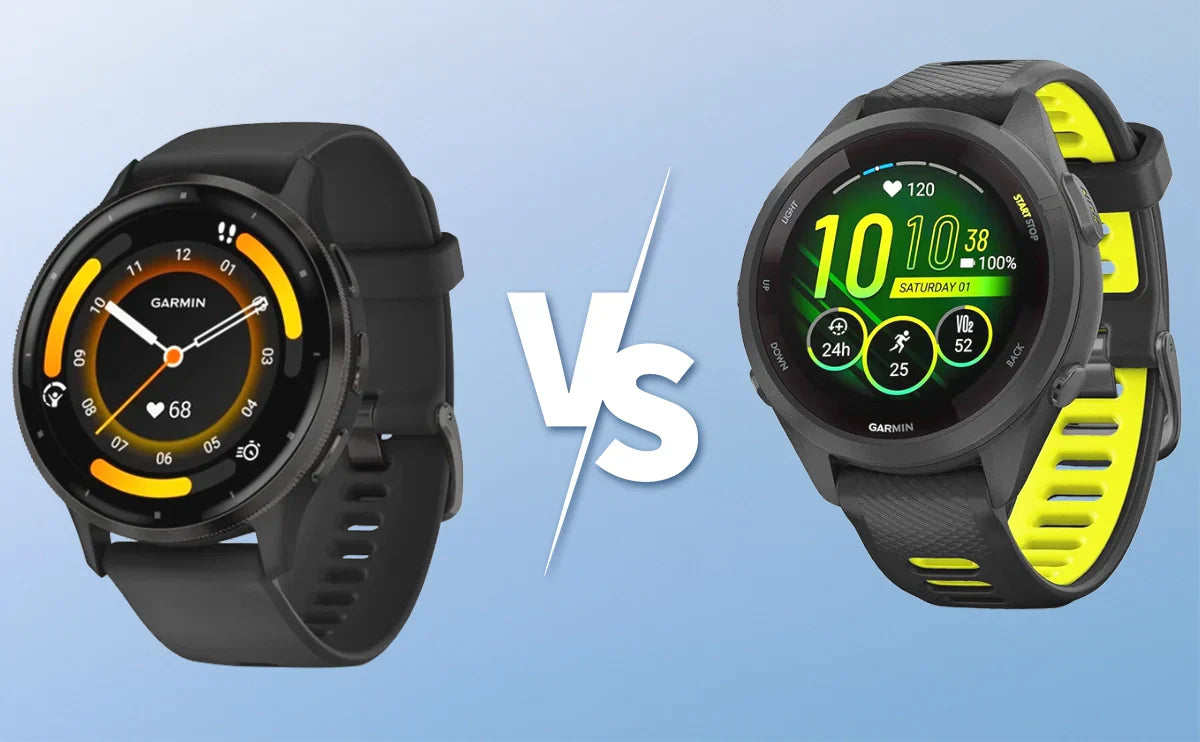
Garmin Venu 3 and Forerunner 265 may look similar, but they are built for very different users. This guide compares real-world use - training, daily life, sleep, GPS, and battery - so you can choose with confidence.
Main content:
- One-Sentence Verdict (30-Second Choice)
- Decision Tree – 3 Questions to Decide in 10 Seconds
- Do You Need Calls and Voice Features on the Watch?
- Do You Rely on Training Load and Suggested Workouts?
- Do You Run in Environments Where GPS Accuracy Matters More?
- Non-Negotiable Differences – What You’ll Lose If You Choose the Wrong One
- Garmin Venu 3 – What You Lose If You Choose the Forerunner 265
- Garmin Forerunner 265 – What You Lose If You Choose the Venu 3
- Fast Regret Check
- Are the Forerunner 265’s Training Metrics Helpful—or Just Data Anxiety?
- When Training Readiness and Suggested Workouts Actually Help
- Not a Runner? A Quick Test to See If the 265 Is Worth It
- The 3 Most Common Buyer Mistakes
- Calls and Voice Control – Is the Venu 3’s Speaker and Microphone Actually Useful?
- Sleep and Naps – Does the Venu 3 Still Have the Advantage?
- Build, Comfort, and Controls – Office Wear vs. Training Use
- Sensors and Health Features – Are You Paying for Today or Future Potential?
- GPS and Outdoor Use – Do You Really Need Stronger Positioning?
- Battery and Display – How Venu 3 and Forerunner 265 Drain Battery Differently
- Conclusion & Final Recommendation
- FAQs about Garmin Venu 3 vs Forerunner 265
If you’re deciding between the Garmin Venu 3 and the Forerunner 265, you’ve probably noticed how similar they appear at first glance. The pricing is close, both use AMOLED displays, and both offer advanced health and fitness tracking. Still, many people hesitate here, because the real difference doesn’t show up on a spec sheet - it shows up in how the watch feels in everyday use.
What most buyers are actually unsure about isn’t technical details, but practical trade-offs. Will the Forerunner 265’s training-focused features genuinely improve your workouts, or just add complexity? Will the Venu 3’s calling and voice features become part of your daily routine, or end up unused? For anyone who runs, trains, and wears a watch all day, those questions matter far more than raw specifications. If you want a deeper look at daily use, calls, and health features, our Garmin Venu 3 review breaks down what actually matters long term.
One-Sentence Verdict (30-Second Choice)
- If you want training guidance, suggested workouts, and a runner-focused training system, the Garmin Forerunner 265 is the better choice.
- If you want an all-day lifestyle watch with on-watch calling, voice features, ECG, and broader health tracking, the Garmin Venu 3 fits better.
- If your decision comes down to sleep and naps, the key difference is whether you want simple nap records or a full training-recovery loop influenced by naps.
Decision Tree — 3 Questions to Decide in 10 Seconds
Do You Need Calls and Voice Features on the Watch?
Yes → Garmin Venu 3
Why this matters: The Venu 3 includes a built-in microphone and speaker, making it suitable for calls and voice interactions in daily use.
Do You Rely on Training Load and Suggested Workouts?
Yes → Garmin Forerunner 265
Why this matters: The Forerunner 265 is designed around training load and suggested workouts, while the Venu 3 does not provide this training guidance system.
Do You Run in Environments Where GPS Accuracy Matters More?
Yes → Garmin Forerunner 265
Why this matters: The Forerunner 265 offers a more runner-focused GPS setup, while the Venu 3 prioritizes lifestyle use and does not include multi-band GPS.
Non-Negotiable Differences — What You’ll Lose If You Choose the Wrong One
These are features you cannot add later. If you care about any of them, choosing the other watch means giving them up entirely.
Garmin Venu 3 — What You Lose If You Choose the Forerunner 265
|
Feature |
Why It Matters |
Best For |
|
On-watch calls & voice assistant (mic + speaker) |
Answer calls and use your phone’s voice assistant directly from the watch, hands-free. |
Commuters, drivers, and daily all-day wear users. |
|
ECG & skin temperature (Elevate V5 sensor) |
Advanced health signals tied to Garmin’s newer sensor generation. |
Users focused on long-term health tracking, not just workouts. |
|
Lifestyle-first daily experience |
Built to feel natural outside training, not centered around workouts. |
People who wear the watch at work, at home, and socially. |
Typical use cases: answering a call while cooking, using voice control while driving, checking health data during a workday.
Garmin Forerunner 265 — What You Lose If You Choose the Venu 3
|
Feature |
Why It Matters |
Best For |
|
Training load & suggested workouts |
Connects recovery, past training, and future sessions into one system. Not available on Venu 3. |
Runners who want guidance on what to train next. |
|
Runner-focused button control |
Physical buttons work reliably with sweat, gloves, or rain. |
Serious runners training in all conditions. |
|
More performance-oriented GPS setup |
Prioritizes training accuracy; Venu 3 does not include dual-band GPS. |
Urban runners, trail runners, and accuracy-focused users. |
Typical use cases: starting intervals in the rain, checking splits mid-run, or running in cities and forests.
Fast Regret Check
- Choose Forerunner 265 → you give up calls, voice interaction, ECG, and a lifestyle-oriented experience.
- Choose Venu 3 → you give up training load, suggested workouts, and a runner-first training system.
If one of those losses feels unacceptable, your choice is already made. If you’re also considering the previous generation, the Garmin Forerunner 265 vs Forerunner 255 comparison highlights what actually improved for runners.
Are the Forerunner 265’s Training Metrics Helpful—or Just Data Anxiety?
If you’re curious how these metrics behave in real training, the Garmin Forerunner 265 review goes deeper into daily readiness, training load, and suggested workouts. For most buyers, the real question isn’t whether the Forerunner 265 has more training metrics than the Venu 3. It’s whether those metrics actually help improve training, or simply add pressure without changing results.
The difference comes down to how you train - and whether you’re willing to act on the data.
When Training Readiness and Suggested Workouts Actually Help
At their best, these metrics answer one simple question: train hard, train easy, or rest today?
The Forerunner 265 uses sleep, HRV, recent training load, and recovery signals to guide daily decisions. For runners, this works well. After several hard sessions, lower readiness and lighter suggested workouts help prevent overtraining; when recovery is strong, the watch encourages intensity.
The limitation is clear in strength training, HIIT, or boxing. Muscle fatigue from heavy lifts or impact work isn’t always reflected by heart rate or HRV. It’s possible to feel physically exhausted while the watch still reports good readiness. This system is optimized for endurance training, not for tracking all types of fatigue.
Not a Runner? A Quick Test to See If the 265 Is Worth It
Ask yourself:
- Will you actually adjust your training based on the watch’s suggestions?
- Are you willing to log workouts consistently or use a chest strap?
- Do you care about a recovery loop where sleep, HRV, and naps affect training?
The Forerunner 265 includes naps in sleep tracking, and they influence recovery and readiness. If you answer “yes” to at least two of these questions, the training metrics are likely useful. Otherwise, they may just become numbers you glance at.
The 3 Most Common Buyer Mistakes
- Mistake 1: Expecting data to create progress without changing behavior
- Mistake 2: Assuming one recovery score works for all training types
- Mistake 3: Looking at training load without considering sleep and recovery
Bottom Line
- The Forerunner 265’s training metrics are powerful for runners who value recovery and adjust training accordingly.
- If you prefer fixed routines or mostly strength-based training, the same data can easily turn into data anxiety.

Calls and Voice Control — Is the Venu 3’s Speaker and Microphone Actually Useful?
The Garmin Venu 3 supports on-watch calling and voice control through its built-in speaker and microphone. Whether this feature matters depends less on how often you make calls, and more on how often your phone is inconvenient to use.
This feature is most useful when your hands are occupied or when pulling out a phone adds friction. For example, answering a call while cooking or carrying items, placing a call or sending a short voice message while driving, or quickly returning a missed call between meetings. In these situations, the watch acts as a faster access point, not a replacement for your phone.
There are also clear limitations. The Venu 3 does not support independent cellular calling and requires a nearby phone connection. Speaker-based calls are best suited for short conversations and quieter environments. Users who rely on earbuds for most calls, or who rarely find their phone out of reach, may see little benefit.
Bottom Line
The Venu 3’s calling and voice features are situational, not universal. They add real value if your daily routine often makes phone use inconvenient. If not, they are unlikely to influence long-term satisfaction.

Sleep and Naps — Does the Venu 3 Still Have the Advantage?
One-sentence verdict:
If you care most about clear nap tracking and sleep presentation, the Venu 3 still feels more straightforward. If you care about naps influencing recovery and training recommendations, the Forerunner 265 now offers a more complete system.
Key Differences That Actually Matter
Nap tracking vs. recovery impact
On the Venu 3, naps are primarily recorded and displayed as part of health tracking. On the Forerunner 265, naps are included in sleep statistics and directly affect recovery metrics and training guidance.
Sleep Coach logic
The Forerunner 265’s Sleep Coach bases its recommendations on sleep and activity history, HRV status, and naps. These inputs feed into recovery assessment and influence next-day training readiness and suggested workouts.
Health focus vs. training focus
The Venu 3 treats sleep as a health metric to monitor. The Forerunner 265 treats sleep and naps as inputs in a broader recovery-to-training loop.
Which One Fits Your Use Case?
If you mainly care about nap tracking
Ask yourself whether you want detailed, easy-to-read nap records or whether you want naps to change how the system evaluates your recovery. The former favors the Venu 3; the latter favors the Forerunner 265.
If training and recovery matter to you
On the Forerunner 265, naps can improve recovery assessment and influence training readiness and suggested workouts. This only adds value if you actually adjust training based on those recommendations.
A Simple Nap Test You Can Do
Take a 20–30 minute nap at roughly the same time on a single day.
Check how Garmin Connect records the nap and whether it is added to overall sleep.
Then observe whether recovery metrics or training suggestions change the next day.
If the nap only appears as a record, its value is limited. If it alters recovery or training guidance, it becomes meaningful.
Bottom Line
- The Venu 3 still offers a cleaner sleep and nap tracking experience. The Forerunner 265 has largely caught up by integrating naps into recovery and training decisions.
- Choose the Venu 3 if sleep tracking is your main goal. Choose the Forerunner 265 if you want sleep and naps to actively shape recovery and training.

Build, Comfort, and Controls — Office Wear vs. Training Use
If you wear your watch all day, comfort and appearance matter more than specs. The Garmin Venu 3 and Forerunner 265 feel very different depending on whether you’re in an office setting or a training environment.
Office and formal settings:
The Venu 3 looks more like a traditional watch. Its stainless steel bezel and slimmer profile make it easier to wear with business or smart-casual clothing. It draws less attention as a sports device and blends better in meetings or formal environments. For smaller wrists, the lighter feel and the option to swap to a leather or metal band can make the Venu 3 look even more like a dress watch.
The Forerunner 265 has a clearly sport-focused design. It is not uncomfortable to wear at work, but its plastic bezel and utilitarian look make it feel more like training gear than an everyday accessory.
Training and workouts:
During workouts, the balance shifts. The Forerunner 265 relies more on physical buttons, which are easier to use with sweat, rain, or gloves. This makes it more reliable during runs, intervals, or bad weather. The Venu 3 depends more on touch input, which works well in the gym but is more prone to mis-taps when hands are wet.
Comfort over long days:
The Venu 3’s thinner, lighter design tends to disappear on the wrist during long workdays. The Forerunner 265 prioritizes stability and control during movement, which can feel more secure during training but slightly more noticeable for all-day wear.
Bottom Line
- The Venu 3 is more comfortable and socially compatible for office wear and all-day use.
- The Forerunner 265 is more reliable and ergonomic during training.
- If your day is mostly work and daily wear, the Venu 3 feels better.
- If your priority is workouts and running, the Forerunner 265 feels more purpose-built.

Sensors and Health Features — Are You Paying for Today or Future Potential?
When choosing between the Garmin Venu 3 and the Forerunner 265, many people hesitate over one question: is it worth paying for newer health sensors like ECG and skin temperature?
The answer depends on whether you want immediate, practical benefits - or long-term health monitoring potential.
What you can use today:
The Venu 3 uses Garmin’s newer Elevate V5 sensor, which enables ECG and skin temperature tracking. These features are designed to provide additional health signals rather than daily training guidance. ECG is an on-demand check, and skin temperature is mainly useful for observing long-term trends, not for making short-term training decisions.
What may expand over time:
Devices with the Elevate V5 sensor have the hardware foundation for future health-related updates. Skin temperature and ECG have already been rolling out gradually, suggesting that Venu 3 owners are partly paying for long-term capability. However, future features are not guaranteed and depend on software updates and regional support.
Who should pay for this:
ECG and skin temperature make sense for users who care about overall health tracking and long-term body trends, not just workout performance. They add value if you regularly review health data and are interested in early signals rather than training metrics.
Who should not:
If your main focus is running performance, structured training, or measurable performance gains, these sensors add little practical value. The Forerunner 265 lacks ECG and skin temperature, but it prioritizes training systems and performance features instead.
Bottom Line
- The Venu 3’s sensor advantage is about health insight and future potential, not immediate training benefits.
- Choose the Venu 3 if health monitoring matters to you. Choose the Forerunner 265 if training improvement is your priority.
If you’re deciding whether to wait for the next generation, this Garmin Venu 4 vs Venu 3 comparison explains what actually changed and what didn’t.

GPS and Outdoor Use — Do You Really Need Stronger Positioning?
Concerns about GPS accuracy are common: drifting routes, unstable pace, or losing signal in difficult environments. Whether stronger GPS matters depends almost entirely on where you run.
Urban “canyons” with tall buildings:
In dense city areas, GPS signals are easily reflected by buildings, which can cause track drift and pace spikes. Dual-band GPS helps reduce this problem by separating real signals from reflections. The Forerunner 265 is better suited for these conditions, while the Venu 3 does not support dual-band GPS and is more likely to show small inaccuracies.
Forests and trail running:
Tree cover and uneven terrain regularly block satellite signals. In these environments, more robust GPS improves track consistency and pace reliability. Runners who train on trails or in mountainous areas benefit more from the Forerunner 265’s positioning approach.
Parks and open running routes:
In open areas such as parks, river paths, or tracks, the difference is much smaller. Standard GPS is usually stable enough, and the lack of dual-band support on the Venu 3 is rarely noticeable.
Who actually needs dual-band GPS:
Runners who frequently train in dense cities, forests, or on trails, and who care about precise pace and route data.
Bottom Line
GPS accuracy matters most in challenging environments.
- If you often run among tall buildings or on trails, the Forerunner 265 offers more reliable positioning.
- If your runs are mostly in open areas, the Venu 3’s GPS is sufficient for everyday use.

Battery and Display — How Venu 3 and Forerunner 265 Drain Battery Differently
With similar settings, battery life on these two watches is shaped more by how you use them than by specs.
Always-On Display (AOD):
Both drain faster with AOD. On the Venu 3, AOD fits everyday use but shortens daily battery margin more quickly. On the Forerunner 265, AOD is less common and easier to disable for longer runtime.
GPS and workouts:
GPS-heavy training drains both, but in different ways. The Forerunner 265 uses more power during high-accuracy runs in exchange for better tracking. The Venu 3 consumes slightly less per session but with less positioning resilience.
Music and health tracking:
On-watch music and overnight SpO₂ reduce battery life on both models. These features align more naturally with the Venu 3’s lifestyle use, while many 265 users disable them to preserve training battery.
Bottom Line
Neither watch clearly wins on battery with the same settings.
- The Venu 3 drains faster through screen time and lifestyle features.
- The Forerunner 265 drains faster through GPS-heavy training.
Manage settings well, and neither requires daily charging. If you’re comparing higher-tier running watches, the Garmin Forerunner 570 vs Forerunner 265 breakdown focuses on GPS, battery trade-offs, and who actually needs the upgrade.

Conclusion & Final Recommendation — Garmin Venu 3 vs Forerunner 265
If you’re still deciding between the Garmin Venu 3 and the Forerunner 265, the choice becomes much clearer when you stop comparing features and start identifying your primary use case.
Choose the Forerunner 265 if your watch is mainly a training tool. It fits runners preparing for races, triathletes, and users who rely on structured training guidance and GPS accuracy. You trade away lifestyle features, but gain a system designed to improve performance.
Choose the Venu 3 if your watch is part of daily life. It suits office wear, commuting, gym training, sleep tracking, and users who value calls, health sensors, and all-day comfort. You give up advanced training tools, but gain versatility and ease of use.
Final Takeaway
- The Forerunner 265 is built to help you train better.
- The Venu 3 is built to fit into your life.
Pick the one that matches how you actually use a watch, and the decision won’t feel complicated.
FAQs about Garmin Venu 3 vs Forerunner 265
Can the Garmin Forerunner 265 make or receive calls like the Venu 3?
No. Calling requires a built-in speaker and microphone, which only the Garmin Venu 3 has.
Is the Garmin Venu 3’s voice assistant independent?
No. Voice features on the Venu 3 require a nearby phone connected via Bluetooth.
Do naps affect recovery and Sleep Coach on the Forerunner 265?
Yes. Naps are included in sleep statistics and influence recovery and training readiness.
Does the Garmin Venu 3 support dual-band GPS?
No. The Venu 3 does not have dual-band GPS, which can matter in cities and trail environments.
Why is the Garmin Venu 3 better for daily and lifestyle use?
It offers on-watch calls, ECG, skin temperature tracking, and a more watch-like design.
Can the Forerunner 265 still make sense if I don’t run much?
Only if you want structured training guidance and recovery-based workout recommendations.
Which watch is better for sleep and nap tracking?
Venu 3 is better for clear sleep and nap records; Forerunner 265 is better if naps affect training recovery.
Will either watch cause “data anxiety”?
The Forerunner 265 can feel overwhelming if you ignore its guidance; the Venu 3 is simpler by default.

Share:
Garmin Forerunner 645 Music Review(2026): Is It Still Worth Buying Used?
Apple Watch Series 5 vs 10 - Should You Upgrade or Skip It?